Confucius — "He who learns but does not think, is lost! He who thinks but does not learn is i…"
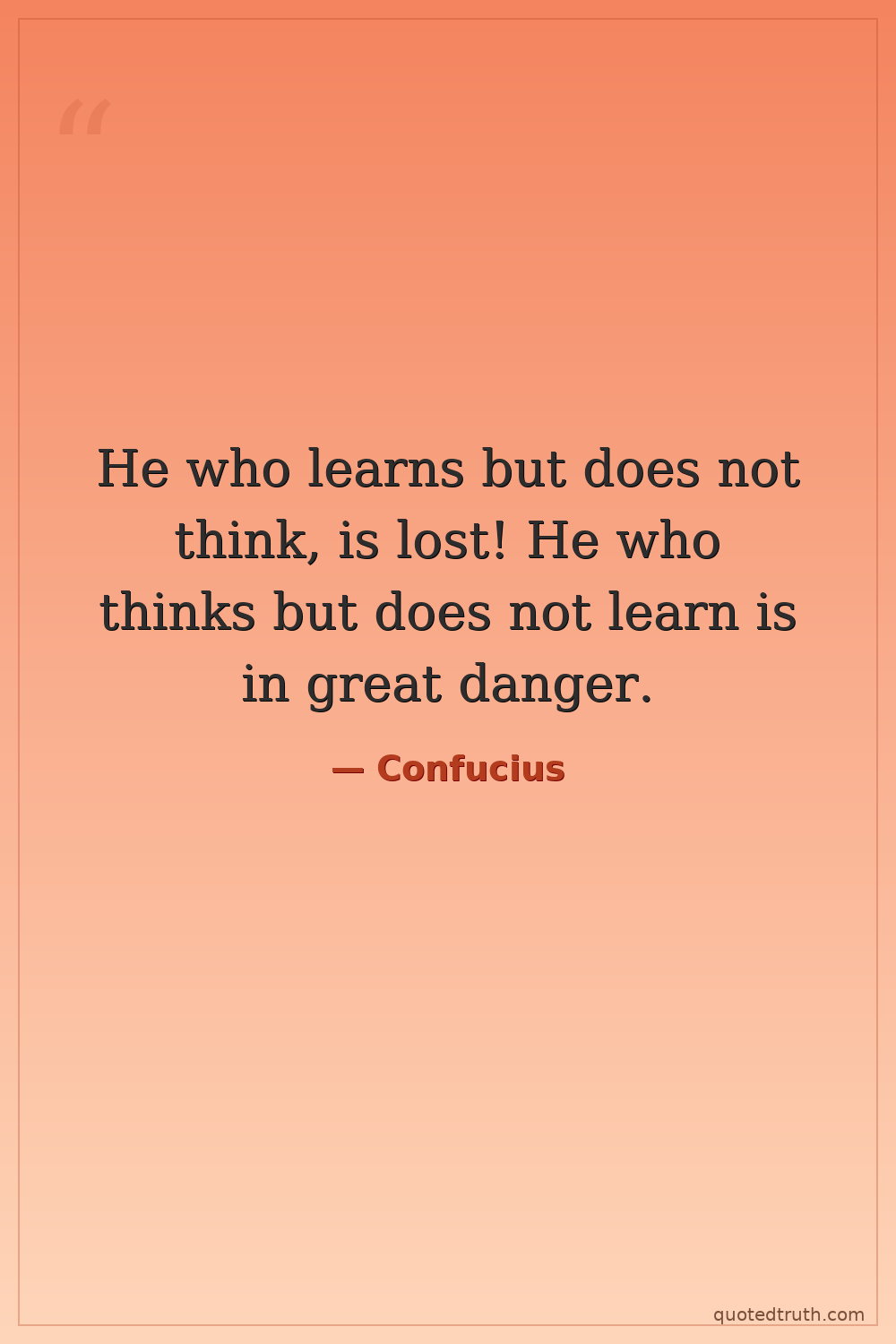
He who learns but does not think, is lost! He who thinks but does not learn is in great danger.
He who learns but does not think, is lost! He who thinks but does not learn is in great danger.
Click any product to generate a realistic preview. Up to 3 at a time.
* Initial load can take up to 90 seconds — revising the preview in another color is nearly instant.
"When the wind blows, the grass bends."
"The faults of a man are characteristic of his class. It is by observing a man's faults that one may know his virtue."
"The gentleman makes demands on himself, the small man makes demands on others."
"The Master said, 'The superior man is anxious lest he should not get the truth; he is not anxious lest poverty should come upon him.'"
"The superior man is watchful over himself when alone."
Chinese philosopher and teacher whose teachings (compiled by his students in the Analects) became the foundational ethical framework of East Asian civilization for 2,500 years. Closely associated with Mencius (his most-influential follower a century later). For an intellectual contrast, see Laozi, near-contemporary Chinese sage and Tao Te Ching author — Confucius systematized social order through ritual and family hierarchy; Laozi's Taoist effortless-action philosophy argued such systems were the disease, not the cure. The two founding poles of Chinese moral philosophy — every East Asian moral tradition since has positioned itself between them.
The standard scholarly entry points to Confucius's work: Philip J. Ivanhoe (Georgetown, Chinese philosophy) — Confucian Moral Self Cultivation (2000); Edward Slingerland (UBC, Asian Studies) — Effortless Action: Wu-wei as Conceptual Metaphor (2003); Tu Weiming (Harvard, Confucian scholar) — Confucian Thought: Selfhood as Creative Transformation (1985). These are the works graduate seminars cite when teaching Confucius.
Found in 1 providers: grok
1 source checked
Learning without reflection leaves you directionless—you accumulate facts but cannot apply them or judge their worth. Thinking without learning is worse: you spin elaborate ideas on a foundation of ignorance, convinced you understand things you actually do not. Real understanding requires both absorbing knowledge from outside yourself and actively wrestling with it internally. Skip either step and you end up either a confused memorizer or a confident fool.
Confucius spent his life as a teacher who rejected rote memorization, pushing students to question, reflect, and connect ideas to conduct. His Analects repeatedly pair study with self-examination, treating education as moral cultivation rather than credential-gathering. Having served briefly as a government minister and traveled between warring states seeking rulers who would apply wisdom, he saw firsthand how both ignorant action and unmoored speculation destroyed kingdoms, making this balance central to his teaching.
Confucius lived during the Spring and Autumn period (551–479 BCE), when the Zhou dynasty's authority was collapsing and rival states waged constant war. Traditional rituals and social bonds were breaking down, and competing schools of thought scrambled to explain the chaos. Literacy was rare and concentrated among aristocratic clerks, while wandering advisors peddled untested theories to desperate rulers. Confucius's insistence on pairing ancient learning with personal reflection was a direct response to both uncritical tradition and reckless innovation.
AI-generated insights based on extensive research and information for context. Factual errors? Email [email protected].
Your cart is empty