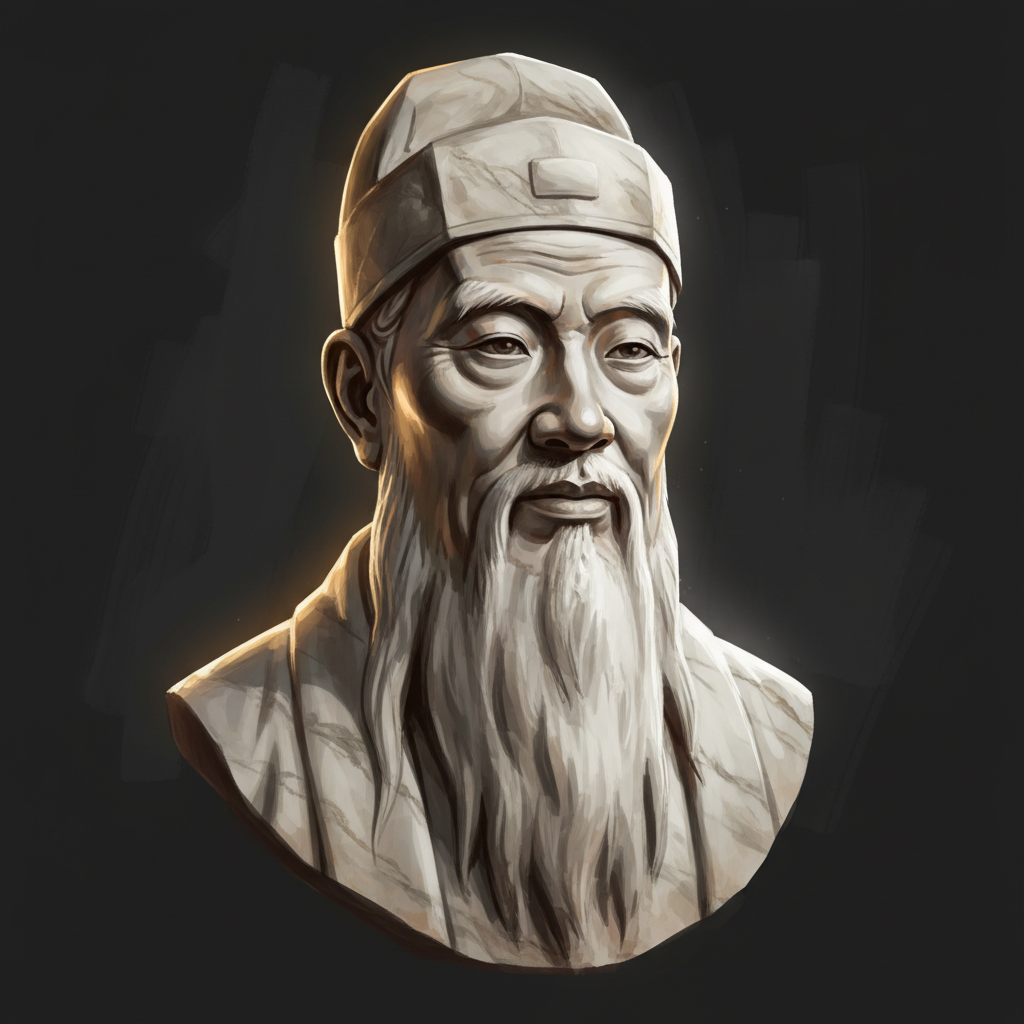
Confucius — "The Master said, 'The superior man is anxious lest he should not get the truth; …"
The Master said, 'The superior man is anxious lest he should not get the truth; he is not anxious lest poverty should come upon him.'
The Master said, 'The superior man is anxious lest he should not get the truth; he is not anxious lest poverty should come upon him.'
Click any product to generate a realistic preview. Up to 3 at a time.
* Initial load can take up to 90 seconds — revising the preview in another color is nearly instant.
"To be able to practice five things everywhere under heaven constitutes perfect virtue... gravity, generosity of soul, sincerity, earnestness, and kindness."
"The gentleman is easy to serve but difficult to please. He who tries to please him in the wrong way will not be pleased. He uses men according to their abilities. The petty man is difficult to serve a…"
"To be poor without murmuring is difficult; to be rich without being proud is easy."
"The Master said, 'A man may be able to recite the three hundred odes, but if, when entrusted with a governmental charge, he knows not how to act, or if, when sent to any quarter on a mission, he canno…"
"When the wind blows, the grass bends."
Chinese philosopher and teacher whose teachings (compiled by his students in the Analects) became the foundational ethical framework of East Asian civilization for 2,500 years. Closely associated with Mencius (his most-influential follower a century later). For an intellectual contrast, see Laozi, near-contemporary Chinese sage and Tao Te Ching author — Confucius systematized social order through ritual and family hierarchy; Laozi's Taoist effortless-action philosophy argued such systems were the disease, not the cure. The two founding poles of Chinese moral philosophy — every East Asian moral tradition since has positioned itself between them.
The standard scholarly entry points to Confucius's work: Philip J. Ivanhoe (Georgetown, Chinese philosophy) — Confucian Moral Self Cultivation (2000); Edward Slingerland (UBC, Asian Studies) — Effortless Action: Wu-wei as Conceptual Metaphor (2003); Tu Weiming (Harvard, Confucian scholar) — Confucian Thought: Selfhood as Creative Transformation (1985). These are the works graduate seminars cite when teaching Confucius.
Found in 1 providers: grok
1 source checked
A person of real character worries about whether they actually understand what is true and right, not about whether they have money. Getting things correct, acting with integrity, and learning deeply matter more than material security. If you chase wealth, you may still end up confused about life; if you chase understanding, the lack of comfort becomes a minor concern rather than a defining fear.
Confucius spent years wandering between warring states seeking a ruler who would apply his teachings, often living in genuine hardship. He took students regardless of wealth, accepting dried meat as tuition, and praised his favorite disciple Yan Hui for staying joyful in a slum. His whole project placed moral cultivation and ritual understanding above official salary or rank.
During the late Spring and Autumn period (roughly 6th-5th century BCE), the Zhou order was collapsing into constant warfare, and scholar-officials commonly chased lucrative court appointments under any lord who would pay. Social mobility through learning was emerging but fragile. Confucius pushed back against this mercenary drift, insisting that the educated class owed loyalty to truth and ritual propriety rather than to whichever patron offered the most grain.
AI-generated insights based on extensive research and information for context. Factual errors? Email [email protected].
Your cart is empty