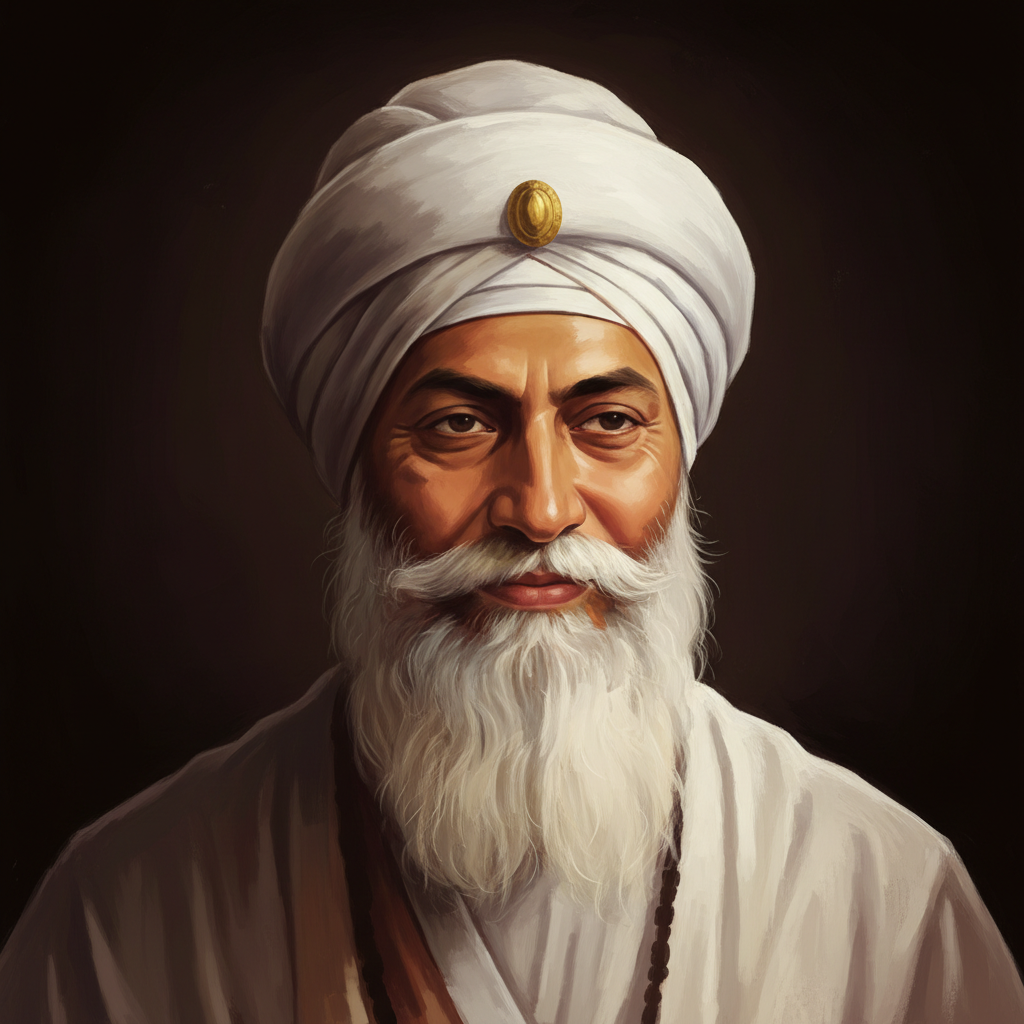
Guru Nanak — "Live a life of honesty and integrity. And try not to spill your tea on yourself."
Live a life of honesty and integrity. And try not to spill your tea on yourself.
Live a life of honesty and integrity. And try not to spill your tea on yourself.
Click any product to generate a realistic preview. Up to 3 at a time.
* Initial load can take up to 90 seconds — revising the preview in another color is nearly instant.
"Through chanting the Name, one crosses the terrifying world-ocean."
"He who considers himself humble, he alone is worthy of praise."
"The nights are wasted sleeping, and the days are wasted eating; the human spends his life in vain."
"Why call her inferior, who gives birth to kings?"
"He who has no faith in himself can never have faith in God."
Founder of Sikhism and the first of the Ten Sikh Gurus, whose teachings of one universal God and rejection of caste shaped Punjab. Closely associated with Kabir (mystical poet whose verses appear in the Sikh Guru Granth Sahib). For an intellectual contrast, see Brahmanical orthodoxy, the Hindu caste-and-ritual establishment of his era — Sikhism was founded as a deliberate alternative to both Hindu ritual hierarchy and Islamic exclusivism — Nanak's universalism was a structural rejection of caste and priestly mediation.
Found in 1 providers: grok
1 source checked
The quote pairs earnest moral advice with deadpan humor. The first part urges authentic, principled living — doing what's right even at personal cost. The second deflates that gravity with a comically mundane reminder. Together they argue that moral seriousness and human imperfection coexist: you can hold integrity as a genuine value while still being the kind of person who occasionally makes a mess. Live well, but stay humble about your limitations.
Guru Nanak (1469–1539) built Sikhism on three pillars: honest labor (Kirat Karni), meditation on truth (Naam Japna), and sharing with others (Vand Chakna). He rejected priestly corruption and caste hierarchy, worked as a farmer, and traveled thousands of miles preaching equality. The quote's opening clause maps directly onto his life's work. The tea quip is obvious modern humor, but the underlying message of principled, humble living is unmistakably aligned with his teachings.
Guru Nanak lived through the violent collapse of the Lodi Sultanate and the Mughal conquest of North India — he witnessed Babur's 1521 invasion and condemned it in his hymns. Punjab was fractured by sectarian conflict, caste exploitation, and corrupt religious institutions. Preaching honesty and integrity was genuinely radical, challenging every power structure that profited from division and deception. His founding of Sikhism offered communities a third path rooted in truth and dignified labor.
AI-generated insights based on extensive research and information for context. Factual errors? Email [email protected].
Your cart is empty