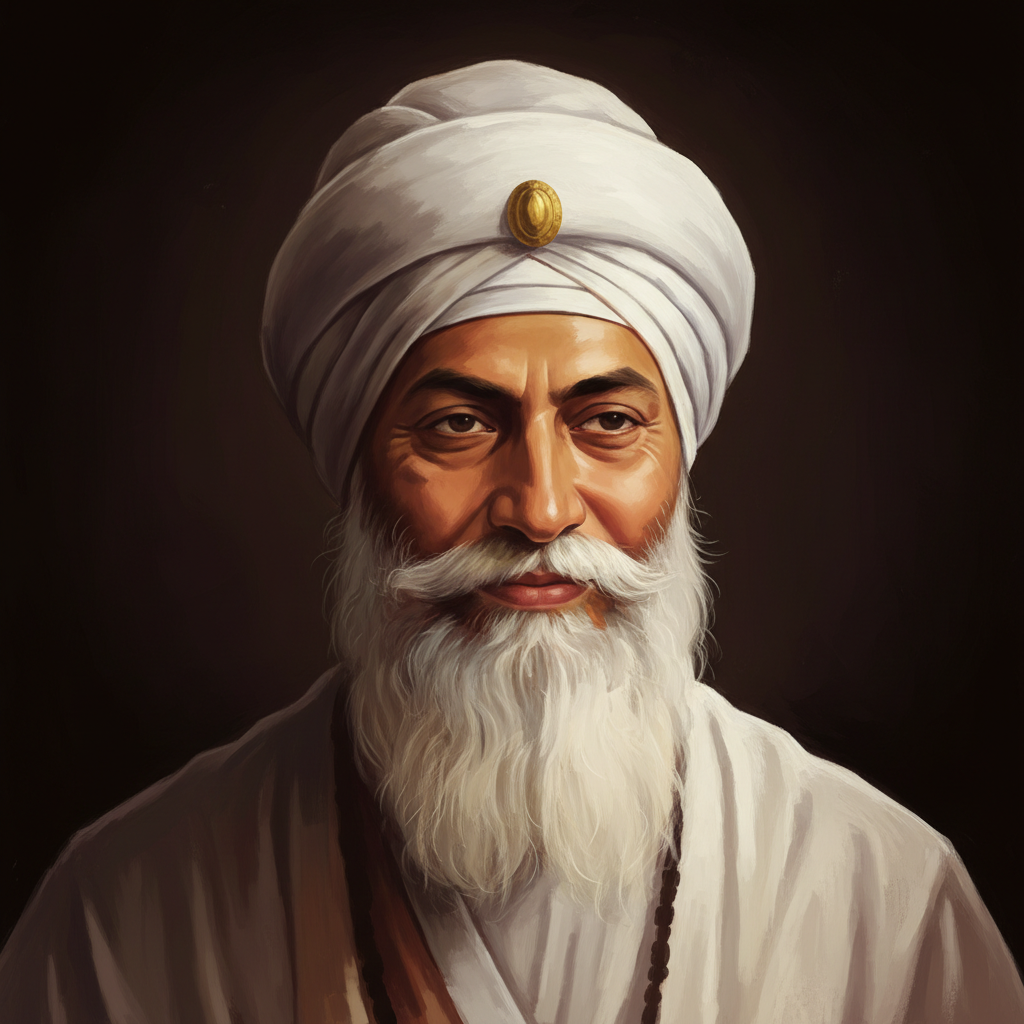
Guru Nanak — "Why call her inferior, who gives birth to kings?"
Why call her inferior, who gives birth to kings?
Why call her inferior, who gives birth to kings?
Click any product to generate a realistic preview. Up to 3 at a time.
* Initial load can take up to 90 seconds — revising the preview in another color is nearly instant.
"God is neither established nor created. He is self-existent."
"Why do you not love the one who created you?"
"To conquer the mind is to conquer the world."
"Through shallow intellect, the mind becomes shallow, and one eats the fly, along with the sweets."
"He who recognizes the One Lord through all, is a true Brahmin."
Founder of Sikhism and the first of the Ten Sikh Gurus, whose teachings of one universal God and rejection of caste shaped Punjab. Closely associated with Kabir (mystical poet whose verses appear in the Sikh Guru Granth Sahib). For an intellectual contrast, see Brahmanical orthodoxy, the Hindu caste-and-ritual establishment of his era — Sikhism was founded as a deliberate alternative to both Hindu ritual hierarchy and Islamic exclusivism — Nanak's universalism was a structural rejection of caste and priestly mediation.
Found in 1 providers: gemini
1 source checked
The line pushes back on the idea that women are lesser beings. It points out a basic contradiction: the same society that treats women as inferior depends on them to bring rulers, leaders, and every person of status into the world. If women produce those who are considered the greatest, calling women beneath men makes no sense. Respect for women is not a favor but simple logic.
Guru Nanak founded Sikhism on the principle that all people share one divine source, and he explicitly rejected caste and gender hierarchy. He appointed women to teach, welcomed them into congregational worship, and insisted they share the communal meal alongside men. This verse, from his Asa di Var, fits his lifelong practice of dismantling social rankings he saw as spiritually baseless, especially those that his contemporaries treated as obvious common sense.
Guru Nanak lived from 1469 to 1539 in Punjab under the Lodi Sultanate and the early Mughal conquest. Women faced strict purdah, child marriage, limited property rights, sati in some communities, and exclusion from scripture study across both Hindu and Muslim society. Widows were often treated as inauspicious. In that climate, publicly defending women's dignity from a devotional platform was a sharp social challenge, not a gentle observation, and it shaped early Sikh community norms.
AI-generated insights based on extensive research and information for context. Factual errors? Email [email protected].
Your cart is empty