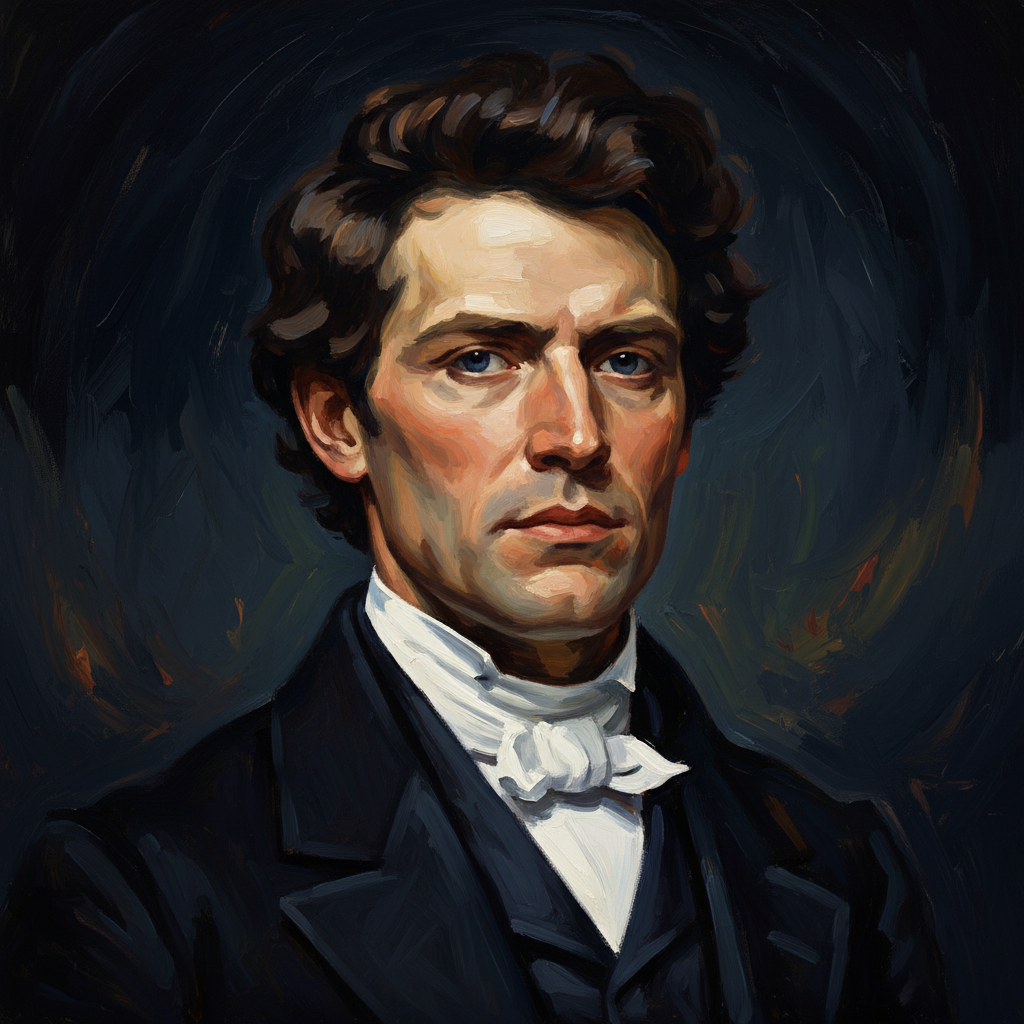
Joseph Smith — "I combat the errors of ages; I meet the violence of mobs; I cope with the cunnin…"
I combat the errors of ages; I meet the violence of mobs; I cope with the cunning of devils and all hell is enraged against me.
I combat the errors of ages; I meet the violence of mobs; I cope with the cunning of devils and all hell is enraged against me.
Click any product to generate a realistic preview. Up to 3 at a time.
* Initial load can take up to 90 seconds — revising the preview in another color is nearly instant.
"We never can comprehend the things of God and of heaven but by revelation."
"I will not be bought, nor sold, nor flattered, nor threatened."
"The standard of truth has been erected; no unhallowed hand can stop the work from progressing."
"I am a servant of God, and I will serve him to the end."
"No man knows my history. I cannot tell it. I shall never tell it. I make no apologies for my life."
Found in 1 providers: grok
1 source checked
The speaker describes himself as simultaneously battling entrenched historical falsehoods, physical attacks from hostile crowds, and spiritual opposition. It conveys a defiant self-image of a lone crusader besieged on every front — intellectual, physical, and supernatural. Being attacked from all sides is framed not as evidence of failure but as proof that the mission matters enough to provoke universal resistance.
Smith founded the Church of Jesus Christ of Latter-day Saints in 1830, claiming to restore lost Christian truth — hence 'errors of ages.' He faced literal mob violence his entire adult life, including being tarred and feathered in 1832 and ultimately killed by a mob in Carthage, Illinois in 1844. His theology emphasized ongoing revelation and cosmic spiritual warfare, making references to devils and enraged hell a direct expression of his lived cosmology.
Smith lived during the Second Great Awakening (1820s–1840s), a period of fierce American religious revivalism where competing sects clashed violently. New religious movements faced hostility from established Protestant denominations and frontier communities suspicious of radical claims. Anti-Mormon sentiment became state policy — Missouri's 1838 Extermination Order legally authorized killing Latter-day Saints. Religious pluralism and mob violence coexisted, making Smith's sense of embattled mission historically grounded rather than purely rhetorical.
AI-generated insights based on extensive research and information for context. Factual errors? Email [email protected].
Your cart is empty