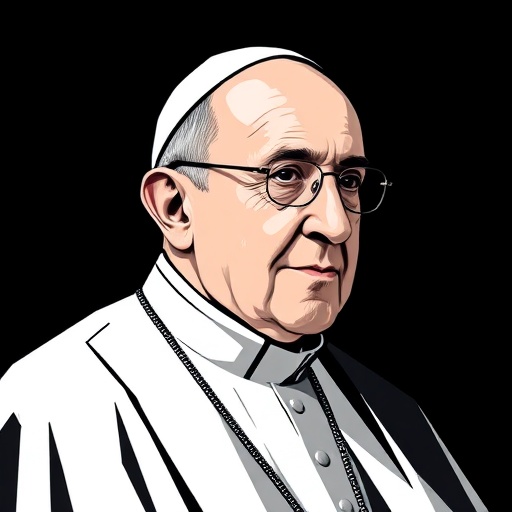
Pope Francis — "I like a lot to be on the street, but I can't."
I like a lot to be on the street, but I can't.
I like a lot to be on the street, but I can't.
Click any product to generate a realistic preview. Up to 3 at a time.
* Initial load can take up to 90 seconds — revising the preview in another color is nearly instant.
"It hurts me when I see priests or nuns with the latest model car. You can’t do this."
"Always keep in mind that the Church is not a museum of saints, but a hospital for sinners."
"The Lord makes us see that there is no true joy without love."
"The first reform must be the attitude."
"The family is in crisis."
First Latin American and Jesuit pope (2013-), who has steered the Catholic Church toward pastoral inclusion on LGBTQ pastoral care, divorced Catholics, and climate. Closely associated with Pope John XXIII (the Vatican II reformer pope) and Cardinal Walter Kasper (his theological ally on pastoral reform). For an intellectual contrast, see Cardinal Raymond Burke, American traditionalist cardinal, former head of the Vatican Apostolic Signatura — Burke is the public face of Catholic traditionalism that views Francis's pastoral approach as doctrinally dangerous — he has formally challenged Amoris Laetitia and other Francis reforms.
Found in 1 providers: grok
1 source checked
The quote expresses a yearning for unmediated human connection — the freedom to walk among ordinary people, the poor, the struggling, without barriers or protocol. Francis conveys honest frustration: personal desire conflicts with institutional reality. He wants the spontaneity of street-level encounter but cannot access it. It is a candid admission that even the most powerful religious office comes with a cage, and that he feels that constraint acutely and personally.
Before his 2013 election, Bergoglio rode Buenos Aires buses, cooked his own meals, and visited villas miserias without ceremony. This directness defined him. As Pope he chose Casa Santa Marta over the Apostolic Palace to stay near people, yet Vatican security protocols ended his personal freedom entirely. His Jesuit formation, centered on going to the margins and meeting people where they are, makes this loss particularly sharp — it contradicts his deepest pastoral instincts.
Francis became Pope in 2013 amid the Catholic Church's gravest crisis in centuries — abuse scandals, financial corruption, and a stunning papal resignation. Simultaneously, global inequality widened, refugee crises surged, and populist movements exposed governments' distance from ordinary citizens. A pope longing for street presence symbolized a Church trying to rebuild trust through proximity rather than power. Yet escalating security threats against high-profile religious and political leaders made that aspiration structurally impossible to fulfill.
AI-generated insights based on extensive research and information for context. Factual errors? Email [email protected].
Your cart is empty