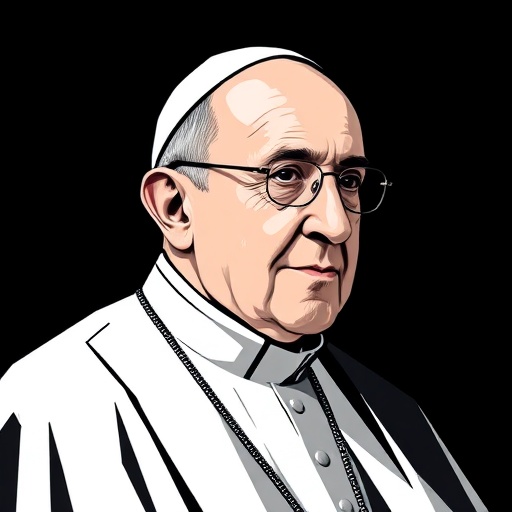
Pope Francis — "The first reform must be the attitude."
The first reform must be the attitude.
The first reform must be the attitude.
Click any product to generate a realistic preview. Up to 3 at a time.
* Initial load can take up to 90 seconds — revising the preview in another color is nearly instant.
"I am not a super-Pope."
"A world without women would be a sterile world."
"God always surprises us."
"There are cases in which separation is inevitable. Sometimes, it can even be morally necessary, when it comes to shielding the weaker spouse or young children from more serious wounds caused by intimi…"
"Some people think that, excuse me if I use the word, in order to be good Catholics, we have to be like rabbits, but no."
First Latin American and Jesuit pope (2013-), who has steered the Catholic Church toward pastoral inclusion on LGBTQ pastoral care, divorced Catholics, and climate. Closely associated with Pope John XXIII (the Vatican II reformer pope) and Cardinal Walter Kasper (his theological ally on pastoral reform). For an intellectual contrast, see Cardinal Raymond Burke, American traditionalist cardinal, former head of the Vatican Apostolic Signatura — Burke is the public face of Catholic traditionalism that views Francis's pastoral approach as doctrinally dangerous — he has formally challenged Amoris Laetitia and other Francis reforms.
Found in 1 providers: deepseek
1 source checked
Before changing systems, institutions, or rules, a person must first transform their inner disposition—how they approach problems, people, and power. External reforms without internal conversion are hollow. True change requires humility, openness, and willingness to see differently. The attitude shapes every action that follows; reform structures without reforming the heart and mind produces bureaucratic reshuffling rather than genuine transformation.
Francis, the first Jesuit pope, entered the Vatican determined to overhaul a scandal-ridden institution. Rather than leading with structural decrees, he modeled simplicity—rejecting papal apartments, washing prisoners' feet, speaking frankly about clericalism. His reform agenda consistently prioritized converting hearts within the Church hierarchy before reorganizing its offices, reflecting his Jesuit formation emphasizing interior conversion.
Francis became pope in 2013 amid the Vatileaks scandal, clerical sexual abuse crises, and widespread disillusionment with institutional religion globally. Church attendance was declining in the West, and critics demanded sweeping structural changes. His emphasis on attitudinal reform addressed a deeper diagnosis: that corrupted power, careerism, and rigid self-preservation within Church culture were root causes no org-chart restructuring alone could fix.
AI-generated insights based on extensive research and information for context. Factual errors? Email [email protected].
Your cart is empty