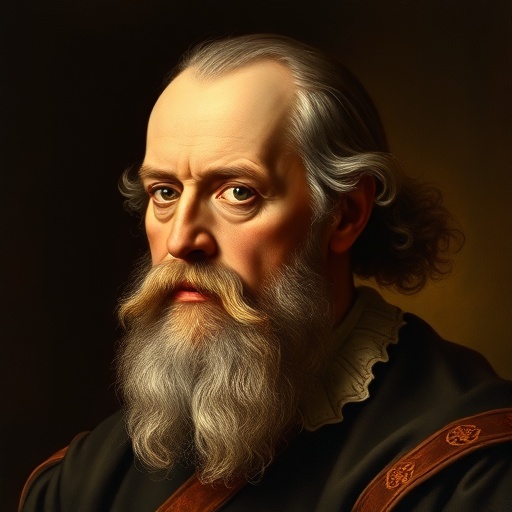
Galileo Galilei — "The greatest wisdom consists in knowing what is truly useful."
The greatest wisdom consists in knowing what is truly useful.
The greatest wisdom consists in knowing what is truly useful.
Click any product to generate a realistic preview. Up to 3 at a time.
* Initial load can take up to 90 seconds — revising the preview in another color is nearly instant.
"To understand the universe, you must understand the language in which it's written. And that language is mathematics."
"To apply oneself to a search for the truth, without any intent to serve some predetermined end, is the true path to discovery."
"Philosophy is written in this grand book, the universe, which stands continually open to our gaze. But the book cannot be understood unless one first learns to comprehend the language and interpret th…"
"Nature is relentless and unchangeable, and it is indifferent as to whether its hidden reasons and actions are understandable to man or not."
"It is a great pity that there are so few who are interested in the true causes of things."
Found in 1 providers: grok
1 source checked
True wisdom isn't about knowing everything — it's about knowing what actually matters. The genuinely wise person can separate useful knowledge from trivia, identifying which facts, skills, and ideas carry real-world value. This is a pragmatic view of intelligence: discernment and prioritization outweigh raw accumulation of information. Knowing a thousand things means little if you can't identify the one insight that solves the problem directly in front of you.
Galileo embodied this principle throughout his career. Rather than defending inherited Aristotelian ideas, he focused on observable, measurable reality — building telescopes to gather useful astronomical data, studying projectile motion for practical military application, and insisting on experiment over authority. His famous commitment to measuring what can be measured reflects the same priority: knowledge that can be tested and applied beats untestable speculation. For Galileo, utility was the ultimate test of truth.
Galileo lived during the early Scientific Revolution, when European intellectual life was still largely governed by Aristotelian scholasticism and Church doctrine. Knowledge was judged by conformity to scripture and ancient texts, not practical utility. Meanwhile, navigation, trade, and warfare created urgent demand for applied science — astronomy for sailors, mechanics for artillery. Galileo's house arrest in 1633 for supporting heliocentrism proved that prioritizing empirically useful truth over received doctrine carried severe political and personal consequences.
AI-generated insights based on extensive research and information for context. Factual errors? Email [email protected].
Your cart is empty