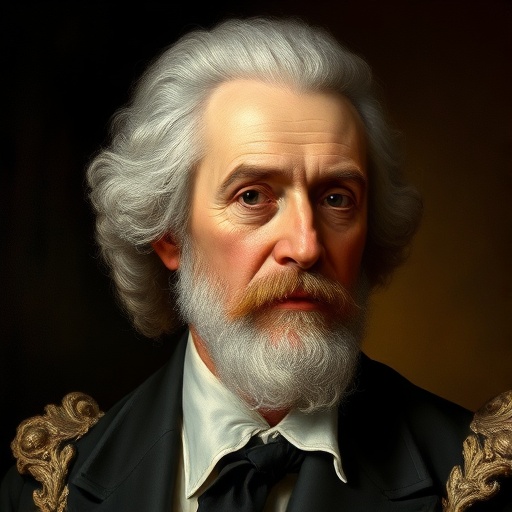
Antoine Lavoisier — "Nothing is lost, nothing is created, everything is transformed."
Nothing is lost, nothing is created, everything is transformed.
Nothing is lost, nothing is created, everything is transformed.
Click any product to generate a realistic preview. Up to 3 at a time.
* Initial load can take up to 90 seconds — revising the preview in another color is nearly instant.
"The success of charlatans, sorcerors, and alchemists—and all those who abuse public credulity—is founded on errors in this type of calculation."
"The true wealth of a nation is its knowledge and its industry."
"I shall be happy if my work contributes to the progress of the sciences, and to the well-being of mankind."
"I die as I have lived, a servant of science and a victim of the French Revolution."
"Chemistry is a science of facts and experiments, and not of opinions."
A foundational statement of the law of conservation of mass, though the exact phrasing varies in translations
Date: 1789
Food & DrinkFound in 1 providers: grok
1 source checked
Matter cannot be created from nothing or destroyed into nothing — it only changes form. When wood burns, it becomes ash, gases, and heat; the total mass remains unchanged. This principle underpins all of chemistry and physics: atoms are rearranged, never annihilated. In modern science, this became the law of conservation of mass and, extended by Einstein, conservation of mass-energy. Transformation, not creation or destruction, is the fundamental rule of the universe.
Lavoisier proved this through meticulous quantitative experiments in the 1770s–1780s, carefully weighing reactants and products in sealed vessels. By disproving phlogiston theory and showing combustion consumes oxygen rather than releasing a mysterious fire-element, he demonstrated matter merely transforms. He named oxygen and hydrogen, co-created the first systematic chemical nomenclature, and wrote Traité Élémentaire de Chimie — the first modern chemistry textbook. This quote is the foundational law his entire career was built on.
Lavoisier worked during the late 18th-century Enlightenment, when rational inquiry was dismantling centuries of alchemical mysticism. Phlogiston theory — claiming substances release a fire-element during burning — dominated chemistry. The French Revolution simultaneously upended society; as a tax collector for the Crown, Lavoisier was guillotined in 1794 during the Reign of Terror. His principle that matter transforms rather than appears or vanishes was radical when creation ex nihilo still carried profound theological and philosophical weight.
AI-generated insights based on extensive research and information for context. Factual errors? Email [email protected].
Your cart is empty