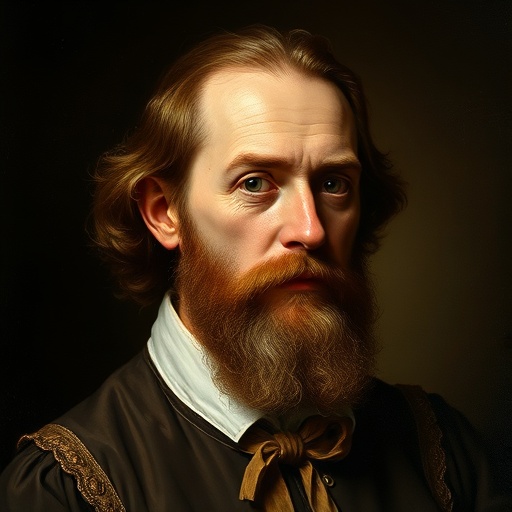
William Harvey — "The greatest art is to conceal art."
The greatest art is to conceal art.
The greatest art is to conceal art.
Click any product to generate a realistic preview. Up to 3 at a time.
* Initial load can take up to 90 seconds — revising the preview in another color is nearly instant.
"The life of man is a perpetual motion."
"It is a thing worthy of observation how much more easily and quickly the mind is deceived than the eye."
"The world is full of wonders, but man is the greatest wonder of all."
"The circulation of the blood is a new thing, never before heard of, or at least not truly understood."
"The physician must be a constant student."
English physician whose On the Motion of the Heart and Blood in Animals (1628) demonstrated blood circulation, overturning 1,400 years of Galenic medicine. Closely associated with Francis Bacon (his contemporary in the new English empiricism). For an intellectual contrast, see Galenic medicine, the 2nd-century Greek medical tradition (humors, blood-as-consumed-fuel) — Harvey calculated that the heart pumps more blood per hour than the body could possibly produce as fuel — a single quantitative observation that demolished the entire Galenic-Aristotelian medical worldview. The cleanest example in medical history of arithmetic disproving 14 centuries of authority.
A statement on the subtlety and skill required in scientific presentation or medical practice.
Date: Uncertain (attributed)
Art & CreativityFound in 1 providers: gemini
1 source checked
True mastery reveals itself by hiding all trace of effort. The greatest skill makes the difficult appear effortless and inevitable—as if it could not have been otherwise. Whether in painting, rhetoric, or science, when the labor, revision, and false starts become invisible and only the clean result remains, technique has transformed into art. The craft disappears, leaving only the thing itself.
Harvey spent decades dissecting animals and calculating blood volumes before publishing De Motu Cordis in 1628. The final argument reads as obvious, almost inevitable—yet it dismantled two millennia of Galenic doctrine. His genius was presenting a radical conclusion through methodical, dispassionate evidence, making the revolution look like simple observation. The enormous labor of proof stayed hidden; what showed was elegant, inescapable logic.
Harvey lived at the peak of the Scientific Revolution, when Renaissance sprezzatura—Castiglione's ideal of performing difficult acts with apparent ease—shaped how ideas were received. New empiricists challenging Aristotelian and Galenic authority had to present radical findings calmly or risk dismissal as reckless. Concealing the labor behind clean, methodical presentation was not affectation but strategy: seamless argument earned credibility that dramatic claims could not.
AI-generated insights based on extensive research and information for context. Factual errors? Email [email protected].
Your cart is empty