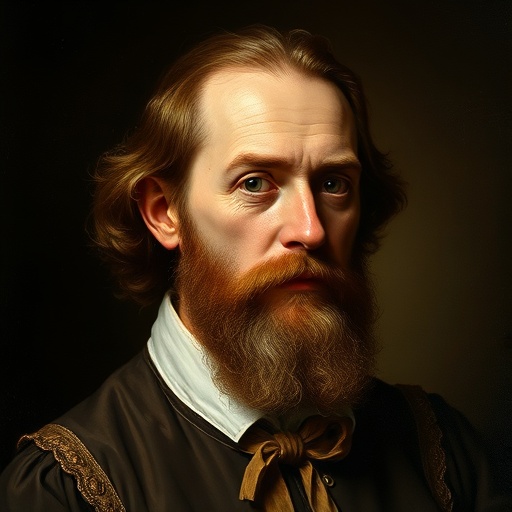
William Harvey — "The life of man is a perpetual motion."
The life of man is a perpetual motion.
The life of man is a perpetual motion.
Click any product to generate a realistic preview. Up to 3 at a time.
* Initial load can take up to 90 seconds — revising the preview in another color is nearly instant.
"It is not by words, but by facts and arguments, that we must seek for truth."
"I appeal to the evidence of my senses, and to the testimony of dissections."
"The greatest pleasure is to be found in the service of humanity."
"The book of nature is the only book that offers a wealth of content on every one of its pages."
"As art is a habit with reference to things to be done, so is science a habit in respect to things to be known."
English physician whose On the Motion of the Heart and Blood in Animals (1628) demonstrated blood circulation, overturning 1,400 years of Galenic medicine. Closely associated with Francis Bacon (his contemporary in the new English empiricism). For an intellectual contrast, see Galenic medicine, the 2nd-century Greek medical tradition (humors, blood-as-consumed-fuel) — Harvey calculated that the heart pumps more blood per hour than the body could possibly produce as fuel — a single quantitative observation that demolished the entire Galenic-Aristotelian medical worldview. The cleanest example in medical history of arithmetic disproving 14 centuries of authority.
A philosophical observation on human existence, resonating with his work on circulation.
Date: Uncertain (attributed)
WisdomFound in 1 providers: gemini
1 source checked
Human life is never static or at rest — it involves constant movement, activity, and change from birth to death. The body, the mind, and experience itself are always in flux. There is no true stillness in living; every moment involves some form of motion, whether physical, mental, or biological. To be alive is fundamentally to be in motion.
Harvey's entire career centered on proving blood circulates continuously through the body — never pausing, never stopping while life persists. His 1628 discovery showed the heart as a perpetual pump driving endless motion through the vessels. This quote is inseparable from his scientific worldview: motion is not incidental to life, it is its defining characteristic and proof.
In the early 17th century, European medicine still wrestled with Galenic ideas that blood was consumed rather than circulated. Harvey's era saw the Scientific Revolution challenging ancient static models of the body and cosmos. The notion of perpetual motion resonated with Galileo's mechanics and Kepler's orbital discoveries — nature as dynamic system, not fixed hierarchy ordained by medieval theology.
AI-generated insights based on extensive research and information for context. Factual errors? Email [email protected].
Your cart is empty