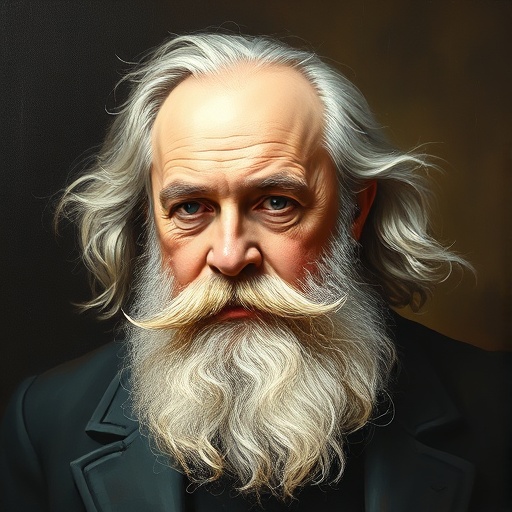
Dmitri Mendeleev — "Knowing how contented, free and joyful is life in the realms of science, one fer…"
Knowing how contented, free and joyful is life in the realms of science, one fervently wishes that many would enter their portals.
Knowing how contented, free and joyful is life in the realms of science, one fervently wishes that many would enter their portals.
Click any product to generate a realistic preview. Up to 3 at a time.
* Initial load can take up to 90 seconds — revising the preview in another color is nearly instant.
"The future of the Russian nation lies in the hands of the schoolmaster and the priest."
"There is nothing in science that cannot be explained to a barmaid."
"The elements, if arranged according to their atomic weights, exhibit an apparent periodicity of properties."
"There exists everywhere a medium in things, determined by equilibrium."
"The chemist must descend into the depths within himself, and find the spark of an idea to illuminate the darkness."
Preface to The Principles of Chemistry, expressing his passion for science and desire for others to join.
Date: 1891
ShockingFound in 1 providers: gemini
1 source checked
Once you experience the deep satisfaction that comes from scientific work, you naturally want others to share it. Research offers a kind of contentment, independence, and happiness that is hard to find elsewhere, because you get to pursue truth on your own terms. The speaker is essentially inviting others to step through the doorway into a life of inquiry, promising it is genuinely rewarding rather than dry or tedious.
Mendeleev devoted his life to chemistry, famously organizing the elements into the periodic table in 1869 after years of obsessive pattern-seeking. He taught at St. Petersburg University, mentored countless students, and wrote influential textbooks meant to draw young Russians into science. This quote captures his evangelistic streak: he genuinely believed research was a joyful calling and spent decades recruiting others into it through teaching, writing, and public advocacy for Russian scientific development.
Mendeleev worked during the late 19th century, when Imperial Russia was racing to catch up with Western Europe industrially and scientifically. Tsarist reforms had expanded universities, and science was seen as key to modernization. Chemistry was exploding with new discoveries, yet Russia lacked trained researchers. Mendeleev's push to recruit students reflected a national urgency: building a homegrown scientific class to fuel industry, agriculture, and prestige against more established Western European research traditions.
AI-generated insights based on extensive research and information for context. Factual errors? Email [email protected].
Your cart is empty