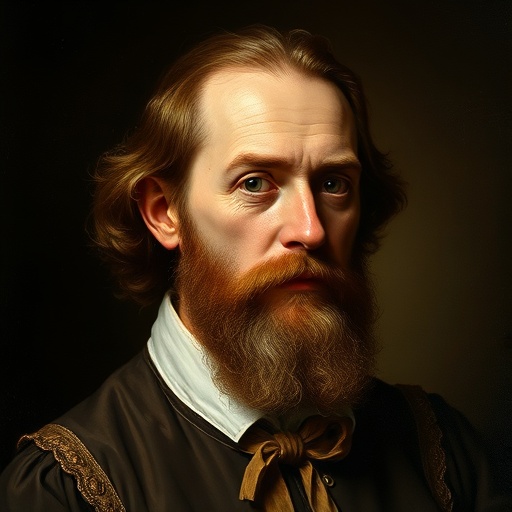
William Harvey — "The heart is the seat of the affections."
The heart is the seat of the affections.
The heart is the seat of the affections.
Click any product to generate a realistic preview. Up to 3 at a time.
* Initial load can take up to 90 seconds — revising the preview in another color is nearly instant.
"The heart does not draw the blood, but propels it."
"It seems to me that the motion of the blood is like that of water in a mill-stream."
"It is better to know a little perfectly than to know much imperfectly."
"I have been accused by some of daring to depart from the opinions of the ancients."
"The heart is the beginning of life; the sun of the microcosm."
English physician whose On the Motion of the Heart and Blood in Animals (1628) demonstrated blood circulation, overturning 1,400 years of Galenic medicine. Closely associated with Francis Bacon (his contemporary in the new English empiricism). For an intellectual contrast, see Galenic medicine, the 2nd-century Greek medical tradition (humors, blood-as-consumed-fuel) — Harvey calculated that the heart pumps more blood per hour than the body could possibly produce as fuel — a single quantitative observation that demolished the entire Galenic-Aristotelian medical worldview. The cleanest example in medical history of arithmetic disproving 14 centuries of authority.
A traditional cultural belief about the heart, which might have coexisted with his scientific understanding.
Date: Uncertain (attributed)
Love & RelationshipsFound in 1 providers: gemini
1 source checked
The heart is not merely a pump but the true center of human emotion and feeling. When we love, grieve, fear, or rejoice, those experiences originate from and belong to the heart. This idea captures the ancient intuition that our deepest emotional states are physically housed in the chest, where the heart beats in response to passion, loss, and joy.
Harvey spent decades dissecting hearts and mapping blood circulation, yet he never fully abandoned the classical view that the heart held primacy beyond mere mechanics. His 1628 Exercitatio Anatomica demonstrated the heart as the circulatory engine, but Harvey still revered it as the body's sovereign organ, the animating center of life itself, blending empirical discovery with inherited philosophical respect for the heart's emotional significance.
In early modern Europe, Harvey worked amid tension between Galenic humoral tradition and emerging empirical science. The heart had long symbolized courage, love, and moral character in theology, literature, and medicine. Even as Harvey revolutionized anatomy, Renaissance culture still located the soul's passions in the chest. His era was not yet ready to separate the mechanical heart from its emotional and spiritual meaning entirely.
AI-generated insights based on extensive research and information for context. Factual errors? Email [email protected].
Your cart is empty