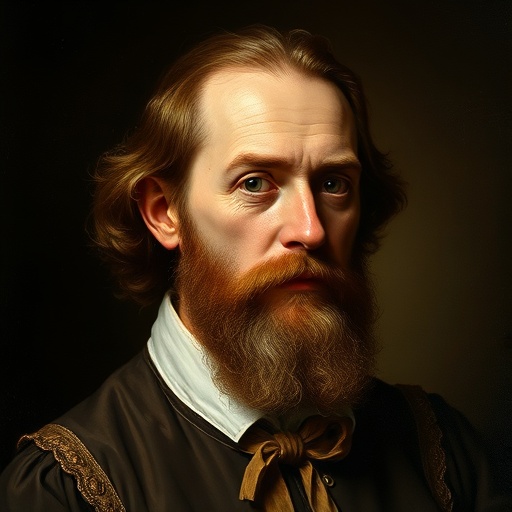
William Harvey — "The most important thing in life is to be useful."
The most important thing in life is to be useful.
The most important thing in life is to be useful.
Click any product to generate a realistic preview. Up to 3 at a time.
* Initial load can take up to 90 seconds — revising the preview in another color is nearly instant.
"The physician must be a man of experience."
"The true physician is one who loves humanity."
"The blood, therefore, returns by the veins to the heart."
"I profess both to learn and to teach anatomy not from books but from dissections; not from the tenets of philosophers but from the fabric of nature."
"The animal's heart is the basis of its life, its chief member, the sun of its microcosm; on the heart all its activity depends, from the heart all its liveliness and strength arise. Equally is the kin…"
English physician whose On the Motion of the Heart and Blood in Animals (1628) demonstrated blood circulation, overturning 1,400 years of Galenic medicine. Closely associated with Francis Bacon (his contemporary in the new English empiricism). For an intellectual contrast, see Galenic medicine, the 2nd-century Greek medical tradition (humors, blood-as-consumed-fuel) — Harvey calculated that the heart pumps more blood per hour than the body could possibly produce as fuel — a single quantitative observation that demolished the entire Galenic-Aristotelian medical worldview. The cleanest example in medical history of arithmetic disproving 14 centuries of authority.
A statement on the value of practical contribution, similar to Linnaeus.
Date: Uncertain (attributed)
WisdomFound in 1 providers: gemini
1 source checked
Being useful means contributing something of real value to others or to the world, not merely existing or accumulating personal comfort. A life gains its weight and purpose through what it builds, heals, solves, or advances for those around you. Usefulness is an active, outward-facing commitment, not passive goodwill.
Harvey spent decades conducting meticulous dissections and experiments to prove blood circulates continuously through the heart, overturning Galenic medicine accepted for 1,400 years. His work had direct practical stakes for physicians and patients. He endured ridicule from contemporaries, yet persisted because demonstrating truth that could improve medicine was, to him, the only justification for a life in natural philosophy.
Early modern Europe was reshaping knowledge through empirical observation rather than inherited authority. The Scientific Revolution challenged ancient texts that had long defined usefulness in medicine. Figures like Harvey, Vesalius, and Galileo faced institutions invested in old certainties. Demonstrating practical, verifiable truth was both intellectually radical and professionally dangerous, making usefulness a moral and vocational declaration as much as a personal philosophy.
AI-generated insights based on extensive research and information for context. Factual errors? Email [email protected].
Your cart is empty