What it means
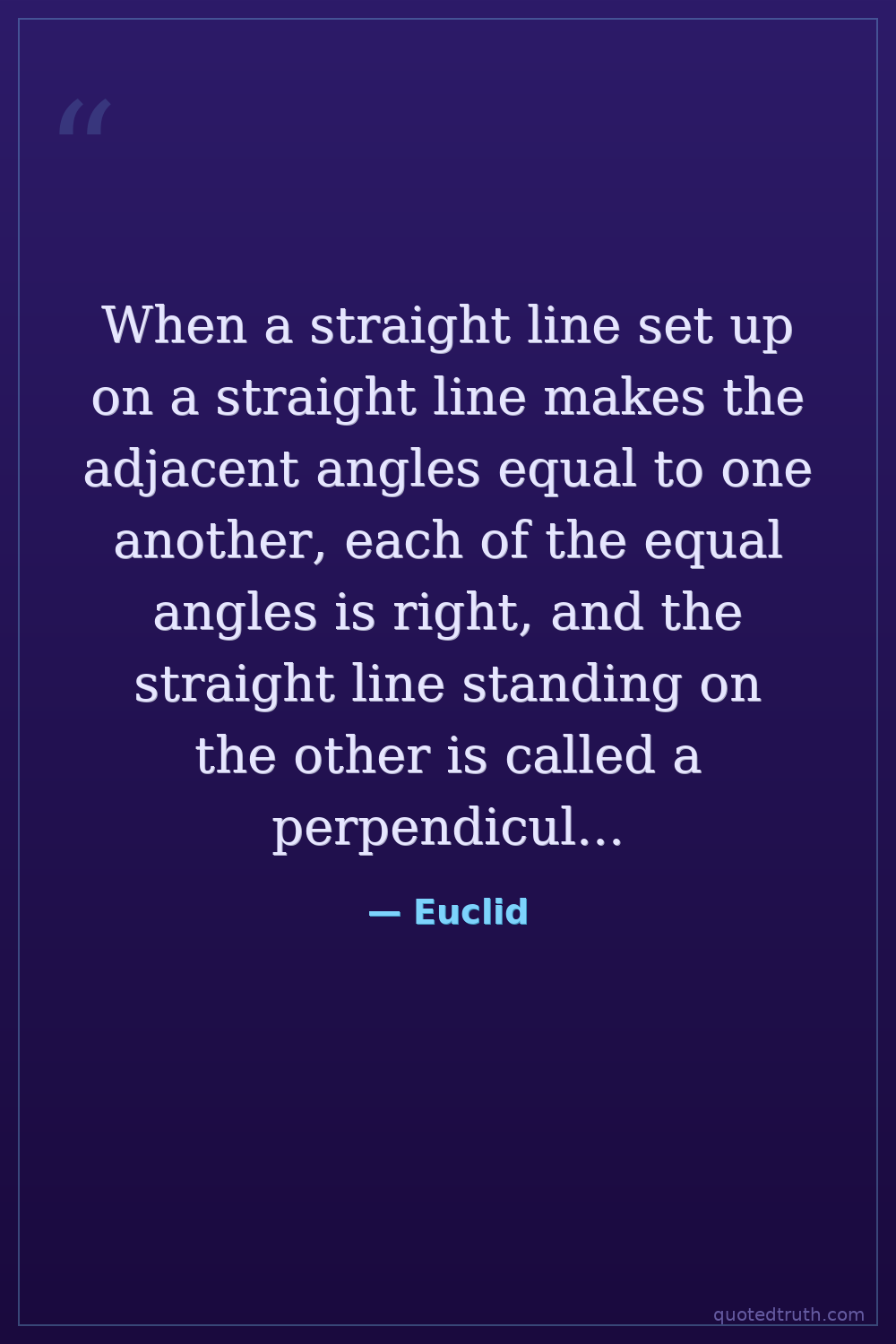
When a line stands on another line and creates two equal adjacent angles, each of those angles is a right angle, and the standing line is perpendicular. This defines perpendicularity through equality rather than degree measurement — 'rightness' means balance: two equal halves of a straight angle. It establishes a foundational geometric concept without assuming prior knowledge, grounding the idea of 90 degrees in observable, provable symmetry.
Relevance to Euclid
Euclid (~300 BCE) wrote Elements, codifying geometry into definitions, postulates, and proofs that dominated mathematics for 2,000 years. This line is Definition 10 from Book I — nothing assumed, every concept defined before use. Working at Alexandria's scholarly center, Euclid believed mathematics required airtight logical foundations. Defining a right angle through equal adjacent angles rather than intuition exemplifies his axiomatic rigor, the trait that earned him the title Father of Geometry.
The era
Around 300 BCE, Alexandria was the intellectual capital of the Hellenistic world. Annual Nile floods erased land boundaries, demanding accurate resurveying; monumental construction required precise right angles; astronomical observation depended on geometric calculation. Yet no universal rigorous standard for perpendicularity existed. Greek philosophy was pushing toward logical proof over tradition and authority. Euclid's definition gave the entire Mediterranean world a culturally neutral, provable anchor for one of geometry's most essential concepts.
AI-generated insights based on extensive research and information for context. Factual errors? Email [email protected].