What it means
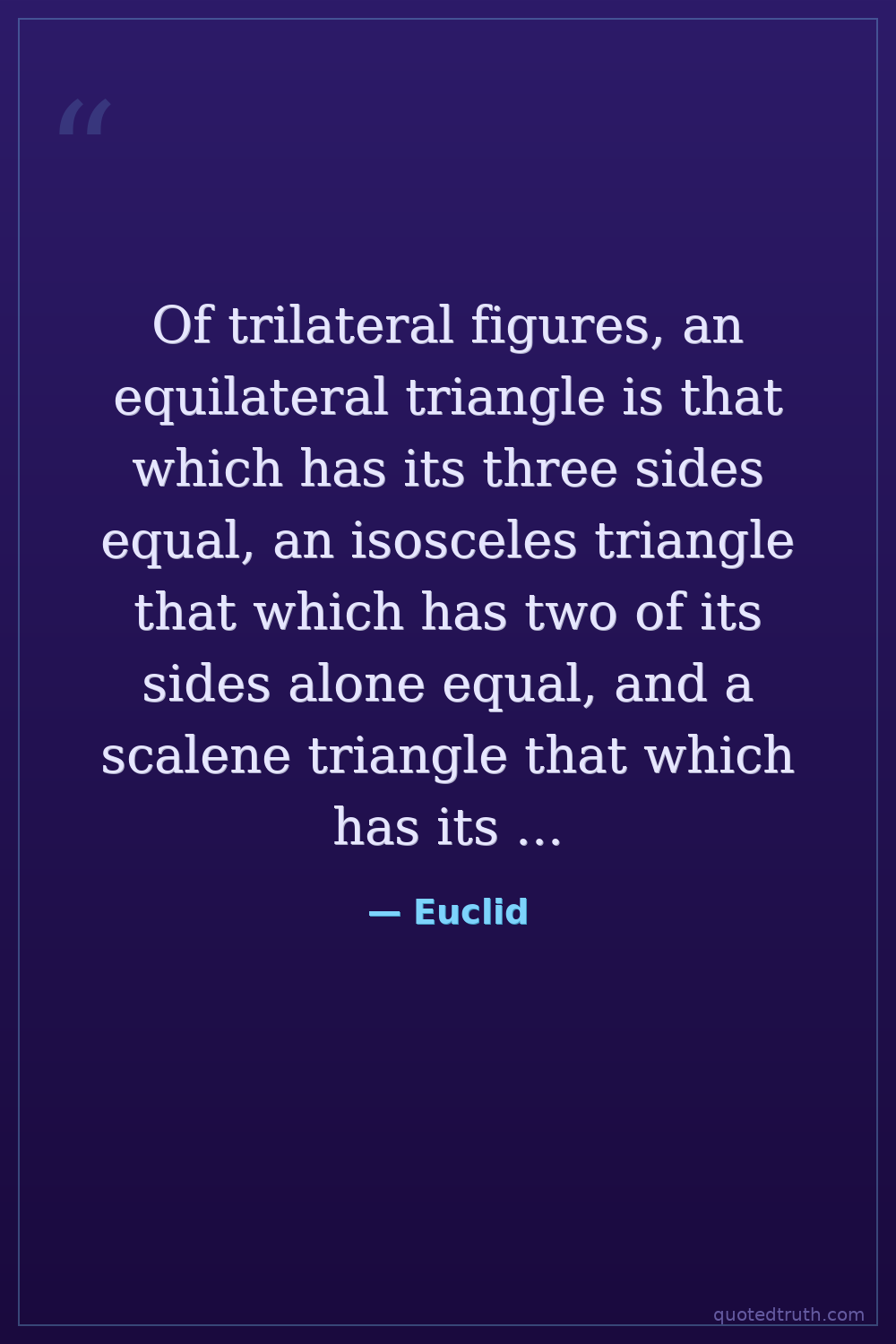
This statement classifies triangles into three distinct types based on how many sides are equal: all three equal makes an equilateral triangle, exactly two equal makes an isosceles triangle, and none equal makes a scalene triangle. It is a foundational definition rather than a philosophical insight — establishing unambiguous shared categories so that geometric reasoning can proceed without confusion about what shape is actually under discussion.
Relevance to Euclid
Euclid's entire legacy rests on his axiomatic method: starting with definitions before deriving any theorem. Working in Alexandria around 300 BCE, he compiled the Elements, geometry's foundational text for two millennia. This definition exemplifies his character — relentlessly precise, leaving nothing assumed. He reportedly told King Ptolemy there is no royal road to geometry, meaning rigor, not shortcuts, is required. Clear, exhaustive definitions were his first and non-negotiable discipline.
The era
Around 300 BCE, Alexandria was becoming the Hellenistic world's intellectual capital under Ptolemy I, who built the Library and Mouseion. Greek mathematics was shifting from practical Egyptian and Babylonian land-measurement traditions toward abstract, proof-based reasoning. Establishing precise shared definitions was revolutionary: it let mathematicians across city-states argue from common ground, transforming geometry from locally varying craft knowledge into a universal, logically airtight system anyone could verify independently.
AI-generated insights based on extensive research and information for context. Factual errors? Email [email protected].