Pythagoras — "The square of the hypotenuse of a right-angled triangle is equal to the sum of t…"
The square of the hypotenuse of a right-angled triangle is equal to the sum of the squares of the other two sides.
The square of the hypotenuse of a right-angled triangle is equal to the sum of the squares of the other two sides.
Click any product to generate a realistic preview. Up to 3 at a time.
* Initial load can take up to 90 seconds — revising the preview in another color is nearly instant.
"There is geometry in the humming of the strings. There is music in the spacing of the spheres."
"Beatitude is the knowledge of the perfection of the numbers of the soul."
"Eat not the matrix of animals."
"The 'tetractys' is the source of all things."
"Don't share your roof with swallows."
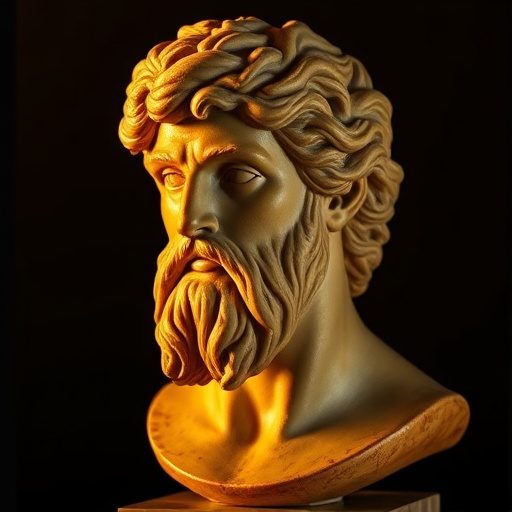
Greek philosopher and mathematician whose school in Croton combined geometry (the Pythagorean theorem), number-mysticism, and a religious-vegetarian way of life. Closely associated with Thales of Miletus (earlier pre-Socratic and the first philosopher). For an intellectual contrast, see Heraclitus, pre-Socratic Greek philosopher of flux — Heraclitus called Pythagoras 'the chief of swindlers' — among the founding insults of the philosophical-rivalry tradition. Their 'all is flux' vs 'all is number' poles still organize the philosophy of mathematics today (Platonist vs anti-realist).
Found in 1 providers: deepseek
1 source checked
In any right triangle, if you draw a square on each of the three sides, the area of the largest square — attached to the side opposite the right angle — equals the combined area of the two smaller squares. Practically: knowing two sides lets you calculate the third. This single relationship underpins navigation, construction, engineering, and virtually all spatial geometry used from ancient times to modern computing.
Pythagoras founded a religious-philosophical brotherhood that treated numbers as sacred — the ultimate fabric of reality. He believed the cosmos operated through numerical harmony, making this theorem not merely a geometric rule but proof of his deepest conviction. Leading disciples in Croton, he blended rigorous mathematical inquiry with mystical reverence, and this result became the Brotherhood's definitive demonstration that abstract numerical relationships reveal universal, unchanging truth.
In 6th-century BCE Greece, rational inquiry was supplanting mythological explanation for the first time. Pre-Socratic thinkers sought natural laws governing the universe. While Babylonian and Egyptian builders had used the 3-4-5 ratio empirically for centuries, Pythagoras's school reportedly produced the first formal proof — transforming a practical observation into universal law. With Greek city-states expanding through trade and architecture, a reliable method for calculating distances and right angles carried enormous practical and intellectual weight.
AI-generated insights based on extensive research and information for context. Factual errors? Email [email protected].
Your cart is empty