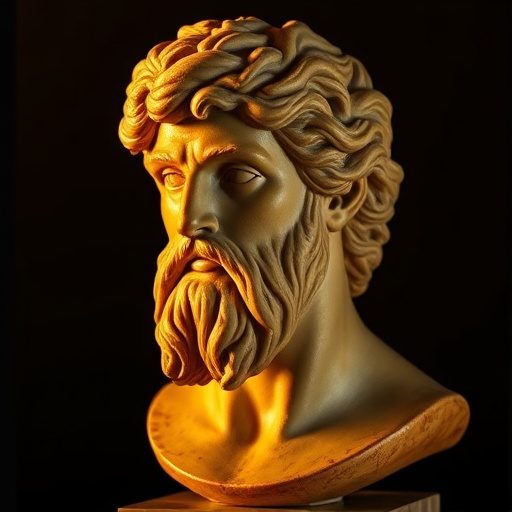
Pythagoras — "Beatitude is the knowledge of the perfection of the numbers of the soul."
Beatitude is the knowledge of the perfection of the numbers of the soul.
Beatitude is the knowledge of the perfection of the numbers of the soul.
Click any product to generate a realistic preview. Up to 3 at a time.
* Initial load can take up to 90 seconds — revising the preview in another color is nearly instant.
"The soul of man is divided into three parts, intelligence, reason, and passion. Intelligence and passion are possessed by other animals, but reason by man alone."
"No one is free who has not obtained the empire of himself."
"Don't try to cover your mistakes with false words. Rather, correct your mistakes with examination."
"There is nothing so easy but that it becomes difficult when you do it reluctantly."
"Don't step over a balance beam."
Greek philosopher and mathematician whose school in Croton combined geometry (the Pythagorean theorem), number-mysticism, and a religious-vegetarian way of life. Closely associated with Thales of Miletus (earlier pre-Socratic and the first philosopher). For an intellectual contrast, see Heraclitus, pre-Socratic Greek philosopher of flux — Heraclitus called Pythagoras 'the chief of swindlers' — among the founding insults of the philosophical-rivalry tradition. Their 'all is flux' vs 'all is number' poles still organize the philosophy of mathematics today (Platonist vs anti-realist).
A statement reflecting the Pythagorean emphasis on numerology and the soul, attributed by later sources.
Date: c. 570-495 BCE (attributed later)
BiblicalFound in 1 providers: gemini
1 source checked
True happiness comes from understanding the perfect mathematical structure within the soul itself. Not pleasure or wealth, but deep comprehension of the numerical harmony governing your inner self. Your highest fulfillment is reached when you grasp the ordered, rational principles underlying your own existence. The soul isn't chaotic—it operates according to perfect numerical laws, and recognizing that harmony brings the supreme form of joy and blessedness.
Pythagoras built his entire philosophy around numbers as the essence of all reality, not mere abstract tools. He founded a secretive brotherhood in Croton where mathematics and spiritual purification were inseparable practices. He believed in the soul's immortality and its transmigration through successive lives. For him, the soul's liberation came through mathematical contemplation. This quote is the core of his worldview: to know numerical perfection is to touch the divine and achieve the highest human state.
In 6th-century BCE Greece, philosophy was breaking free from pure myth as pre-Socratic thinkers sought rational explanations for existence. Pythagoras lived when Greek colonies in southern Italy were intellectual frontiers, and mystery cults—Orphism especially—shaped beliefs about the soul's immortality and need for purification. Numbers carried cosmic weight culturally: sacred geometry, musical harmony, and celestial motion were believed to follow numerical laws simultaneously governing the universe and the individual soul.
AI-generated insights based on extensive research and information for context. Factual errors? Email [email protected].
Your cart is empty