Pythagoras — "There is geometry in the humming of the strings. There is music in the spacing o…"
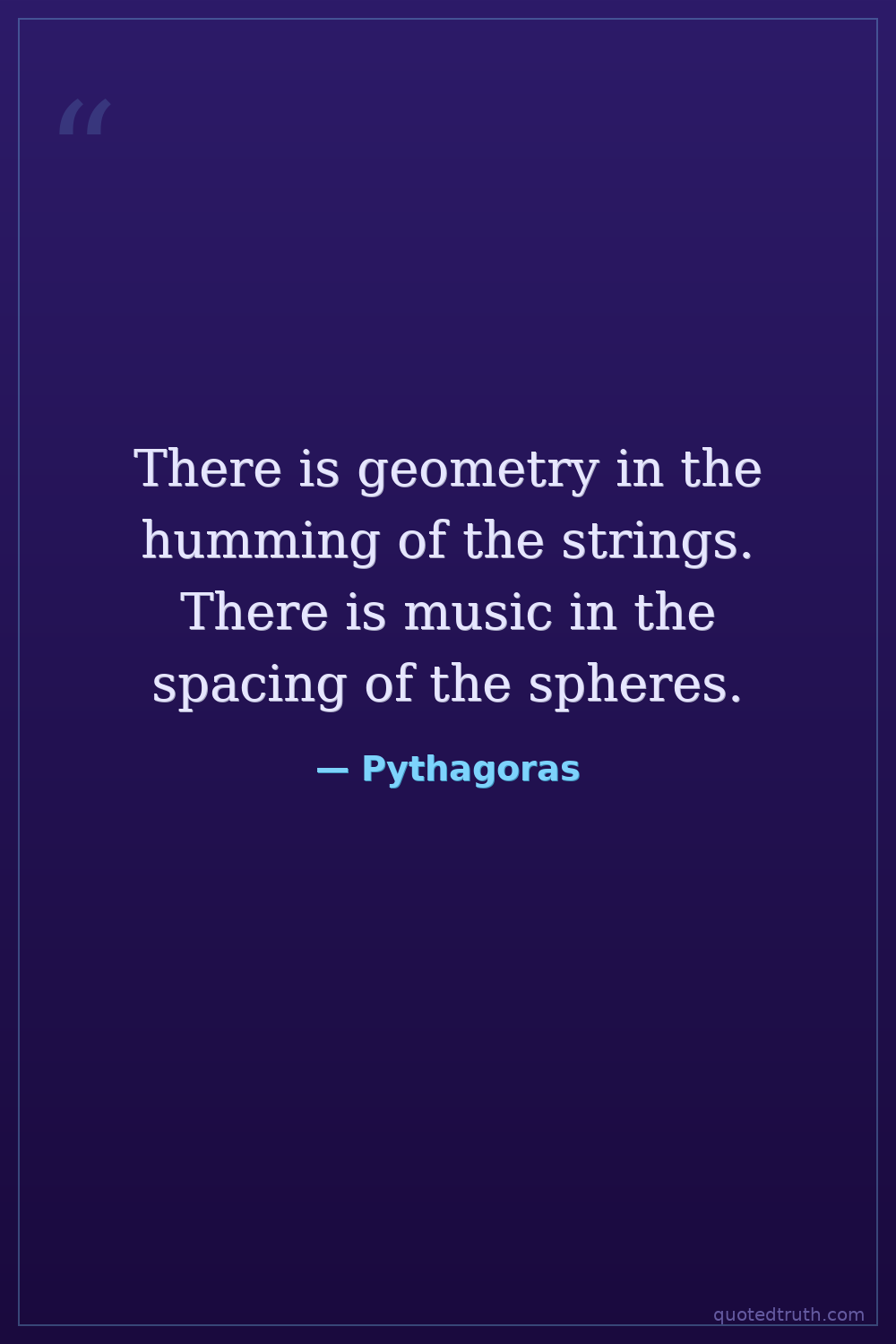
There is geometry in the humming of the strings. There is music in the spacing of the spheres.
There is geometry in the humming of the strings. There is music in the spacing of the spheres.
Click any product to generate a realistic preview. Up to 3 at a time.
* Initial load can take up to 90 seconds — revising the preview in another color is nearly instant.
"It is not possible to conceal a base mind by a fair face."
"If there be light, then there is darkness; if cold, heat; if height, depth; if solid, fluid; if hard, soft; if rough, smooth; if calm, tempest; if prosperity, adversity; if life, death."
"Stop! Don't hit it! It's the soul of a friend of mine. I knew it when I heard it cry."
"Don't sit on a bushel."
"Do not give sleep to your eyes nor slumber to your eyelids until you have balanced the account of your soul with what is right."
Greek philosopher and mathematician whose school in Croton combined geometry (the Pythagorean theorem), number-mysticism, and a religious-vegetarian way of life. Closely associated with Thales of Miletus (earlier pre-Socratic and the first philosopher). For an intellectual contrast, see Heraclitus, pre-Socratic Greek philosopher of flux — Heraclitus called Pythagoras 'the chief of swindlers' — among the founding insults of the philosophical-rivalry tradition. Their 'all is flux' vs 'all is number' poles still organize the philosophy of mathematics today (Platonist vs anti-realist).
Expressing the concept of 'Musica universalis' or harmony of the spheres, a central Pythagorean belief.
Date: c. 570-495 BCE
Art & CreativityFound in 3 providers: gemini,deepseek,grok
3 sources checked
Mathematical patterns underlie both music and the cosmos. The vibrating strings of an instrument follow precise geometric ratios — shorter strings produce higher pitches in exact proportions. The planets and celestial bodies, in their measured orbits and distances, obey those same numerical laws, as if the universe itself is a cosmic instrument. Mathematics is the hidden language connecting sound, space, and existence. Beauty and harmony are fundamentally mathematical.
Pythagoras discovered this connection experimentally. He tested a monochord — a single-stringed instrument — and found that harmonious intervals like the octave, fifth, and fourth correspond to exact whole-number ratios: 2:1, 3:2, 4:3. This wasn't poetry; it was proof that numbers govern reality. He extended the principle to musica universalis — the belief that planetary orbits generate inaudible cosmic harmonies. For Pythagoras, mathematics, music, and the cosmos were not separate domains but one unified, numerical truth.
Pythagoras lived in ancient Greece around 570–495 BCE, when philosophers were first asking what the fundamental substance of reality was. Thinkers like Thales proposed water; others suggested fire or the infinite. Pythagoras made a radical leap: numbers, not matter, were the foundation of everything. Greek astronomers were simultaneously beginning to model planetary motion mathematically. This quote captures that pivotal moment when quantitative reasoning was first applied to both art and the heavens — the birth of mathematical science.
AI-generated insights based on extensive research and information for context. Factual errors? Email [email protected].
Your cart is empty