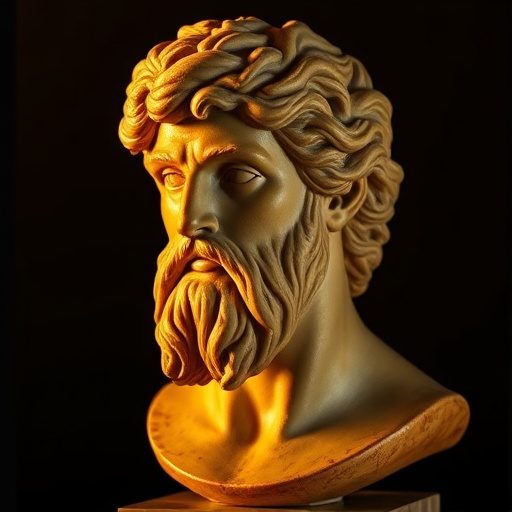
Pythagoras — "Educate the children and it won't be necessary to punish the men."
Educate the children and it won't be necessary to punish the men.
Educate the children and it won't be necessary to punish the men.
Click any product to generate a realistic preview. Up to 3 at a time.
* Initial load can take up to 90 seconds — revising the preview in another color is nearly instant.
"Respect yourself, and others will respect you."
"It is only necessary to make war with five things; with the maladies of the body, the ignorances of the mind, with the passions of the body, with the seditions of the city and the discords of families…"
"No one is free who has not obtained the empire of himself."
"Do not break bread."
"The most momentous thing in human life is the art of winning the soul to good or to evil."
Greek philosopher and mathematician whose school in Croton combined geometry (the Pythagorean theorem), number-mysticism, and a religious-vegetarian way of life. Closely associated with Thales of Miletus (earlier pre-Socratic and the first philosopher). For an intellectual contrast, see Heraclitus, pre-Socratic Greek philosopher of flux — Heraclitus called Pythagoras 'the chief of swindlers' — among the founding insults of the philosophical-rivalry tradition. Their 'all is flux' vs 'all is number' poles still organize the philosophy of mathematics today (Platonist vs anti-realist).
Found in 3 providers: deepseek,grok,gemini
3 sources checked
Invest in educating children and you prevent the behaviors that require punishing adults. When people are taught values, reasoning, and ethics early, they grow into disciplined, moral citizens. Punishment is costly, reactive, and often ineffective — education is proactive and formative. It reflects a belief that human character is shaped by nurture, not fixed by nature, and that society spares itself enormous suffering by getting that formation right from the start.
Pythagoras didn't just theorize — he founded an actual school and brotherhood in Croton, southern Italy, around 530 BC, where students lived and studied mathematics, philosophy, music, and ethics together. He believed knowledge transformed the soul, not merely the mind. His community was literally built on education as moral formation. This quote mirrors his life's work directly: he was constructing a living model of the idea that rigorous teaching produces virtuous people.
Pythagoras lived in the 6th–5th century BC, when Greek city-states relied heavily on punishment — exile, execution, public shaming — to maintain social order. Philosophical schools were just emerging as alternatives, proposing reason and education as tools for building better citizens. His era predates Socrates and Plato but ignited the tradition they developed: that wisdom, not fear, is the true foundation of a just and stable society.
AI-generated insights based on extensive research and information for context. Factual errors? Email [email protected].
Your cart is empty