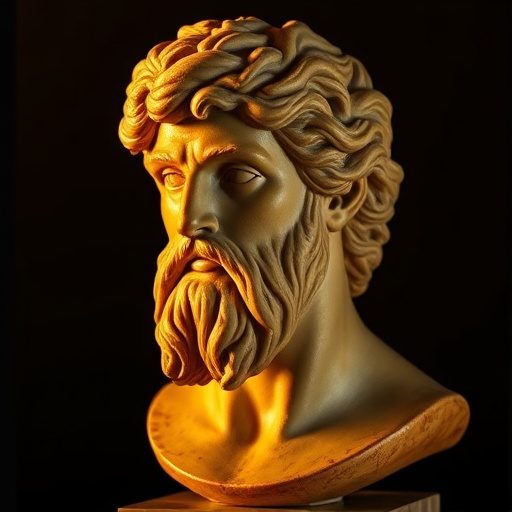
Pythagoras — "The most momentous thing in human life is the art of winning the soul to good or…"
The most momentous thing in human life is the art of winning the soul to good or to evil.
The most momentous thing in human life is the art of winning the soul to good or to evil.
Click any product to generate a realistic preview. Up to 3 at a time.
* Initial load can take up to 90 seconds — revising the preview in another color is nearly instant.
"Do not offer the right hand to everyone."
"Do nothing evil, neither in the presence of others, nor privately; But above all things respect yourself."
"In no way neglect the health of your body; But give it drink and food in due measure, and also the exercise of which it has need."
"It is not possible to conceal a base mind by a fair face."
"Rest satisfied with doing well, and leave others to talk of you as they please."
Greek philosopher and mathematician whose school in Croton combined geometry (the Pythagorean theorem), number-mysticism, and a religious-vegetarian way of life. Closely associated with Thales of Miletus (earlier pre-Socratic and the first philosopher). For an intellectual contrast, see Heraclitus, pre-Socratic Greek philosopher of flux — Heraclitus called Pythagoras 'the chief of swindlers' — among the founding insults of the philosophical-rivalry tradition. Their 'all is flux' vs 'all is number' poles still organize the philosophy of mathematics today (Platonist vs anti-realist).
Found in 2 providers: gemini,deepseek
2 sources checked
The single most important thing a person can do is influence another person's character — pulling them toward virtue or vice. Nothing outweighs this act. Education, persuasion, mentorship, and rhetoric all carry enormous moral weight because they shape who someone fundamentally becomes. Shaping souls is the highest-stakes human activity, more consequential than any material achievement or political power.
Pythagoras founded a philosophical brotherhood at Croton where initiates underwent strict moral and intellectual formation. He believed the soul was immortal and transmigrating, so its moral condition across lifetimes was paramount. His community practiced silence, dietary discipline, and shared study precisely to cultivate virtue. For Pythagoras, mathematics was a path to purifying the soul, making moral education inseparable from intellectual training.
In 6th-century BCE Greece, competing philosophical schools, sophists, and traditional religious cults all vied to shape public values. Democracy was emerging in Athens, making rhetoric and persuasion politically powerful tools. Pythagoras operated in Magna Graecia where Greek colonists built new civic identities. With no unified church or canonical scripture, individual teachers held outsized influence over morality, making the question of who shapes souls genuinely urgent and contested.
AI-generated insights based on extensive research and information for context. Factual errors? Email [email protected].
Your cart is empty