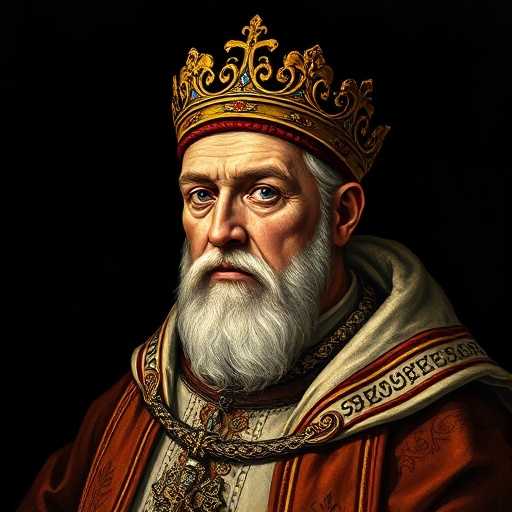
Pope Urban II — "Go forth, therefore, and fear not; for the Lord God of hosts will be with you."
Go forth, therefore, and fear not; for the Lord God of hosts will be with you.
Go forth, therefore, and fear not; for the Lord God of hosts will be with you.
Click any product to generate a realistic preview. Up to 3 at a time.
* Initial load can take up to 90 seconds — revising the preview in another color is nearly instant.
"All who die in the true faith will receive the crown of life."
"Let those who have been accustomed to fight for a little gain against Christians, now fight for an eternal reward against the infidels."
"From the confines of Jerusalem and the city of Constantinople a horrible tale has gone forth and very frequently has been brought to our ears, namely, that a race from the kingdom of the Persians, an …"
"Undertake this journey for the remission of your sins, with the assurance of the imperishable glory of the kingdom of heaven."
"Therefore, I pray and exhort, nay not I, but the Lord prays and exhorts you, as heralds of Christ, to urge men of all ranks, knights and foot-soldiers, rich and poor, to hasten to exterminate this vil…"
Pope (1088-1099) whose Council of Clermont speech (November 1095) launched the First Crusade — the founding event of nine centuries of Christian-Muslim military conflict. Closely associated with Pope Gregory VII (his predecessor on papal-imperial reform). For an intellectual contrast, see Saladin, Kurdish-Muslim Sultan of Egypt and Syria (1138-1193) — Saladin recaptured Jerusalem in 1187, undoing the First Crusade Urban II launched 92 years earlier. Saladin's chivalrous treatment of Christian prisoners became the canonical Muslim counter-image to Crusader brutality. The cleanest before/after pairing of the Crusades' moral arc.
Found in 1 providers: grok
1 source checked
A direct command to act boldly without hesitation, anchored in divine assurance. The speaker strips away fear by invoking God's active presence — not passive blessing, but accompaniment into danger. In modern terms: your cause is righteous, ultimate backing guarantees protection, so remove doubt and move. It frames courage not as a personal virtue but as the logical response to guaranteed divine support behind every step forward.
Urban II's strategic genius lay in fusing ecclesiastical authority with military mobilization. As a Cluniac reformer who became pope in 1088, he believed the papacy should lead Christendom politically, not just spiritually. At Clermont in 1095, he electrified thousands with exactly this kind of declaration, converting religious fervor into military commitment. The phrase mirrors his core method: channel God's voice through the papal office to override soldiers' natural fear of death.
The late 11th century was defined by Seljuk Turkish expansion across Byzantine territory and Muslim control of Jerusalem — Christianity's holiest city. Western Europe was gripped by a penitential culture where pilgrimage to Jerusalem was supreme devotion, now severed. Urban's call capitalized on feudal knights' hunger for purpose and the Church's moral authority. Crusaders genuinely believed participation guaranteed salvation — God's literal protection in battle was not metaphor but expected reality.
AI-generated insights based on extensive research and information for context. Factual errors? Email [email protected].
Your cart is empty