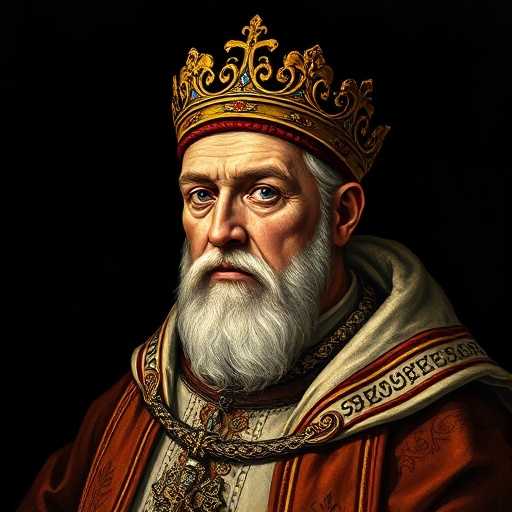
Pope Urban II — "Fight for the Holy Sepulchre, and you will be absolved from all your sins."
Fight for the Holy Sepulchre, and you will be absolved from all your sins.
Fight for the Holy Sepulchre, and you will be absolved from all your sins.
Click any product to generate a realistic preview. Up to 3 at a time.
* Initial load can take up to 90 seconds — revising the preview in another color is nearly instant.
"All who die by the way, whether by land or by sea, or in battle against the pagans, shall have immediate remission of sins."
"Let those who go not put off the journey, but rent their lands and collect money for their expenses."
"Let no one who is rich hold back, and let no poor man hesitate, for God will be his guide and provider."
"For if He, shall find worms, that is, sins, In them, because you have been negligent in your duty, He will command them as worthless to be thrown into the abyss of unclean things."
"Go forth, therefore, and fear not; for the Lord God of hosts will be with you."
Pope (1088-1099) whose Council of Clermont speech (November 1095) launched the First Crusade — the founding event of nine centuries of Christian-Muslim military conflict. Closely associated with Pope Gregory VII (his predecessor on papal-imperial reform). For an intellectual contrast, see Saladin, Kurdish-Muslim Sultan of Egypt and Syria (1138-1193) — Saladin recaptured Jerusalem in 1187, undoing the First Crusade Urban II launched 92 years earlier. Saladin's chivalrous treatment of Christian prisoners became the canonical Muslim counter-image to Crusader brutality. The cleanest before/after pairing of the Crusades' moral arc.
Found in 1 providers: grok
1 source checked
The quote offers a transaction: risk your life in military combat to retake Jerusalem's Church of the Holy Sepulchre — revered as the site of Christ's burial and resurrection — and God will forgive every sin you've committed. It frames violent warfare as a path to eternal salvation, collapsing the distinction between soldier and penitent, making participation in holy war spiritually equivalent to full absolution through confession and penance.
Urban II (born Odo of Châtillon, c. 1042–1099) was a Cluniac monk and committed Church reformer before reaching the papacy. At the Council of Clermont in 1095 he delivered this promise, launching the First Crusade. His offer of plenary indulgence channeled the papacy's supreme spiritual authority toward a geopolitical goal, revealing his conviction that the pope, not secular kings, should direct Christendom's collective military and moral will.
Jerusalem fell to Seljuk Turks in 1071, severing Christian pilgrimage routes to the Holy Sepulchre. Byzantine Emperor Alexios I appealed to Rome for military aid in 1095. Medieval Christians believed sin required arduous penance, so a blanket absolution for crusading was electrifying. The Gregorian Reform movement had simultaneously elevated papal authority over secular rulers, giving Urban II both the ambition and the theological machinery to mobilize an entire civilization toward armed pilgrimage.
AI-generated insights based on extensive research and information for context. Factual errors? Email [email protected].
Your cart is empty