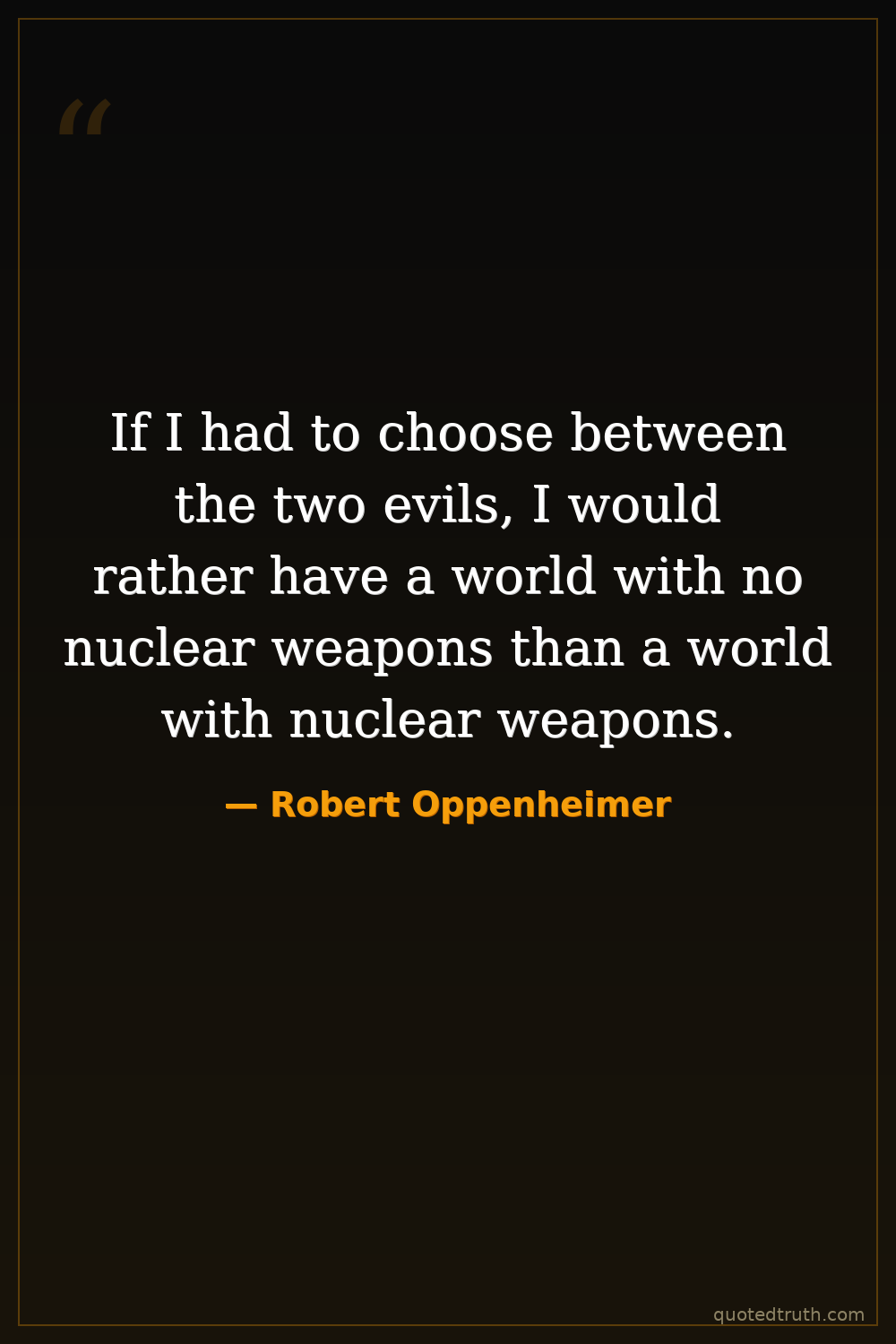
Robert Oppenheimer — "If I had to choose between the two evils, I would rather have a world with no nu…"
If I had to choose between the two evils, I would rather have a world with no nuclear weapons than a world with nuclear weapons.
If I had to choose between the two evils, I would rather have a world with no nuclear weapons than a world with nuclear weapons.
Click any product to generate a realistic preview. Up to 3 at a time.
* Initial load can take up to 90 seconds — revising the preview in another color is nearly instant.
"We have to learn to live with the knowledge that we have changed the world forever, and that we can never go back."
"The atomic bomb is not a weapon to be used lightly."
"No man should escape our universities without knowing how little he knows."
"The atomic bomb is a symbol of man's destructive power, but it is also a symbol of man's ability to create."
"The atomic bomb is a culmination of a hundred years of physics."
American theoretical physicist who directed the Manhattan Project's Los Alamos Laboratory and oversaw the atomic bombs; lost his security clearance in 1954. Closely associated with Niels Bohr (Manhattan Project consultant and atomic-policy advisor) and Hans Bethe (Los Alamos theoretical-division chief). For an intellectual contrast, see Edward Teller, Hungarian-American physicist and 'father of the H-bomb' — Teller pushed the H-bomb against Oppenheimer's objections and testified against him at his 1954 security hearing — the precise moment that ended Oppenheimer's career. The canonical 'physicist-of-conscience vs physicist-of-state' pairing in nuclear-age ethics; Christopher Nolan's Oppenheimer (2023) dramatized this rivalry for a mass audience.
Found in 1 providers: grok
1 source checked
The quote expresses a clear moral preference: a world without nuclear weapons — even with all its other conflicts and imperfections — is better than one where nuclear weapons exist. Choosing between two evils, Oppenheimer sides with disarmament. It acknowledges no ideal option exists but insists humanity is safer without weapons capable of causing unprecedented, civilization-ending destruction on a massive scale.
As director of the Manhattan Project, Oppenheimer helped build the bombs dropped on Hiroshima and Nagasaki. Afterward he was profoundly haunted, famously recalling the Bhagavad Gita: 'Now I am become Death, the destroyer of worlds.' He opposed developing the hydrogen bomb, advocated international nuclear controls, and lost his security clearance in 1954. This quote reflects his lifelong guilt and conviction that science had unleashed a force requiring abolition, not further proliferation.
After Hiroshima and Nagasaki in 1945, the Cold War nuclear arms race escalated rapidly. The Soviet Union tested its bomb in 1949; both superpowers built hydrogen bombs by the mid-1950s. The Cuban Missile Crisis in 1962 brought the world to the brink of annihilation. Duck-and-cover drills and fallout shelters defined civilian life. Scientists who had built these weapons increasingly called for disarmament, making such statements both politically charged and deeply personal.
AI-generated insights based on extensive research and information for context. Factual errors? Email [email protected].
Your cart is empty