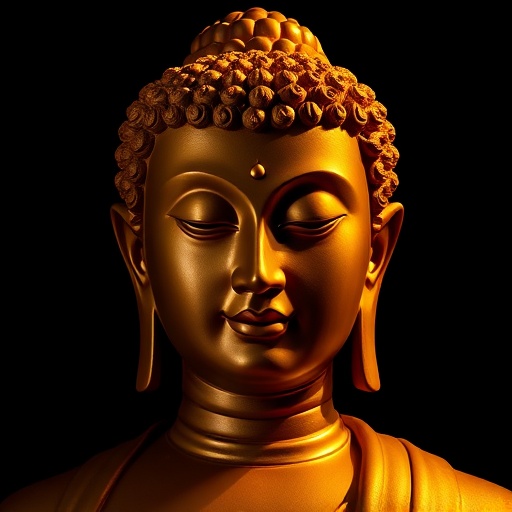
Siddhartha Gautama (Buddha) — "Where self is, truth is not. Where truth is, self is not."
Where self is, truth is not. Where truth is, self is not.
Where self is, truth is not. Where truth is, self is not.
Click any product to generate a realistic preview. Up to 3 at a time.
* Initial load can take up to 90 seconds — revising the preview in another color is nearly instant.
"Just as a candle cannot burn without fire, men cannot live without a spiritual life."
"All conditioned things are impermanent — when one sees this with wisdom, then one turns away from suffering."
"Much though he recites the sacred texts, but acts not accordingly, that heedless man is like a cowherd who only counts the cows of others."
"Do not believe anything simply because you have heard it. Do not believe in traditions because they have been handed down for many generations. Do not believe anything because it is spoken and rumored…"
"The body, monks, is not self. If the body were the self, this body would not lend itself to dis-ease. It would be possible (to say) with regard to the body, 'Let my body be thus. Let my body not be th…"
Found in 1 providers: gemini
1 source checked
The saying draws a sharp line between ego-driven existence and genuine reality. As long as a person clings to a fixed, separate 'me'—identity, cravings, pride, personal story—they cannot perceive things as they actually are. The moment truth is directly seen, that constructed self dissolves, because it was never a solid thing to begin with. Self and truth function like light and shadow: one necessarily vanishes when the other appears.
This cuts to the heart of what Siddhartha taught after his awakening under the Bodhi tree. Born a Shakya prince named Gautama, he abandoned palace, wife, and son to investigate suffering, and concluded that attachment to a permanent self (anatta) is the root of human anguish. His entire teaching career—forty-five years wandering the Ganges plain—aimed at dismantling that illusion so disciples could see reality unfiltered, exactly as this line declares.
In 5th-century BCE northern India, Brahmanical religion centered on the eternal atman, a soul identical with cosmic Brahman, and on ritual sacrifice performed by priests. Siddhartha spoke during the Shramana ferment, when wandering ascetics—Jains, Ajivikas, skeptics—openly challenged Vedic orthodoxy. Declaring that clinging to self blocks truth was a direct theological provocation, undercutting caste authority, priestly mediation, and the soul doctrine, and offering liberation through personal insight rather than inherited ritual.
AI-generated insights based on extensive research and information for context. Factual errors? Email [email protected].
Your cart is empty