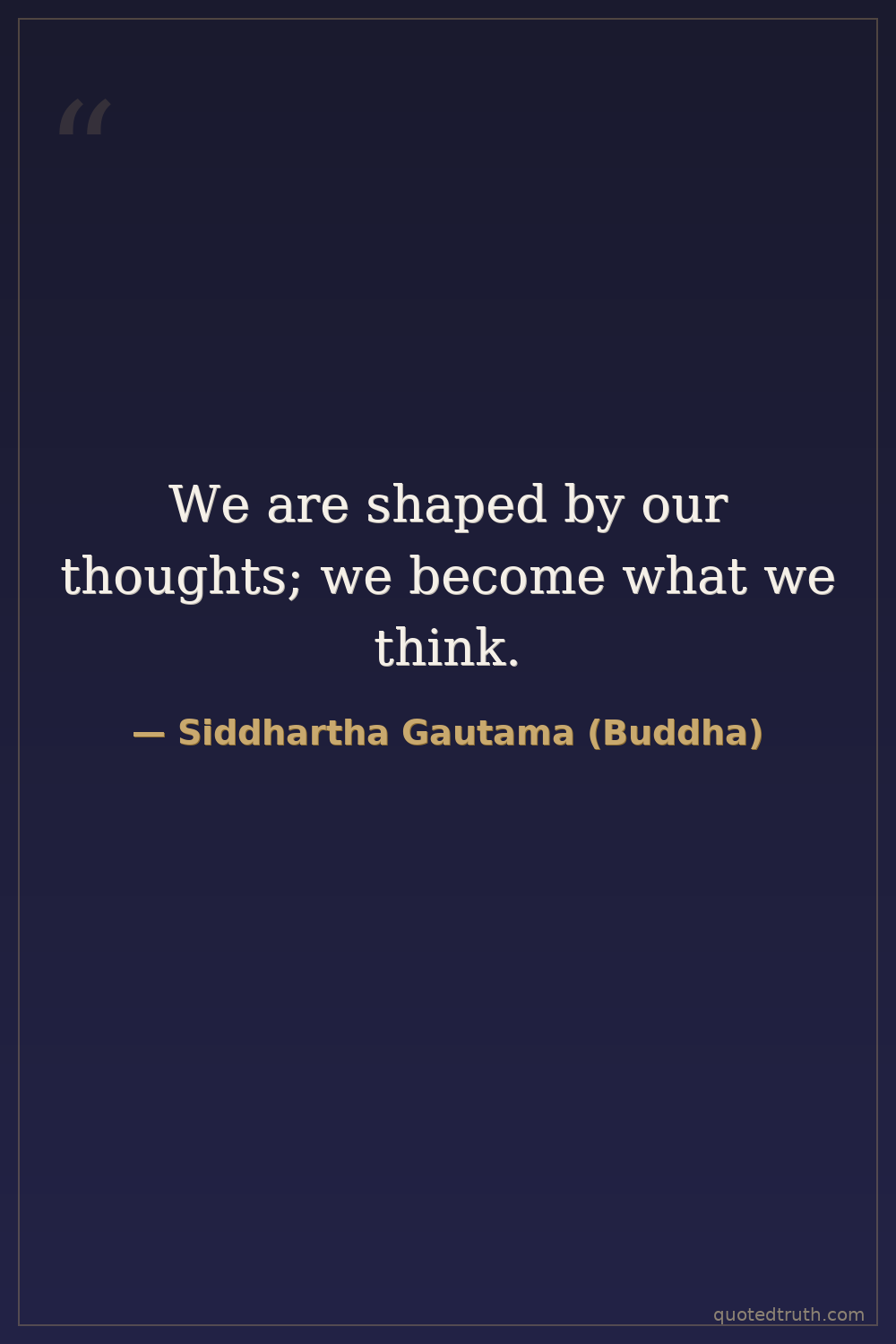
Siddhartha Gautama (Buddha) — "We are shaped by our thoughts; we become what we think."
We are shaped by our thoughts; we become what we think.
We are shaped by our thoughts; we become what we think.
Click any product to generate a realistic preview. Up to 3 at a time.
* Initial load can take up to 90 seconds — revising the preview in another color is nearly instant.
"The secret of health for both mind and body is not to mourn for the past, nor to worry about the future, but to live the present moment wisely and earnestly."
"The Enlightened One is deep, boundless, hard to fathom, like the ocean."
"Where self is, truth is not. Where truth is, self is not."
"When the mind is pure, joy follows like a shadow that never leaves."
"Let them not do the slightest thing that the wise would later reprove."
From the Dhammapada, a teaching on the power of the mind
Date: c. 5th-6th Century BCE
PhilosophicalFound in 1 providers: gemini
1 source checked
Your inner mental life creates your outer reality. The thoughts you repeat, the beliefs you entertain, and the emotions you dwell on gradually harden into character, habits, and actions. Over time, a person literally turns into the sum of what their mind rehearses most often. If you want to change who you are, you have to change what you think first, because identity follows attention rather than the other way around.
The Buddha built his entire teaching on mental cultivation. After leaving his royal life, he spent six years in ascetic and meditative training, eventually awakening under the Bodhi tree by observing his own mind. Right Thought and Right Mindfulness sit at the heart of his Eightfold Path, and the Dhammapada opens with nearly these exact words. For him, liberation was not granted by gods but engineered internally through disciplined awareness of thought.
Around the 5th century BCE in northern India, the Vedic religion dominated through ritual sacrifice, rigid caste, and Brahmin priestly authority. A wave of wandering ascetics, the shramanas, challenged that order by seeking truth through personal experience rather than inherited ritual. The Buddha emerged from this ferment, offering a psychological path open to any caste. Teaching that thought shapes destiny was radical in a society where karma was tied to birth and priestly ceremony.
AI-generated insights based on extensive research and information for context. Factual errors? Email [email protected].
Your cart is empty