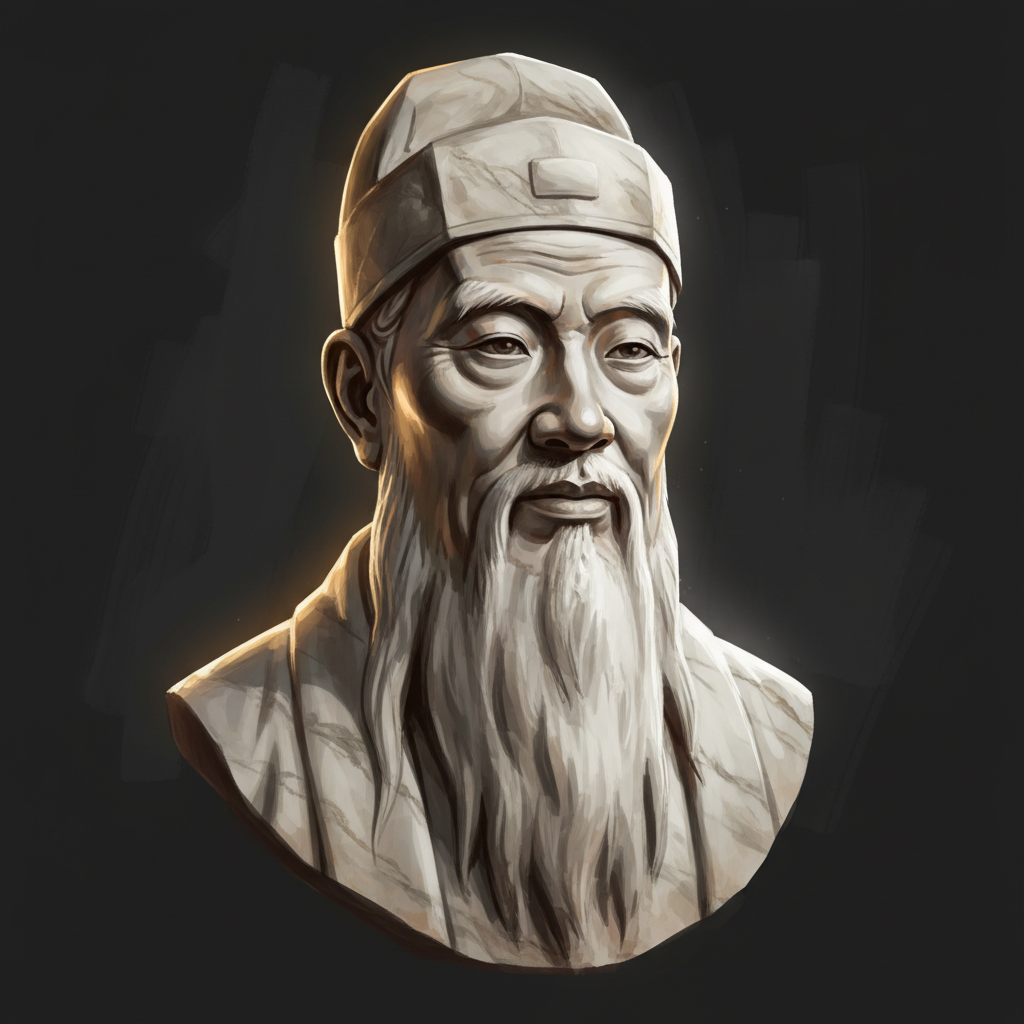
Confucius — "Silence is a true friend who never betrays."
Silence is a true friend who never betrays.
Silence is a true friend who never betrays.
Click any product to generate a realistic preview. Up to 3 at a time.
* Initial load can take up to 90 seconds — revising the preview in another color is nearly instant.
"If names be not correct, language is not in accordance with the truth of things. If language be not in accordance with the truth of things, affairs cannot be carried on to success."
"The superior man is easy to serve and difficult to please."
"The Master said, 'The student of virtue has no anxieties; the man of wisdom has no perplexities; the man of courage has no fears.'"
"The Master said, 'A man can enlarge the Way, but the Way cannot enlarge a man.'"
"I transmit, but don't innovate. I am faithful to and love the ancients."
Chinese philosopher and teacher whose teachings (compiled by his students in the Analects) became the foundational ethical framework of East Asian civilization for 2,500 years. Closely associated with Mencius (his most-influential follower a century later). For an intellectual contrast, see Laozi, near-contemporary Chinese sage and Tao Te Ching author — Confucius systematized social order through ritual and family hierarchy; Laozi's Taoist effortless-action philosophy argued such systems were the disease, not the cure. The two founding poles of Chinese moral philosophy — every East Asian moral tradition since has positioned itself between them.
The standard scholarly entry points to Confucius's work: Philip J. Ivanhoe (Georgetown, Chinese philosophy) — Confucian Moral Self Cultivation (2000); Edward Slingerland (UBC, Asian Studies) — Effortless Action: Wu-wei as Conceptual Metaphor (2003); Tu Weiming (Harvard, Confucian scholar) — Confucian Thought: Selfhood as Creative Transformation (1985). These are the works graduate seminars cite when teaching Confucius.
Found in 1 providers: gemini
1 source checked
Keeping quiet protects you in ways that talking cannot. Words, once spoken, can be repeated, twisted, or used against you, but silence gives nothing away. By holding back, you avoid revealing secrets, hurting others, or saying something you will regret. Silence is dependable because it cannot be misquoted or turned into evidence. In practical terms, choosing not to speak is often the safer and wiser option.
Confucius built his teachings around self-restraint, careful speech, and moral discipline. As a traveling teacher and former minister who watched careless words wreck careers and alliances, he repeatedly warned students to think before speaking and to prefer action over boasting. His Analects praise the gentleman who is slow in speech but quick in conduct. This saying fits his conviction that a person's integrity is guarded by measured words, humility, and the discipline to stay quiet when others rush to talk.
Confucius lived during the Spring and Autumn period, a chaotic stretch of late Zhou China when rival states schemed, assassinated, and warred constantly. Court intrigue meant a single leaked comment could cost a scholar his post or his life, and advisors rose or fell on their reputations for discretion. Ritual propriety was breaking down, and Confucius sought to restore order through personal virtue. In that climate of spies, shifting loyalties, and loose tongues, silence was not passivity but genuine political and moral protection.
AI-generated insights based on extensive research and information for context. Factual errors? Email [email protected].
Your cart is empty