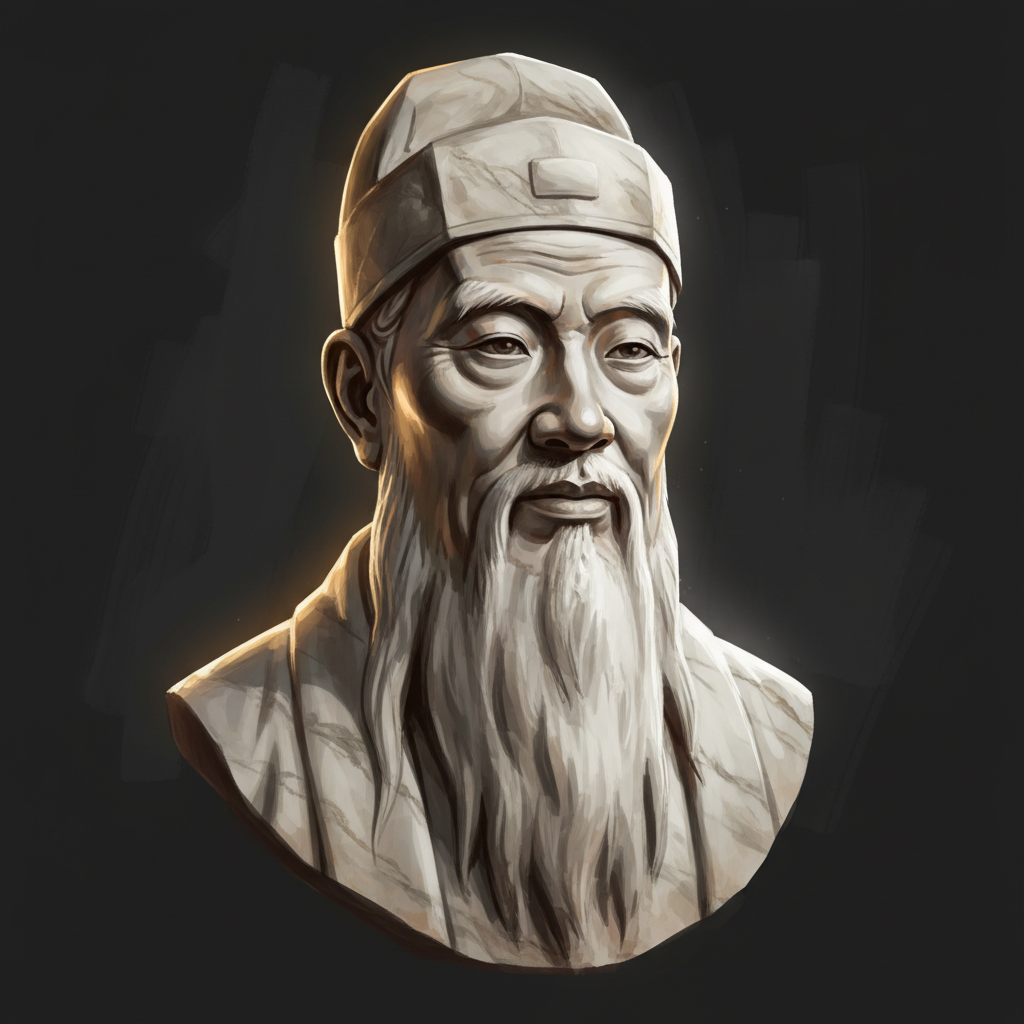
Confucius — "Everything has beauty, but not everyone sees it."
Everything has beauty, but not everyone sees it.
Everything has beauty, but not everyone sees it.
Click any product to generate a realistic preview. Up to 3 at a time.
* Initial load can take up to 90 seconds — revising the preview in another color is nearly instant.
"The Master said, 'The superior man is dignified, but not proud. The mean man is proud, but not dignified.'"
"He who is not concerned about the distant future will find sorrow near at hand."
"The superior man is modest in his speech, but exceeds in his actions."
"The superior man is dignified, but not contentious; social, but not clannish."
"Wheresoever you go, go with all your heart."
Chinese philosopher and teacher whose teachings (compiled by his students in the Analects) became the foundational ethical framework of East Asian civilization for 2,500 years. Closely associated with Mencius (his most-influential follower a century later). For an intellectual contrast, see Laozi, near-contemporary Chinese sage and Tao Te Ching author — Confucius systematized social order through ritual and family hierarchy; Laozi's Taoist effortless-action philosophy argued such systems were the disease, not the cure. The two founding poles of Chinese moral philosophy — every East Asian moral tradition since has positioned itself between them.
The standard scholarly entry points to Confucius's work: Philip J. Ivanhoe (Georgetown, Chinese philosophy) — Confucian Moral Self Cultivation (2000); Edward Slingerland (UBC, Asian Studies) — Effortless Action: Wu-wei as Conceptual Metaphor (2003); Tu Weiming (Harvard, Confucian scholar) — Confucian Thought: Selfhood as Creative Transformation (1985). These are the works graduate seminars cite when teaching Confucius.
Found in 1 providers: gemini
1 source checked
Beauty exists in all things, people, and moments, but recognizing it requires attentive perception and an open mind. Most people walk past wonder because they are distracted, hurried, or jaded by routine. The saying places responsibility on the observer rather than the world: if life seems dull, the deficit lies in how we look, not in what is there. Cultivating awareness transforms ordinary experience into something rich and meaningful.
Confucius taught that moral and aesthetic refinement came from disciplined attention, ritual practice, and lifelong learning. He believed the junzi, or exemplary person, cultivated sensitivity to harmony in music, ceremony, nature, and human relationships. This saying mirrors his conviction that wisdom is a trained capacity for noticing what coarser minds overlook. His own career advising rulers and editing classics rested on the premise that careful observation reveals patterns and value others dismiss as ordinary.
Confucius lived during the late Spring and Autumn period, roughly 551 to 479 BCE, when the Zhou dynasty was fracturing into warring states marked by violence, shifting alliances, and collapsing rituals. Amid this turmoil, he urged a return to refined conduct, music, and reverence for tradition as antidotes to chaos. Teaching people to perceive beauty and order was a quietly radical act in an era where survival, conquest, and political maneuvering dominated daily concerns across the Chinese cultural world.
AI-generated insights based on extensive research and information for context. Factual errors? Email [email protected].
Your cart is empty