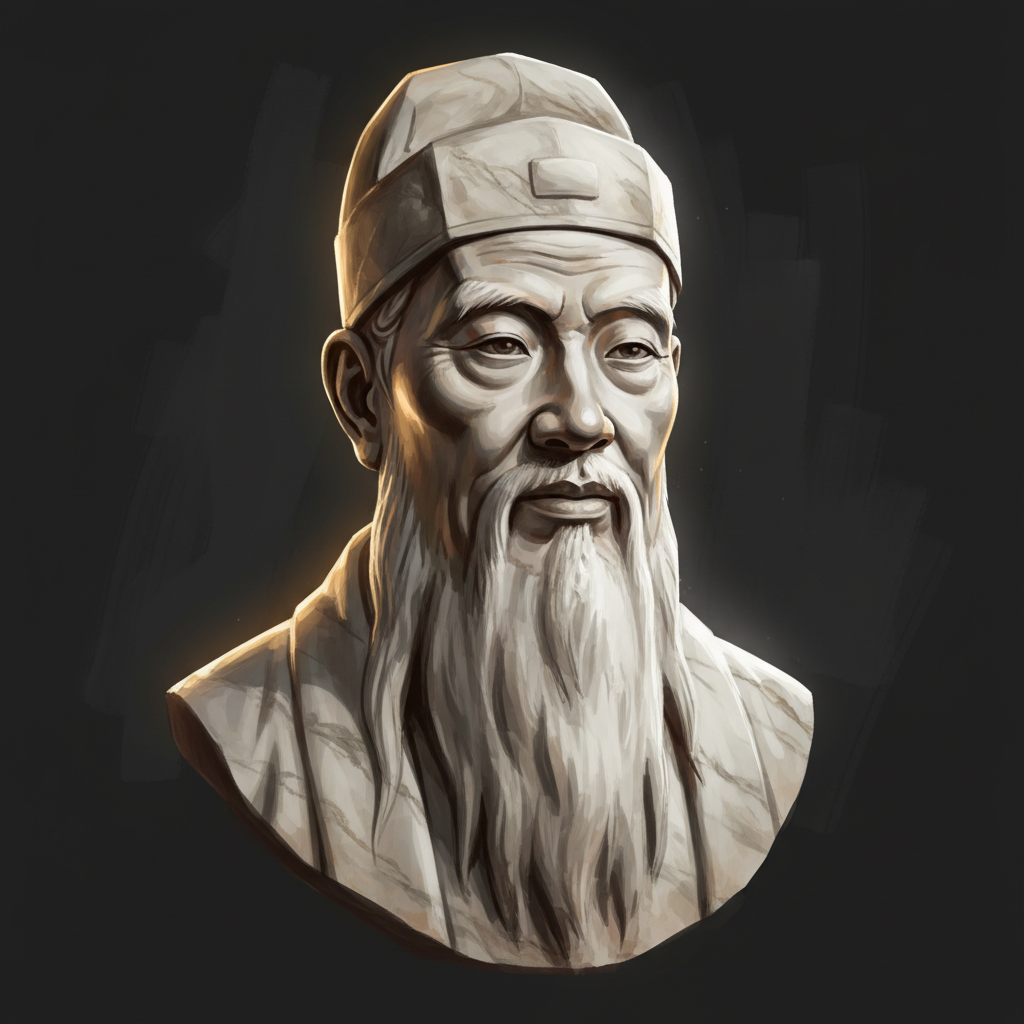
Confucius — "I transmit but do not innovate; I am truthful in what I say and devoted to antiq…"
I transmit but do not innovate; I am truthful in what I say and devoted to antiquity.
I transmit but do not innovate; I am truthful in what I say and devoted to antiquity.
Click any product to generate a realistic preview. Up to 3 at a time.
* Initial load can take up to 90 seconds — revising the preview in another color is nearly instant.
"Respect yourself and others will respect you."
"The superior man is modest in his speech, but exceeds in his actions."
"By three methods we may learn wisdom: First, by reflection, which is noblest; Second, by imitation, which is easiest; and third by experience, which is the bitterest."
"The Master said, 'It is not easy to find a man who has learned for three years without having his thoughts bent on learning.'"
"I will not be afflicted that men do not know me; I will be afflicted that I do not know men."
Chinese philosopher and teacher whose teachings (compiled by his students in the Analects) became the foundational ethical framework of East Asian civilization for 2,500 years. Closely associated with Mencius (his most-influential follower a century later). For an intellectual contrast, see Laozi, near-contemporary Chinese sage and Tao Te Ching author — Confucius systematized social order through ritual and family hierarchy; Laozi's Taoist effortless-action philosophy argued such systems were the disease, not the cure. The two founding poles of Chinese moral philosophy — every East Asian moral tradition since has positioned itself between them.
The standard scholarly entry points to Confucius's work: Philip J. Ivanhoe (Georgetown, Chinese philosophy) — Confucian Moral Self Cultivation (2000); Edward Slingerland (UBC, Asian Studies) — Effortless Action: Wu-wei as Conceptual Metaphor (2003); Tu Weiming (Harvard, Confucian scholar) — Confucian Thought: Selfhood as Creative Transformation (1985). These are the works graduate seminars cite when teaching Confucius.
Found in 1 providers: grok
1 source checked
The speaker claims to pass along established wisdom rather than invent new ideas. They present themselves as a faithful messenger, committed to honesty in speech and deeply loyal to the traditions, teachings, and practices of earlier generations. It is a statement of humility and conservatism: the value lies in preserving and transmitting proven truth, not in originality or personal cleverness.
Confucius spent his life studying the rites, poetry, and records of the early Zhou dynasty, editing classics like the Book of Songs and the Spring and Autumn Annals. He taught roughly 3,000 disciples and insisted he was merely a conduit for ancient sages like the Duke of Zhou. This line captures his self-image as teacher-curator rather than prophet, grounding his authority in fidelity to tradition rather than personal revelation.
Confucius lived during the late Spring and Autumn period (551-479 BCE), when the Zhou dynasty's ritual order was collapsing into warfare between rival states. Moral norms, family hierarchies, and ceremonial governance were breaking down. In that climate of upheaval, appealing to antiquity was a radical conservative response: reviving the supposed golden age of the early Zhou kings offered a stable model against the chaos of competing warlords and emerging legalist pragmatism.
AI-generated insights based on extensive research and information for context. Factual errors? Email [email protected].
Your cart is empty