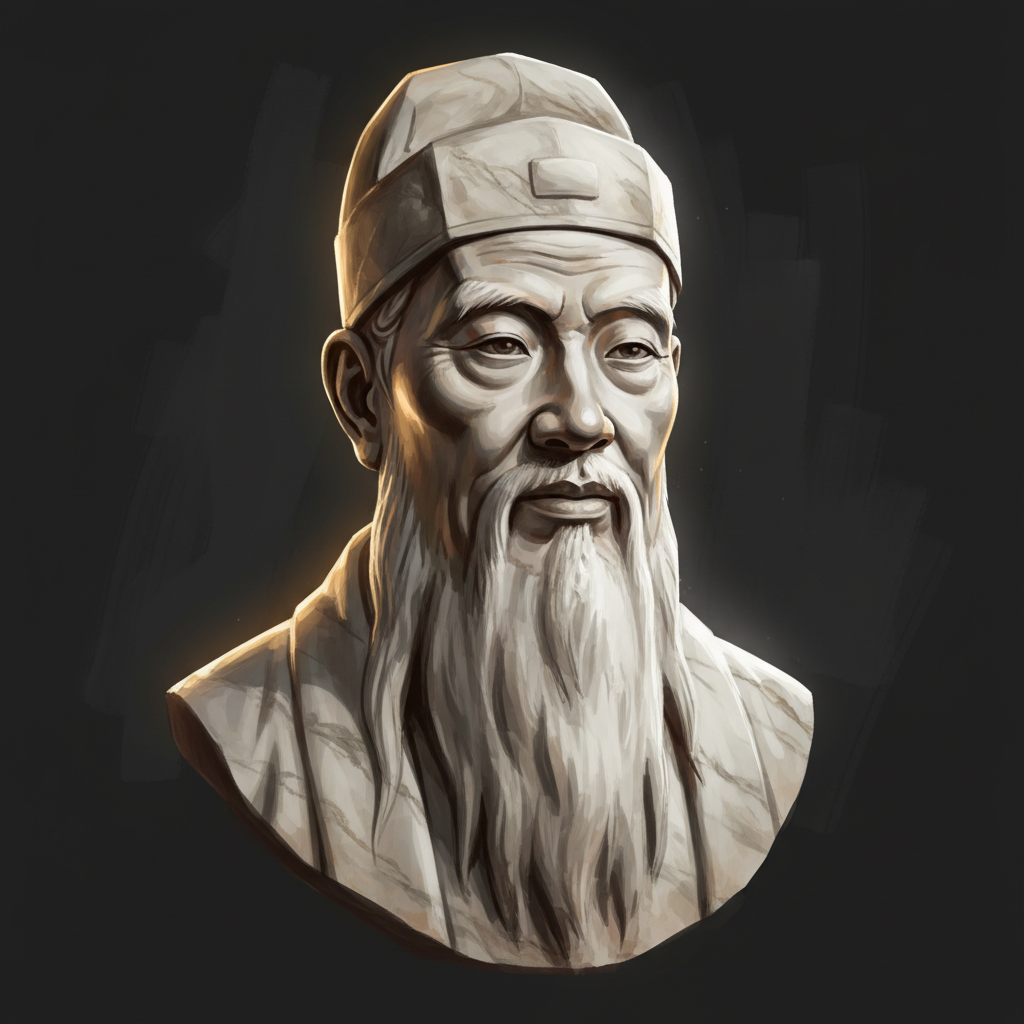
Confucius — "The gentleman is not a tool."
The gentleman is not a tool.
The gentleman is not a tool.
Click any product to generate a realistic preview. Up to 3 at a time.
* Initial load can take up to 90 seconds — revising the preview in another color is nearly instant.
"To be poor without murmuring is difficult; to be rich without being proud is easy."
"When you have faults, do not fear to abandon them."
"The Master said, 'A man who is not a man of benevolence—what has he to do with ceremonies? A man who is not a man of benevolence—what has he to do with music?'"
"The gentleman reveres three things. He reveres the mandate of Heaven; he reveres great people; and he reveres the words of sages."
"Is it not a pleasure, having learned something, to try it out at due intervals?"
Chinese philosopher and teacher whose teachings (compiled by his students in the Analects) became the foundational ethical framework of East Asian civilization for 2,500 years. Closely associated with Mencius (his most-influential follower a century later). For an intellectual contrast, see Laozi, near-contemporary Chinese sage and Tao Te Ching author — Confucius systematized social order through ritual and family hierarchy; Laozi's Taoist effortless-action philosophy argued such systems were the disease, not the cure. The two founding poles of Chinese moral philosophy — every East Asian moral tradition since has positioned itself between them.
The standard scholarly entry points to Confucius's work: Philip J. Ivanhoe (Georgetown, Chinese philosophy) — Confucian Moral Self Cultivation (2000); Edward Slingerland (UBC, Asian Studies) — Effortless Action: Wu-wei as Conceptual Metaphor (2003); Tu Weiming (Harvard, Confucian scholar) — Confucian Thought: Selfhood as Creative Transformation (1985). These are the works graduate seminars cite when teaching Confucius.
Found in 2 providers: grok,gemini
2 sources checked
A truly cultivated person is not a single-purpose instrument, useful only for one narrow job. They possess broad wisdom, moral judgment, and adaptability, allowing them to respond thoughtfully to any situation rather than mechanically performing one task. Character and understanding matter more than technical specialization. A person of depth brings principles and humanity to every role, whereas a mere tool simply executes a function without reflection, virtue, or the capacity to adjust when circumstances change.
Confucius spent his life training disciples to be junzi, cultivated gentlemen fit for statecraft, ritual, and ethical leadership, not narrow technicians. He personally moved across many roles, teacher, minister, advisor, and believed moral cultivation outranked any single skill. Rulers who hired specialists but ignored virtue frustrated him. This saying captures his central conviction that education should shape whole persons of character, capable of wise judgment, rather than efficient functionaries bound to one task.
During the late Spring and Autumn period, feudal states competed fiercely, and rulers increasingly hired specialists, scribes, warriors, diplomats, as disposable instruments of power. Traditional ritual order was collapsing, and court life rewarded narrow usefulness over integrity. Confucius responded by arguing that a society led by broadly cultivated, virtuous men would be more stable than one run by expert functionaries. His words defended an older humanistic ideal against the emerging instrumental, results-obsessed political culture of warring Zhou-era courts.
AI-generated insights based on extensive research and information for context. Factual errors? Email [email protected].
Your cart is empty