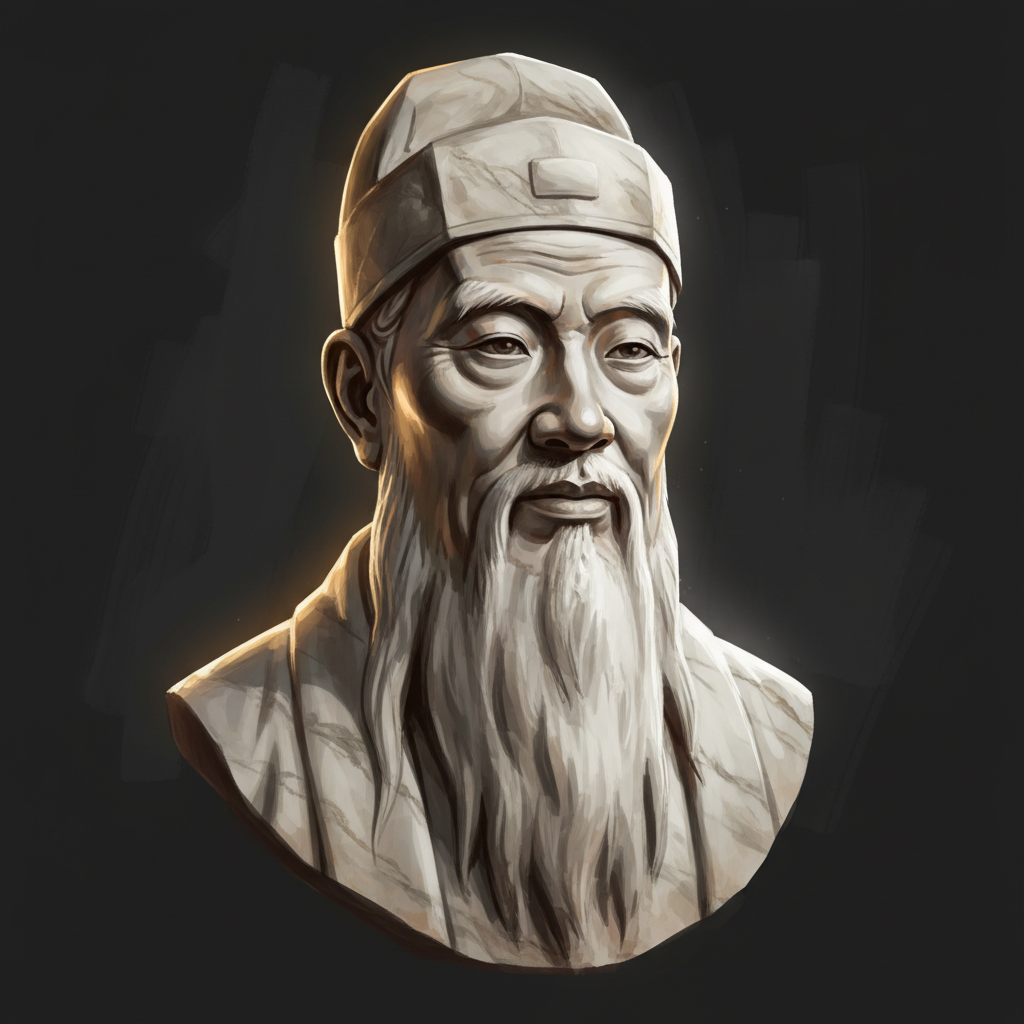
Confucius — "Is humanity far away? Whenever I want the virtue of humanity, it comes at once."
Is humanity far away? Whenever I want the virtue of humanity, it comes at once.
Is humanity far away? Whenever I want the virtue of humanity, it comes at once.
Click any product to generate a realistic preview. Up to 3 at a time.
* Initial load can take up to 90 seconds — revising the preview in another color is nearly instant.
"He who knows all the answers has not been asked all the questions."
"The Master said, 'It is not easy to find a man who has learned for three years without having his thoughts bent on learning.'"
"The faults of a man are characteristic of his class. It is by observing a man's faults that one may know his virtue."
"To worship ancestors whom one does not know is to be presumptuous."
"The Master said, 'He who is not concerned about the distant future will find trouble right at hand.'"
Chinese philosopher and teacher whose teachings (compiled by his students in the Analects) became the foundational ethical framework of East Asian civilization for 2,500 years. Closely associated with Mencius (his most-influential follower a century later). For an intellectual contrast, see Laozi, near-contemporary Chinese sage and Tao Te Ching author — Confucius systematized social order through ritual and family hierarchy; Laozi's Taoist effortless-action philosophy argued such systems were the disease, not the cure. The two founding poles of Chinese moral philosophy — every East Asian moral tradition since has positioned itself between them.
The standard scholarly entry points to Confucius's work: Philip J. Ivanhoe (Georgetown, Chinese philosophy) — Confucian Moral Self Cultivation (2000); Edward Slingerland (UBC, Asian Studies) — Effortless Action: Wu-wei as Conceptual Metaphor (2003); Tu Weiming (Harvard, Confucian scholar) — Confucian Thought: Selfhood as Creative Transformation (1985). These are the works graduate seminars cite when teaching Confucius.
Found in 1 providers: gemini
1 source checked
Genuine goodness is not a distant ideal reserved for saints or sages. It lives within every person and activates the moment we sincerely choose it. The barrier is not capability or circumstance but willingness. When you truly want to act with kindness, fairness, and compassion, that virtue is instantly accessible. Moral excellence is a decision available right now, not a destination requiring years of preparation or special qualifications to reach.
Confucius devoted his life to teaching ren, the cardinal virtue of humaneness, as the foundation of ethical living. Though he traveled for years seeking rulers who would implement his ideas, he insisted moral cultivation began with the individual's willing heart. This saying reflects his optimistic conviction that ordinary people could become junzi, exemplary persons, through sincere daily effort. He rejected the notion that virtue required noble birth or mystical knowledge, democratizing ethics for his students.
Confucius lived during the Spring and Autumn period around 551 to 479 BCE, an era of political fragmentation, warfare between rival states, and collapsing Zhou dynasty authority. Traditional rituals and social bonds were deteriorating as warlords pursued naked power. Against this moral chaos, Confucius offered a radical message that social order could be rebuilt through personal character rather than force. Making virtue immediately accessible to any willing person was both philosophically bold and politically urgent.
AI-generated insights based on extensive research and information for context. Factual errors? Email [email protected].
Your cart is empty