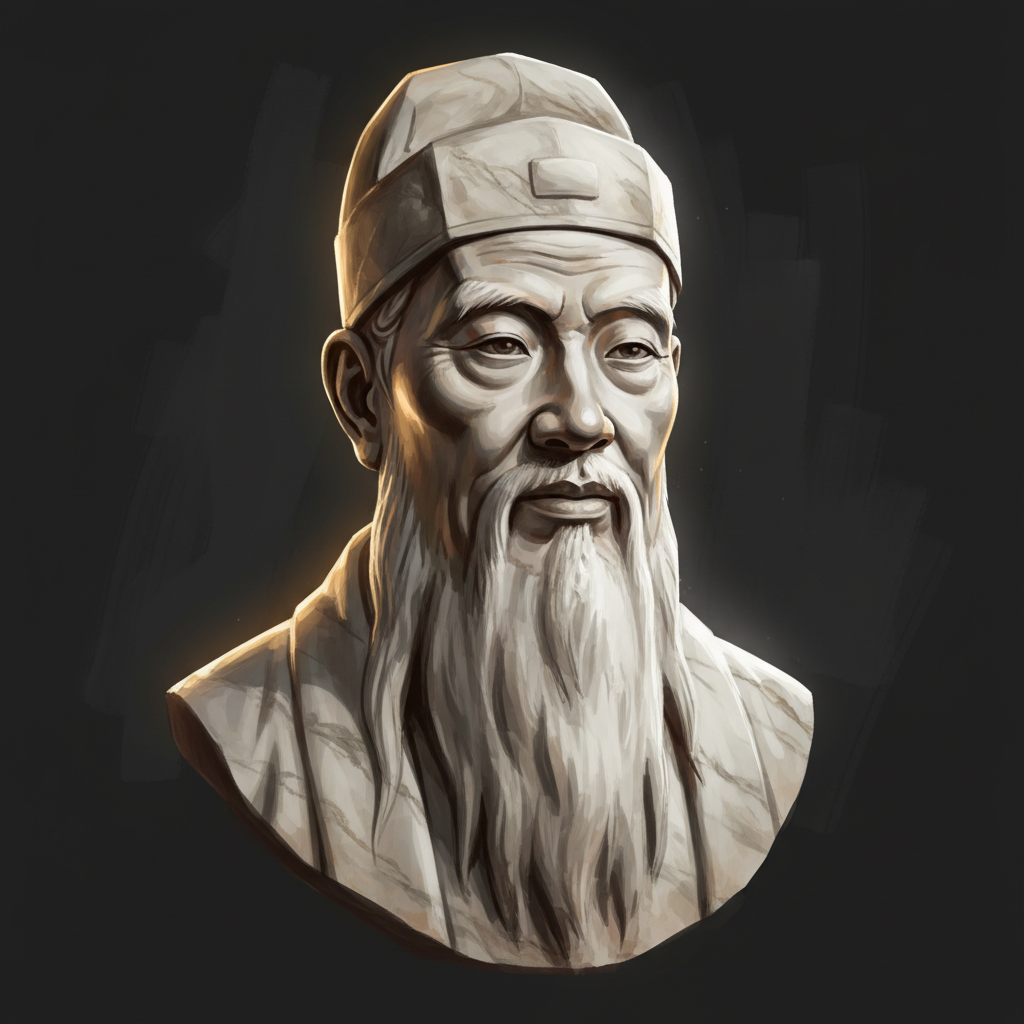
Confucius — "The cautious seldom err."
The cautious seldom err.
The cautious seldom err.
Click any product to generate a realistic preview. Up to 3 at a time.
* Initial load can take up to 90 seconds — revising the preview in another color is nearly instant.
"The student of virtue has no time for idleness."
"A man without constancy cannot be a diviner or a physician."
"The Master said, 'If the will be set on virtue, there will be no practice of wickedness.'"
"The superior man is satisfied and composed; the inferior man is always full of distress."
"The Master said, 'The student of virtue has no anxieties; the man of wisdom has no perplexities; the man of courage has no fears.'"
Chinese philosopher and teacher whose teachings (compiled by his students in the Analects) became the foundational ethical framework of East Asian civilization for 2,500 years. Closely associated with Mencius (his most-influential follower a century later). For an intellectual contrast, see Laozi, near-contemporary Chinese sage and Tao Te Ching author — Confucius systematized social order through ritual and family hierarchy; Laozi's Taoist effortless-action philosophy argued such systems were the disease, not the cure. The two founding poles of Chinese moral philosophy — every East Asian moral tradition since has positioned itself between them.
The standard scholarly entry points to Confucius's work: Philip J. Ivanhoe (Georgetown, Chinese philosophy) — Confucian Moral Self Cultivation (2000); Edward Slingerland (UBC, Asian Studies) — Effortless Action: Wu-wei as Conceptual Metaphor (2003); Tu Weiming (Harvard, Confucian scholar) — Confucian Thought: Selfhood as Creative Transformation (1985). These are the works graduate seminars cite when teaching Confucius.
Found in 1 providers: grok
1 source checked
Being careful and thoughtful before acting tends to keep you out of trouble. People who pause, weigh consequences, and avoid reckless choices make fewer mistakes than those who rush ahead impulsively. It is not a call to timidity but to deliberate judgment: check your footing, consider outcomes, and proceed only when you have reasonable grounds. Caution trades a little speed for a much lower failure rate.
Confucius spent his life advising rulers and training disciples in self-discipline, ritual propriety, and measured conduct. He prized the junzi, the exemplary person who governs speech and action with restraint, and repeatedly warned against hasty words and rash deeds. Having served briefly as a minister in Lu and seen careless officials ruin states, he treated prudence as a practical virtue essential to ethical leadership and personal cultivation alike.
Confucius lived during the late Spring and Autumn period (6th-5th century BCE), when the Zhou dynasty's authority had collapsed and rival states waged constant war, intrigue, and assassination. Ministers who spoke or acted carelessly could be executed or exiled overnight. In this volatile climate, caution was survival. Confucius's teachings on restraint, ritual, and careful conduct offered a stabilizing ethic for a fractured society sliding toward the even bloodier Warring States era.
AI-generated insights based on extensive research and information for context. Factual errors? Email [email protected].
Your cart is empty