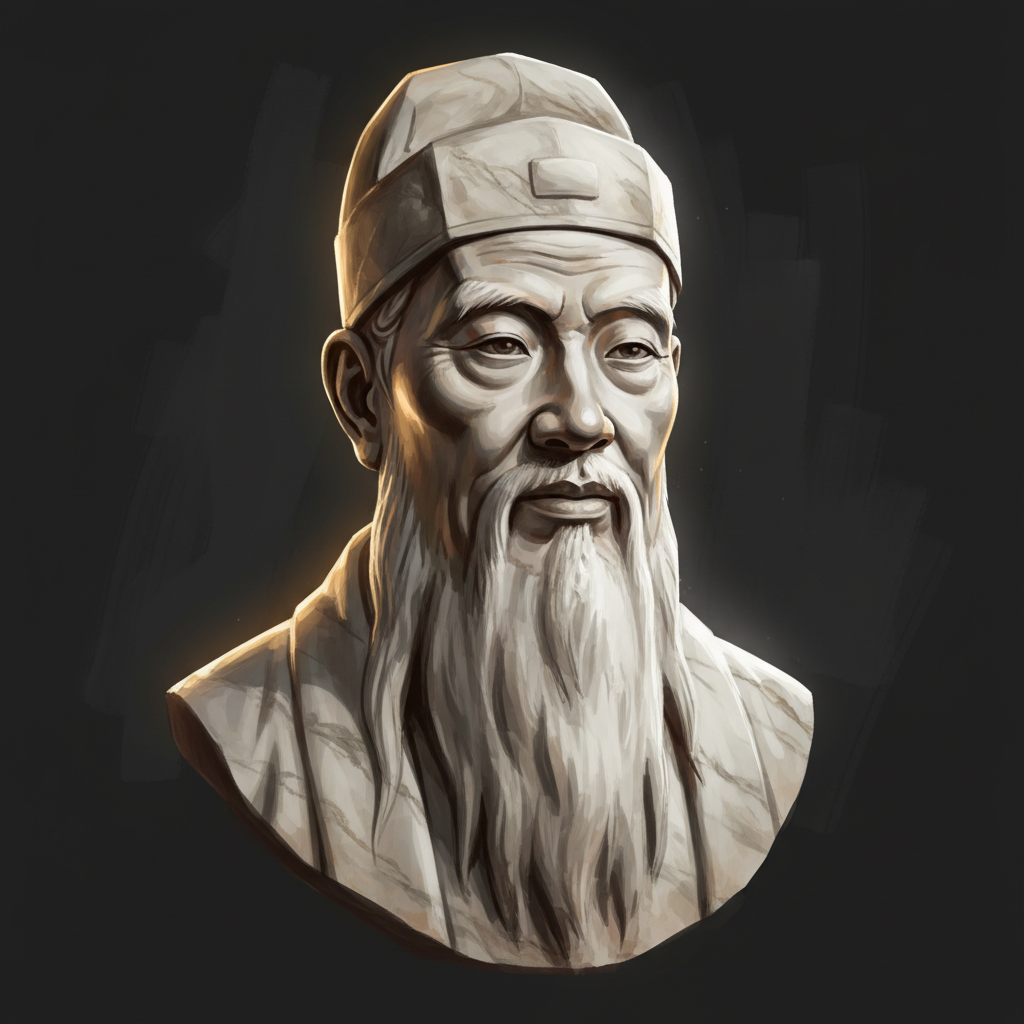
Confucius — "The gentleman concerns himself with the Way; he does not worry about his salary."
The gentleman concerns himself with the Way; he does not worry about his salary.
The gentleman concerns himself with the Way; he does not worry about his salary.
Click any product to generate a realistic preview. Up to 3 at a time.
* Initial load can take up to 90 seconds — revising the preview in another color is nearly instant.
"The Master said, 'Riches and honors are what men desire. If they cannot be obtained in the proper way, they should not be held. Poverty and meanness are what men dislike. If they cannot be avoided in …"
"Is humanity far away? Whenever I want the virtue of humanity, it comes at once."
"Before you embark on a journey of revenge, dig two graves."
"What the gentleman wants is in himself, what the small man wants is in others."
"It is man that can make the Way great, and not the Way that can make man great."
Chinese philosopher and teacher whose teachings (compiled by his students in the Analects) became the foundational ethical framework of East Asian civilization for 2,500 years. Closely associated with Mencius (his most-influential follower a century later). For an intellectual contrast, see Laozi, near-contemporary Chinese sage and Tao Te Ching author — Confucius systematized social order through ritual and family hierarchy; Laozi's Taoist effortless-action philosophy argued such systems were the disease, not the cure. The two founding poles of Chinese moral philosophy — every East Asian moral tradition since has positioned itself between them.
The standard scholarly entry points to Confucius's work: Philip J. Ivanhoe (Georgetown, Chinese philosophy) — Confucian Moral Self Cultivation (2000); Edward Slingerland (UBC, Asian Studies) — Effortless Action: Wu-wei as Conceptual Metaphor (2003); Tu Weiming (Harvard, Confucian scholar) — Confucian Thought: Selfhood as Creative Transformation (1985). These are the works graduate seminars cite when teaching Confucius.
Found in 1 providers: gemini
1 source checked
A person of true character focuses on doing what is right and pursuing meaningful principles rather than obsessing over money or material rewards. If you commit yourself to living well and working with integrity, financial security tends to follow as a byproduct. The priority is inner development and ethical purpose, not chasing a paycheck or measuring success through income alone.
Confucius lived this principle directly, wandering between states for over a decade seeking rulers who would adopt his ethical teachings, often in poverty. He famously praised his student Yan Hui for remaining joyful despite eating simple food and living in a shabby alley. Confucius treated teaching as a moral calling, accepting students regardless of wealth, and prioritized cultivating virtue over securing lucrative government positions.
During the Spring and Autumn period (roughly 771-476 BCE), the Zhou dynasty was fracturing into warring states where officials frequently switched loyalties for better pay and status. Corruption, bribery, and opportunism defined court life. Confucius pushed back against this climate by insisting scholar-officials should serve the Way, meaning proper moral order, rather than treat government posts as mere career ladders for personal enrichment.
AI-generated insights based on extensive research and information for context. Factual errors? Email [email protected].
Your cart is empty