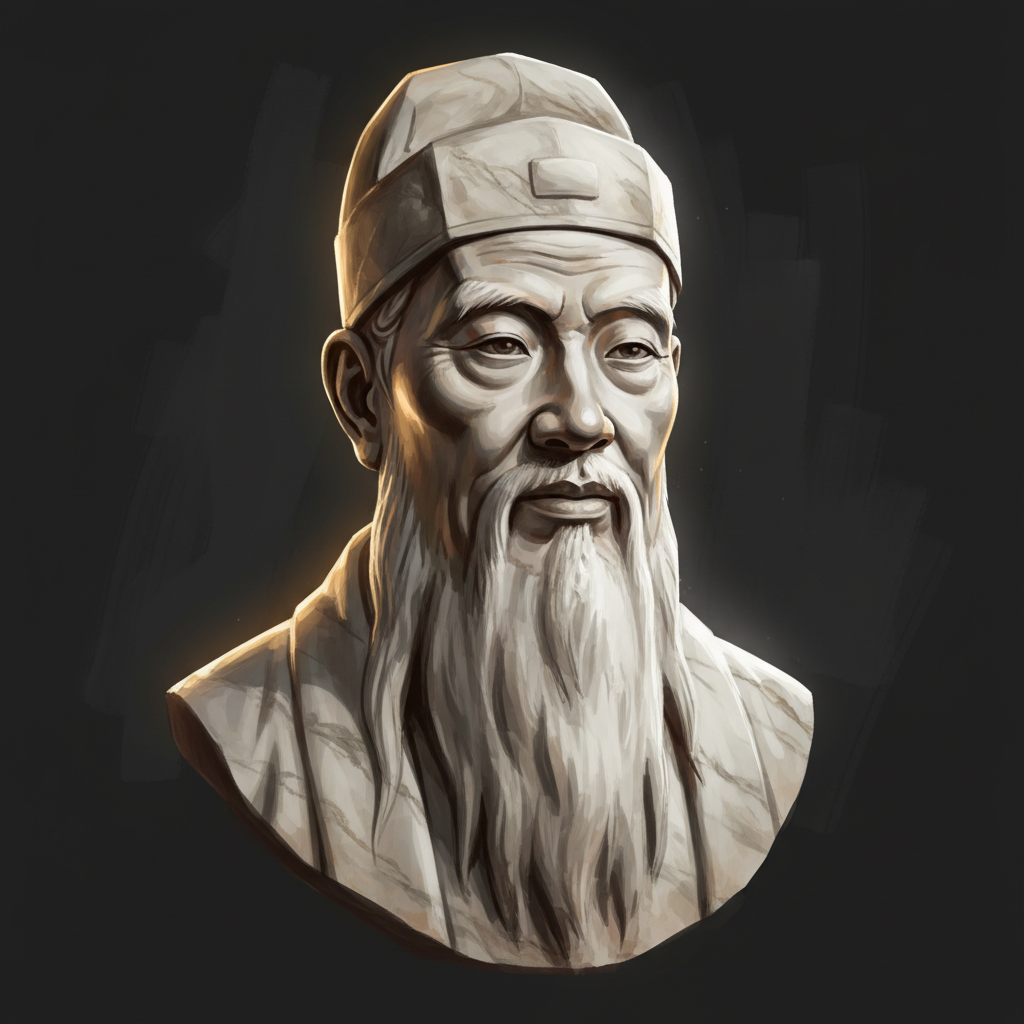
Confucius — "A good man is not a complete vessel."
A good man is not a complete vessel.
A good man is not a complete vessel.
Click any product to generate a realistic preview. Up to 3 at a time.
* Initial load can take up to 90 seconds — revising the preview in another color is nearly instant.
"The superior man is slow in speech but quick in action."
"I have not seen a man who loves benevolence, or one who hates what is not benevolent. A man who loves benevolence will not place anything above it. A man who hates what is not benevolent will practice…"
"Fix your mind on truth, hold firm to virtue, rely on loving kindness, and find your recreation in the Arts."
"The superior man is easy to serve but difficult to please; the inferior man is difficult to serve but easy to please."
"The superior man is distressed by his want of ability; he is not distressed by men’s not knowing him."
Chinese philosopher and teacher whose teachings (compiled by his students in the Analects) became the foundational ethical framework of East Asian civilization for 2,500 years. Closely associated with Mencius (his most-influential follower a century later). For an intellectual contrast, see Laozi, near-contemporary Chinese sage and Tao Te Ching author — Confucius systematized social order through ritual and family hierarchy; Laozi's Taoist effortless-action philosophy argued such systems were the disease, not the cure. The two founding poles of Chinese moral philosophy — every East Asian moral tradition since has positioned itself between them.
The standard scholarly entry points to Confucius's work: Philip J. Ivanhoe (Georgetown, Chinese philosophy) — Confucian Moral Self Cultivation (2000); Edward Slingerland (UBC, Asian Studies) — Effortless Action: Wu-wei as Conceptual Metaphor (2003); Tu Weiming (Harvard, Confucian scholar) — Confucian Thought: Selfhood as Creative Transformation (1985). These are the works graduate seminars cite when teaching Confucius.
Analects 2.12 (often translated as 'The superior man is not a tool')
Date: c. 5th century BCE
WisdomFound in 1 providers: grok
1 source checked
A truly good person isn't a single-purpose tool, limited to one function or skill. Instead, they cultivate broad character, wisdom, and adaptability that transcends any specific role. Unlike a vessel made to hold just one thing, a person of virtue brings judgment, humanity, and moral insight to any situation they encounter. Excellence of character means rising above narrow specialization to become someone capable of acting rightly across all of life's varied demands.
Confucius spent his life training students to become junzi, or exemplary persons, rather than mere technicians seeking office. He personally studied ritual, music, archery, charioteering, calligraphy, and mathematics, rejecting narrow expertise. Having served briefly as a minister in Lu before wandering for decades teaching ethics, he valued moral cultivation over specialized skill. This saying captures his core belief that education should shape whole human beings, not produce bureaucratic instruments.
During the Spring and Autumn period, the Zhou dynasty's authority was collapsing and warring states competed ruthlessly for power. Rulers increasingly hired specialists—legal experts, military tacticians, diplomats—as interchangeable tools for statecraft. Confucius rejected this reductive view, insisting that governance required morally cultivated persons, not functional instruments. Amid social chaos, hereditary aristocracy decaying, and ritual tradition fracturing, his vision of broad virtue offered an alternative foundation for restoring order through character rather than mere utility.
AI-generated insights based on extensive research and information for context. Factual errors? Email [email protected].
Your cart is empty