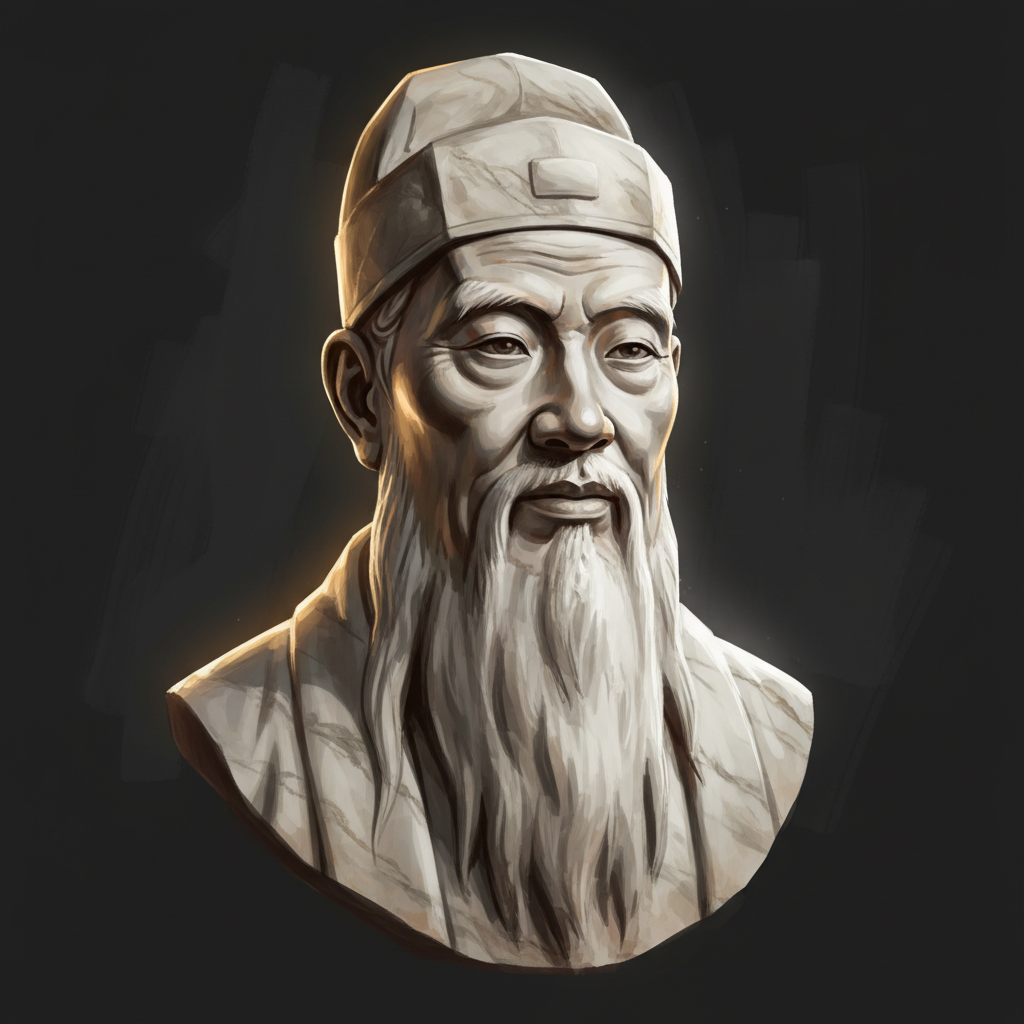
Confucius — "The gentleman reveres three things. He reveres the mandate of Heaven; he reveres…"
The gentleman reveres three things. He reveres the mandate of Heaven; he reveres great people; and he reveres the words of sages.
The gentleman reveres three things. He reveres the mandate of Heaven; he reveres great people; and he reveres the words of sages.
Click any product to generate a realistic preview. Up to 3 at a time.
* Initial load can take up to 90 seconds — revising the preview in another color is nearly instant.
"When you see a good person, think of becoming like her/him. When you see someone not so good, reflect on your own weak points."
"The Master said, 'A man may be able to recite the three hundred odes, but if, when entrusted with a governmental charge, he knows not how to act, or if, when sent to any quarter on a mission, he canno…"
"First he behaves properly and then he speaks, so that his words follow his actions."
"The superior man is easy to serve and difficult to please."
"It is not possible for one to be a gentleman and yet not be benevolent."
Chinese philosopher and teacher whose teachings (compiled by his students in the Analects) became the foundational ethical framework of East Asian civilization for 2,500 years. Closely associated with Mencius (his most-influential follower a century later). For an intellectual contrast, see Laozi, near-contemporary Chinese sage and Tao Te Ching author — Confucius systematized social order through ritual and family hierarchy; Laozi's Taoist effortless-action philosophy argued such systems were the disease, not the cure. The two founding poles of Chinese moral philosophy — every East Asian moral tradition since has positioned itself between them.
The standard scholarly entry points to Confucius's work: Philip J. Ivanhoe (Georgetown, Chinese philosophy) — Confucian Moral Self Cultivation (2000); Edward Slingerland (UBC, Asian Studies) — Effortless Action: Wu-wei as Conceptual Metaphor (2003); Tu Weiming (Harvard, Confucian scholar) — Confucian Thought: Selfhood as Creative Transformation (1985). These are the works graduate seminars cite when teaching Confucius.
From a teaching on the reverence of a gentleman (Analects 16.8)
Date: c. 551-479 BCE
PhilosophicalFound in 1 providers: gemini
1 source checked
A person of genuine moral character holds three sources of authority in deep respect: the natural order and moral law governing existence, individuals whose wisdom and virtue have earned them standing, and the accumulated teachings of those who came before. Humility before these forces keeps someone grounded, teachable, and aware that personal judgment alone is insufficient. Rejecting any of them leads to arrogance, recklessness, and moral drift.
Confucius spent his life teaching that self-cultivation required submission to something larger than oneself. As a scholar who studied ancient rituals and revered the Duke of Zhou, he modeled this reverence daily. He distinguished the junzi (gentleman) from the petty person precisely by this capacity for awe. His career advising rulers and training disciples depended on transmitting, not inventing, the wisdom of sage-kings like Yao and Shun.
Confucius lived during the Spring and Autumn period (551-479 BCE), when Zhou dynasty authority was collapsing and rival states fought constantly. Traditional rituals, hereditary hierarchies, and belief in Heaven's mandate were eroding as warlords seized power through force rather than virtue. Confucius saw this breakdown of reverence as the root cause of social chaos. Reaffirming deference to Heaven, worthy leaders, and ancestral wisdom was his prescription for restoring a fractured civilization.
AI-generated insights based on extensive research and information for context. Factual errors? Email [email protected].
Your cart is empty