Confucius — "When the wind blows, the grass bends."
When the wind blows, the grass bends.
When the wind blows, the grass bends.
Click any product to generate a realistic preview. Up to 3 at a time.
* Initial load can take up to 90 seconds — revising the preview in another color is nearly instant.
"Attack the evil that is within yourself, rather than attacking the evil that is in others."
"If the mechanic wishes to do his work well, he must first sharpen his tools."
"A good man is not a complete vessel."
"The man who moves a mountain begins by carrying away small stones."
"The superior man understands what is right; the inferior man understands what will sell."
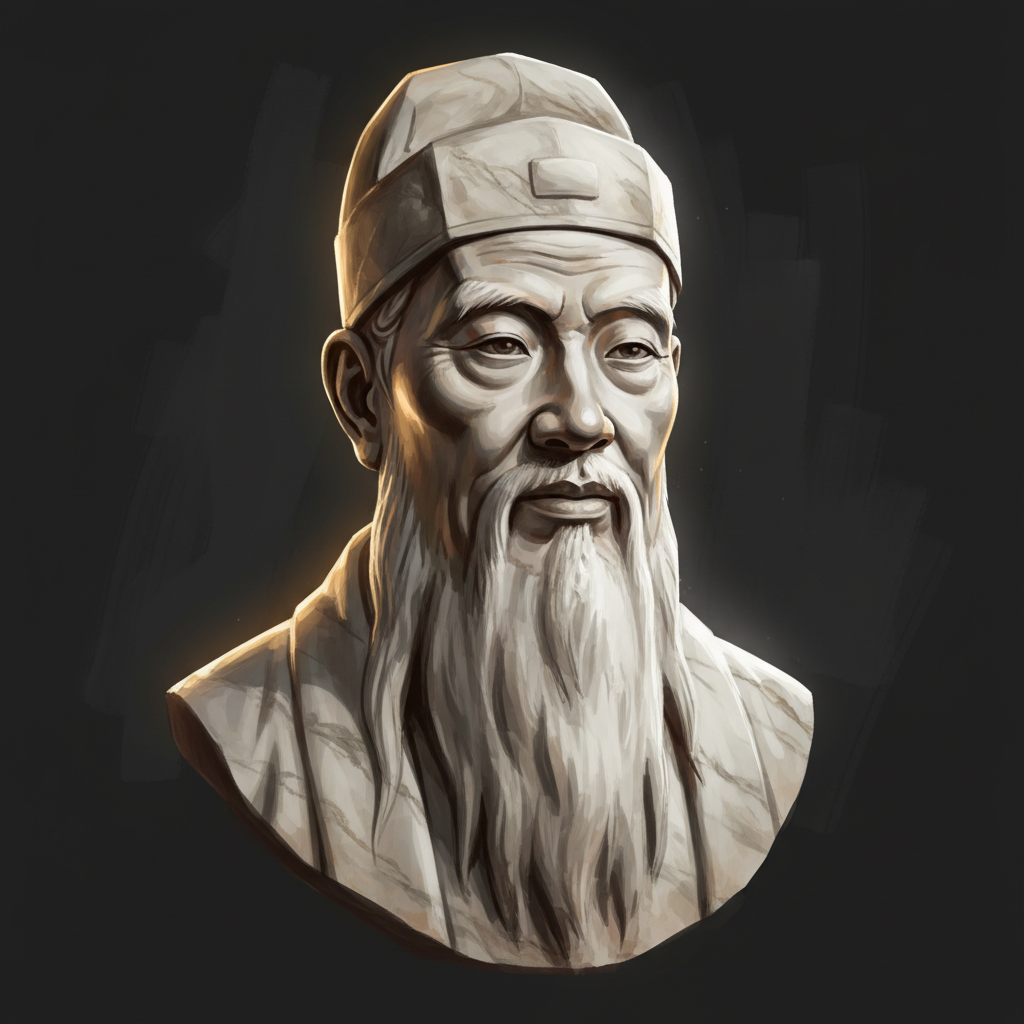
Chinese philosopher and teacher whose teachings (compiled by his students in the Analects) became the foundational ethical framework of East Asian civilization for 2,500 years. Closely associated with Mencius (his most-influential follower a century later). For an intellectual contrast, see Laozi, near-contemporary Chinese sage and Tao Te Ching author — Confucius systematized social order through ritual and family hierarchy; Laozi's Taoist effortless-action philosophy argued such systems were the disease, not the cure. The two founding poles of Chinese moral philosophy — every East Asian moral tradition since has positioned itself between them.
The standard scholarly entry points to Confucius's work: Philip J. Ivanhoe (Georgetown, Chinese philosophy) — Confucian Moral Self Cultivation (2000); Edward Slingerland (UBC, Asian Studies) — Effortless Action: Wu-wei as Conceptual Metaphor (2003); Tu Weiming (Harvard, Confucian scholar) — Confucian Thought: Selfhood as Creative Transformation (1985). These are the works graduate seminars cite when teaching Confucius.
From a teaching on the influence of leadership or circumstance
Date: c. 551-479 BCE
PhilosophicalFound in 1 providers: gemini
1 source checked
Ordinary people naturally follow the example set by those in power. When leaders act with integrity, their subjects mirror that behavior; when leaders are corrupt or careless, society bends the same way. Influence flows downward from authority, so the character of those at the top quietly shapes the conduct of everyone beneath them. Leadership is less about commands than about the moral atmosphere a ruler creates.
Confucius spent his life advising rulers and training officials, convinced that good government started with the personal virtue of the leader rather than harsh laws. He repeatedly told dukes and ministers that if they cultivated themselves, the people would reform without coercion. This grass-and-wind image appears directly in the Analects, capturing his lifelong conviction that ethical example, not punishment, was the true engine of social order and stable rule.
Confucius lived during the late Spring and Autumn period, when the Zhou dynasty had fractured into warring states, rulers seized power by force, and traditional rituals were collapsing. Ordinary people suffered under unstable, often brutal lords. Against this chaos, Confucius argued that restoring order required rulers to model virtue rather than rely on armies and punishments. The grass-bending metaphor spoke directly to aristocrats whose daily choices determined whether their territories knew peace or violence.
AI-generated insights based on extensive research and information for context. Factual errors? Email [email protected].
Your cart is empty