Confucius — "Hold faithfulness and sincerity as first principles. Then no friends will be unl…"
Hold faithfulness and sincerity as first principles. Then no friends will be unlike yourself.
Hold faithfulness and sincerity as first principles. Then no friends will be unlike yourself.
Click any product to generate a realistic preview. Up to 3 at a time.
* Initial load can take up to 90 seconds — revising the preview in another color is nearly instant.
"To govern means to rectify. If you lead the people with correctness, who will dare not to be correct?"
"What the superior man seeks is in himself; what the small man seeks is in others."
"When you know a thing, to hold that you know it; and when you do not know a thing, to allow that you do not know it—this is knowledge."
"He who is not concerned about the distant future will find sorrow near at hand."
"The Master said, 'The superior man is firm in the right way, and not merely firm.'"
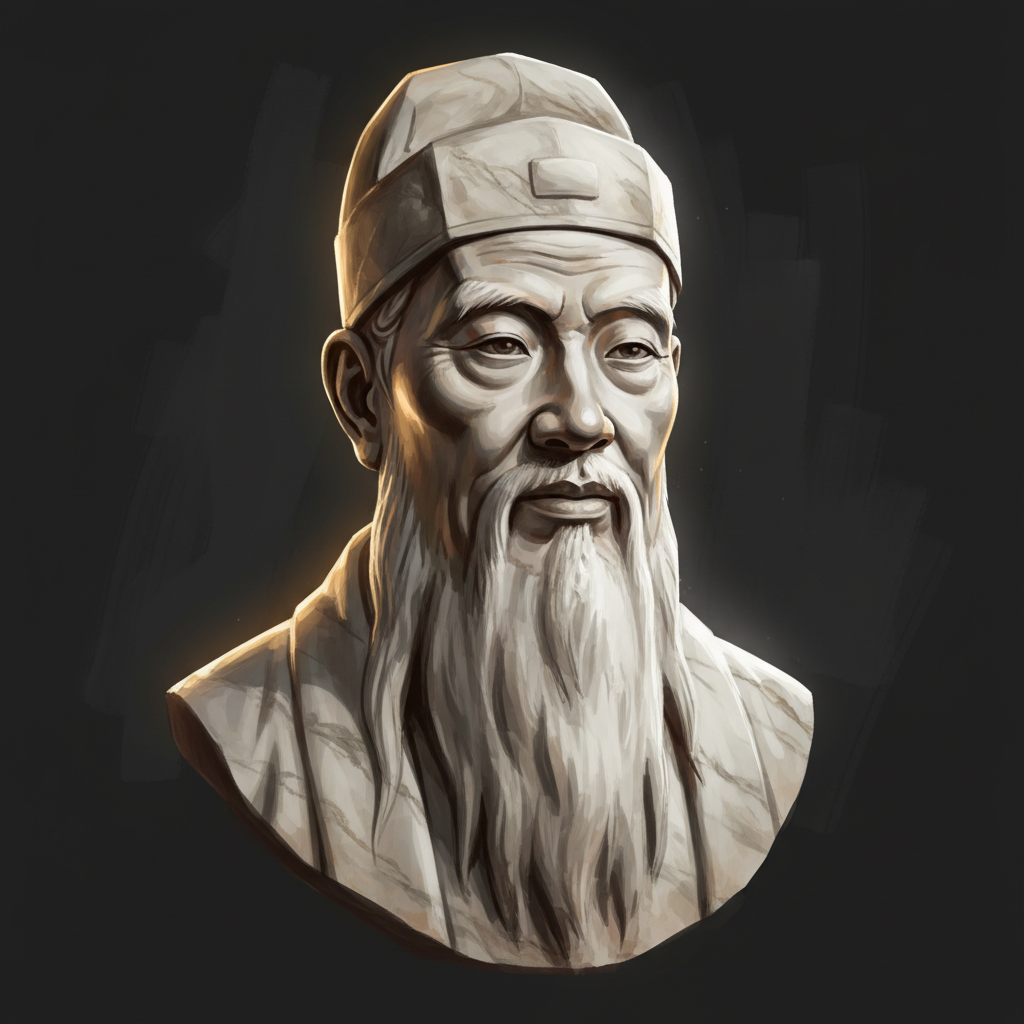
Chinese philosopher and teacher whose teachings (compiled by his students in the Analects) became the foundational ethical framework of East Asian civilization for 2,500 years. Closely associated with Mencius (his most-influential follower a century later). For an intellectual contrast, see Laozi, near-contemporary Chinese sage and Tao Te Ching author — Confucius systematized social order through ritual and family hierarchy; Laozi's Taoist effortless-action philosophy argued such systems were the disease, not the cure. The two founding poles of Chinese moral philosophy — every East Asian moral tradition since has positioned itself between them.
The standard scholarly entry points to Confucius's work: Philip J. Ivanhoe (Georgetown, Chinese philosophy) — Confucian Moral Self Cultivation (2000); Edward Slingerland (UBC, Asian Studies) — Effortless Action: Wu-wei as Conceptual Metaphor (2003); Tu Weiming (Harvard, Confucian scholar) — Confucian Thought: Selfhood as Creative Transformation (1985). These are the works graduate seminars cite when teaching Confucius.
From the Analects (1.8), on the importance of sincerity in friendship
Date: c. 551-479 BCE
PhilosophicalFound in 1 providers: gemini
1 source checked
Make honesty and genuine commitment the foundation of how you live. When you do, the people who stay close to you will share those same values, because you attract and keep company with those who match your standards. Dishonest or shallow people won't stick around someone anchored in integrity, and you won't tolerate them either. Your character acts as a filter for your relationships.
Confucius built his entire ethical system around ren (humaneness) and xin (trustworthiness), treating personal virtue as the root of social order. As a traveling teacher advising rulers, he saw firsthand how rare sincere officials were, and he taught disciples that cultivating inner character mattered more than status. This saying reflects his conviction that moral self-discipline naturally shapes one's circle and, ultimately, governance.
Confucius lived during the Spring and Autumn period (roughly 551–479 BCE), when the Zhou dynasty's authority was collapsing and rival states waged constant war. Loyalty oaths were broken, ministers betrayed lords, and opportunism thrived. Against this backdrop of political treachery, Confucius urged a return to ritual propriety and personal trustworthiness as the only stable foundation for friendship, family, and state.
AI-generated insights based on extensive research and information for context. Factual errors? Email [email protected].
Your cart is empty