Confucius — "The Master said, 'The superior man is firm in the right way, and not merely firm…"
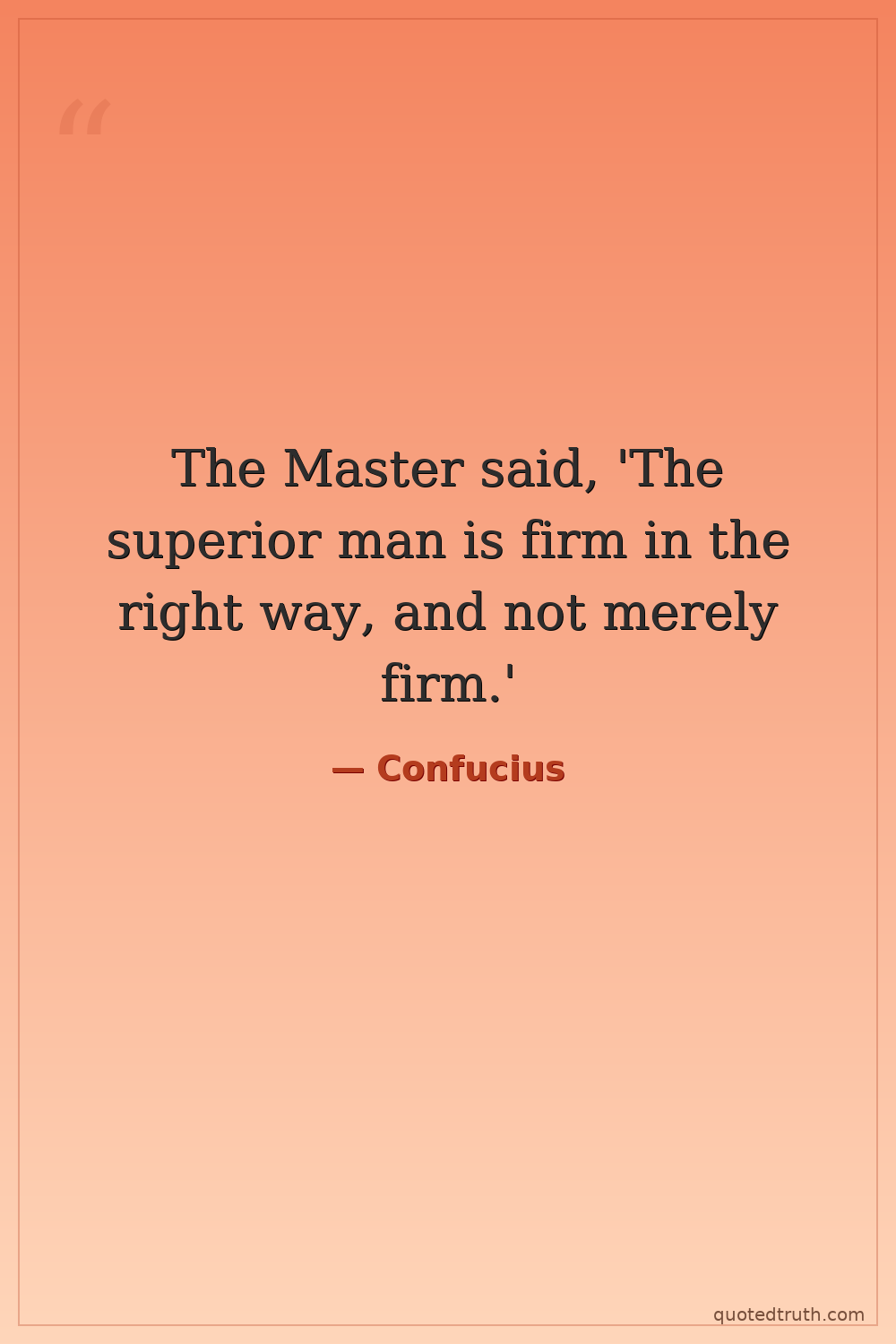
The Master said, 'The superior man is firm in the right way, and not merely firm.'
The Master said, 'The superior man is firm in the right way, and not merely firm.'
Click any product to generate a realistic preview. Up to 3 at a time.
* Initial load can take up to 90 seconds — revising the preview in another color is nearly instant.
"To go too far is as bad as to fall short."
"The superior man understands what is right; the inferior man understands what will sell."
"The wise find pleasure in water; the virtuous find pleasure in mountains. The wise are active; the virtuous are tranquil. The wise are joyful; the virtuous are long-lived."
"The superior man is satisfied and composed; the inferior man is always full of distress."
"Hold faithfulness and sincerity as first principles. Then no friends will be unlike yourself."
Chinese philosopher and teacher whose teachings (compiled by his students in the Analects) became the foundational ethical framework of East Asian civilization for 2,500 years. Closely associated with Mencius (his most-influential follower a century later). For an intellectual contrast, see Laozi, near-contemporary Chinese sage and Tao Te Ching author — Confucius systematized social order through ritual and family hierarchy; Laozi's Taoist effortless-action philosophy argued such systems were the disease, not the cure. The two founding poles of Chinese moral philosophy — every East Asian moral tradition since has positioned itself between them.
The standard scholarly entry points to Confucius's work: Philip J. Ivanhoe (Georgetown, Chinese philosophy) — Confucian Moral Self Cultivation (2000); Edward Slingerland (UBC, Asian Studies) — Effortless Action: Wu-wei as Conceptual Metaphor (2003); Tu Weiming (Harvard, Confucian scholar) — Confucian Thought: Selfhood as Creative Transformation (1985). These are the works graduate seminars cite when teaching Confucius.
Found in 2 providers: grok,deepseek
2 sources checked
Real integrity is not just stubbornness. Standing your ground only matters when the ground itself is right. A person of character commits firmly to what is just and true, but stays flexible and open to correction when they are wrong. Rigidity without moral grounding is simply obstinacy; true steadfastness is loyalty to principle, not to one's own position. Know what you stand for before you refuse to move.
Confucius spent his life distinguishing genuine virtue from its counterfeits, which is exactly what this saying does. As a teacher who wandered between feuding states seeking a ruler who would adopt ethical governance, he met many leaders who mistook pigheadedness for principle. His ideal junzi, or superior person, cultivated ren and yi, humaneness and righteousness, rather than mere willpower. He lived this himself by refusing office under corrupt rulers while remaining open to reform elsewhere.
Confucius lived during the Spring and Autumn period of the Zhou dynasty, around 551 to 479 BCE, when the old feudal order was collapsing into warring factions. Rulers clung stubbornly to power through cruelty and cunning, confusing force with virtue. Aristocratic codes were decaying, and many mistook ruthless resolve for leadership. Against this backdrop, Confucius insisted that moral character, not sheer obstinacy, should guide a gentleman, offering ethics as the foundation for restoring a broken society.
AI-generated insights based on extensive research and information for context. Factual errors? Email [email protected].
Your cart is empty