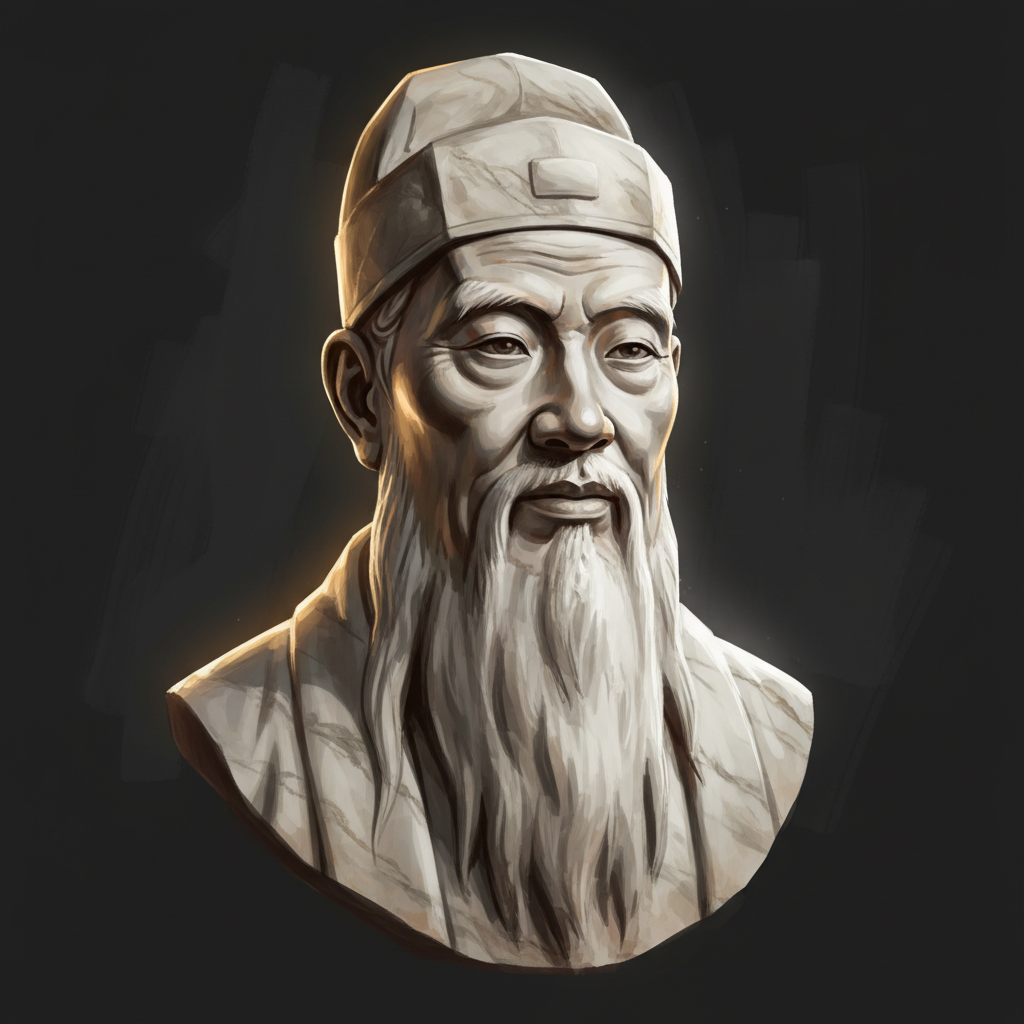
Confucius — "A journey of a thousand miles begins with a single step."
A journey of a thousand miles begins with a single step.
A journey of a thousand miles begins with a single step.
Click any product to generate a realistic preview. Up to 3 at a time.
* Initial load can take up to 90 seconds — revising the preview in another color is nearly instant.
"The Master said, 'It is not easy to find a man who has learned for three years without having his thoughts bent on learning.'"
"Respect yourself and others will respect you."
"He who is not concerned about the distant future will find sorrow near at hand."
"When you see a good person, think of becoming like her/him. When you see someone not so good, reflect on your own weak points."
"The superior man is distressed by his want of ability; he is not distressed by men’s not knowing him."
Chinese philosopher and teacher whose teachings (compiled by his students in the Analects) became the foundational ethical framework of East Asian civilization for 2,500 years. Closely associated with Mencius (his most-influential follower a century later). For an intellectual contrast, see Laozi, near-contemporary Chinese sage and Tao Te Ching author — Confucius systematized social order through ritual and family hierarchy; Laozi's Taoist effortless-action philosophy argued such systems were the disease, not the cure. The two founding poles of Chinese moral philosophy — every East Asian moral tradition since has positioned itself between them.
The standard scholarly entry points to Confucius's work: Philip J. Ivanhoe (Georgetown, Chinese philosophy) — Confucian Moral Self Cultivation (2000); Edward Slingerland (UBC, Asian Studies) — Effortless Action: Wu-wei as Conceptual Metaphor (2003); Tu Weiming (Harvard, Confucian scholar) — Confucian Thought: Selfhood as Creative Transformation (1985). These are the works graduate seminars cite when teaching Confucius.
Widely attributed to Laozi (Tao Te Ching), but sometimes also to Confucius in popular culture; however, its direct presence in the Analects is debated.
Date: c. 551-479 BCE (Attribution to Confucius is less certain than to Laozi)
PhilosophicalFound in 1 providers: gemini
1 source checked
Every large goal, no matter how overwhelming, starts with one small action. Progress is not made by staring at the full distance ahead but by taking the first concrete move, then another. The size of an ambition should not paralyze you; breaking it into immediate, doable steps turns something impossible into something inevitable. Start now, start small, and the rest follows through steady continuation.
Though often attributed to Confucius, this line traces to Laozi, a contemporary Daoist thinker. Still, it mirrors Confucius's own teaching method: cultivating virtue through daily rituals, study, and incremental self-improvement. He spent decades traveling between warring states seeking a ruler who would adopt his reforms, practicing the patient, step-by-step persistence the saying describes. His emphasis on learning as a lifelong, gradual discipline reflects the same philosophy.
Confucius lived during the late Spring and Autumn period (551-479 BCE), a time of collapsing Zhou authority, constant interstate warfare, and moral disorder. Philosophers competed to offer rulers a path back to stability. Against this chaos, teachings that emphasized patient, cumulative effort—rebuilding society through disciplined daily conduct rather than sweeping conquest—carried real weight. The metaphor of a long journey resonated in an era when scholars literally walked between kingdoms seeking audiences with rulers.
AI-generated insights based on extensive research and information for context. Factual errors? Email [email protected].
Your cart is empty