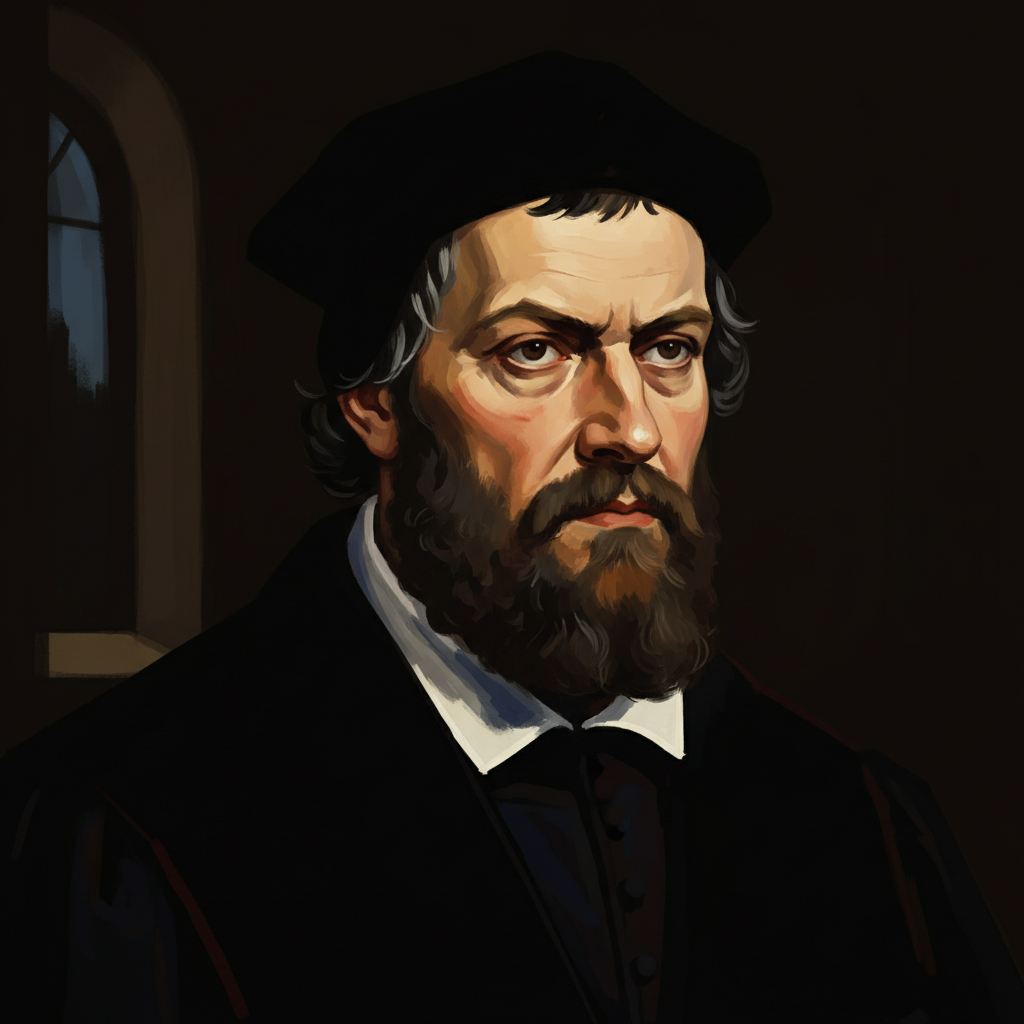
Martin Luther — "It does not matter what people DO; it only matters what they BELIEVE."
It does not matter what people DO; it only matters what they BELIEVE.
It does not matter what people DO; it only matters what they BELIEVE.
Click any product to generate a realistic preview. Up to 3 at a time.
* Initial load can take up to 90 seconds — revising the preview in another color is nearly instant.
"Christianity is nothing but a continual exercise in feeling that you have no sin although you sin, but that your sins are thrown on Christ."
"I am more afraid of my own heart than of the pope and all his cardinals. I have within me the great pope, Self."
"The stomach is the greatest lord on earth."
"If you want to change the world, pick up your pen."
"Reason is the Devil's greatest whore."
German theologian whose 95 Theses (1517) launched the Protestant Reformation and broke the Catholic Church's monopoly on Western Christianity. Closely associated with Philipp Melanchthon (Lutheran systematizer) and John Calvin (later Reformer who built on Luther's break). For an intellectual contrast, see Pope Leo X, Renaissance pope (1513-1521) — Leo X's indulgence sales triggered Luther's break and Leo excommunicated him in 1521 — Luther's entire Reformation is structured as a direct answer to the indulgence-funded Vatican Leo represented.
Found in 1 providers: gemini
1 source checked
Your actions and good deeds cannot earn you salvation or divine favor. What truly counts is inner faith and trust in God. A person can perform every charitable act imaginable, but without genuine belief, those works are spiritually empty. Conversely, someone with authentic faith is justified regardless of their track record. Salvation comes from conviction of the heart, not from a checklist of accomplishments or moral behavior that others can observe and measure.
Luther built his entire theological revolt around this idea, captured in his doctrine of sola fide, justification by faith alone. As an Augustinian monk tortured by scrupulosity, he found no peace through fasting, confession, or pilgrimage. His 1517 Ninety-Five Theses attacked indulgences precisely because they commodified works-righteousness. He translated Romans with this conviction, even inserting allein into Romans 3:28 to emphasize faith alone.
In the early modern era, the Catholic Church taught salvation through a combination of faith, sacraments, and meritorious works, including purchased indulgences funding St. Peter's Basilica. Tetzel's indulgence sales in Germany sparked Luther's 1517 protest. Printing presses spread his arguments across Europe within weeks, fracturing Western Christendom. This saying crystallized the theological earthquake dividing Protestants from Rome, fueling peasant revolts, princely realignments, and eventually the devastating Thirty Years' War.
AI-generated insights based on extensive research and information for context. Factual errors? Email [email protected].
Your cart is empty