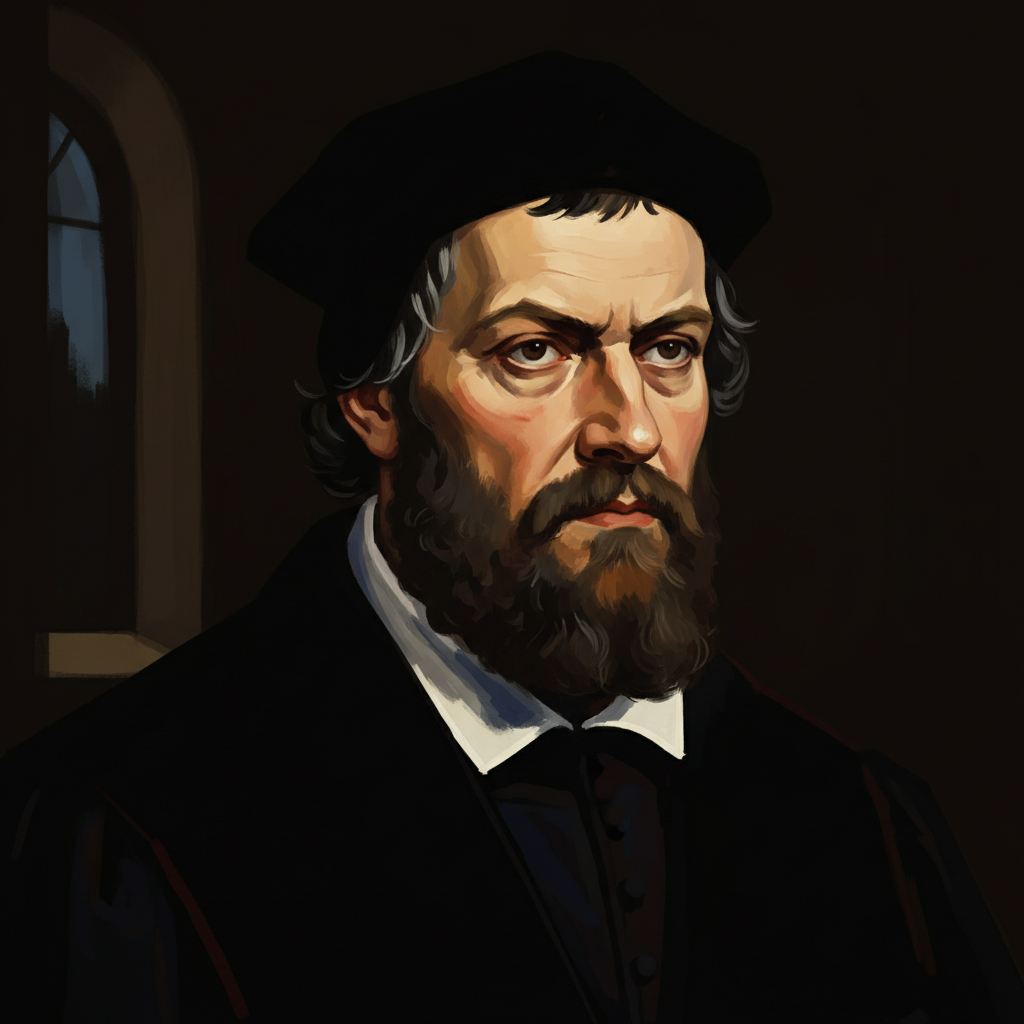
Martin Luther — "Whoever smells it first, out of him it crept."
Whoever smells it first, out of him it crept.
Whoever smells it first, out of him it crept.
Click any product to generate a realistic preview. Up to 3 at a time.
* Initial load can take up to 90 seconds — revising the preview in another color is nearly instant.
"When I am assailed by temptation, I merely eat and drink more, and laugh and joke, and so kill the thoughts."
"He who would be a Christian must be a Jew."
"Fifthly, passport and traveling privileges should be absolutely forbidden to the Jews. For they have no business in the countryside, since they are not farmers or craftsmen or merchants, but only usur…"
"God does many things that he does not disclose to us in his word; he also wills many things which he does not disclose himself as willing in his word. Thus he does not will the death of a sinner, acco…"
"The article of justification must be sounded in our ears incessantly because the frailty of our flesh will not permit us to take hold of it perfectly and to believe it with all our heart."
German theologian whose 95 Theses (1517) launched the Protestant Reformation and broke the Catholic Church's monopoly on Western Christianity. Closely associated with Philipp Melanchthon (Lutheran systematizer) and John Calvin (later Reformer who built on Luther's break). For an intellectual contrast, see Pope Leo X, Renaissance pope (1513-1521) — Leo X's indulgence sales triggered Luther's break and Leo excommunicated him in 1521 — Luther's entire Reformation is structured as a direct answer to the indulgence-funded Vatican Leo represented.
Found in 1 providers: gemini
1 source checked
This is a crude childhood saying suggesting that the person who first notices or announces a bad smell, particularly flatulence, is actually the one responsible for it. It flips accusation back onto the accuser, implying guilt lies with whoever draws attention to the offense. It captures a playful, deflective logic used to dodge blame by turning the act of detection itself into evidence of wrongdoing.
Luther was famously earthy and scatological, peppering sermons, table talk, and polemics against the Pope with bathroom humor and barnyard insults. Raised a miner's son in rural Saxony, he never abandoned peasant bluntness despite becoming a theologian. His Tischreden (Table Talk) brims with gas, dung, and bodily jokes, reflecting his belief that the Devil could be defeated through laughter and vulgarity rather than pious solemnity alone.
In early sixteenth-century Germany, coarse humor permeated all social classes, from tavern to university. Printing democratized pamphlet warfare, and Reformation-era polemics routinely deployed scatological woodcuts mocking opponents as defecating demons or farting monks. Personal hygiene was minimal, chamber pots common, and bodily functions openly discussed. Luther's peasant idiom resonated with ordinary readers who found Latin-drenched scholastic theology alienating, helping his vernacular Bible and tracts spread explosively through a newly literate public.
AI-generated insights based on extensive research and information for context. Factual errors? Email [email protected].
Your cart is empty