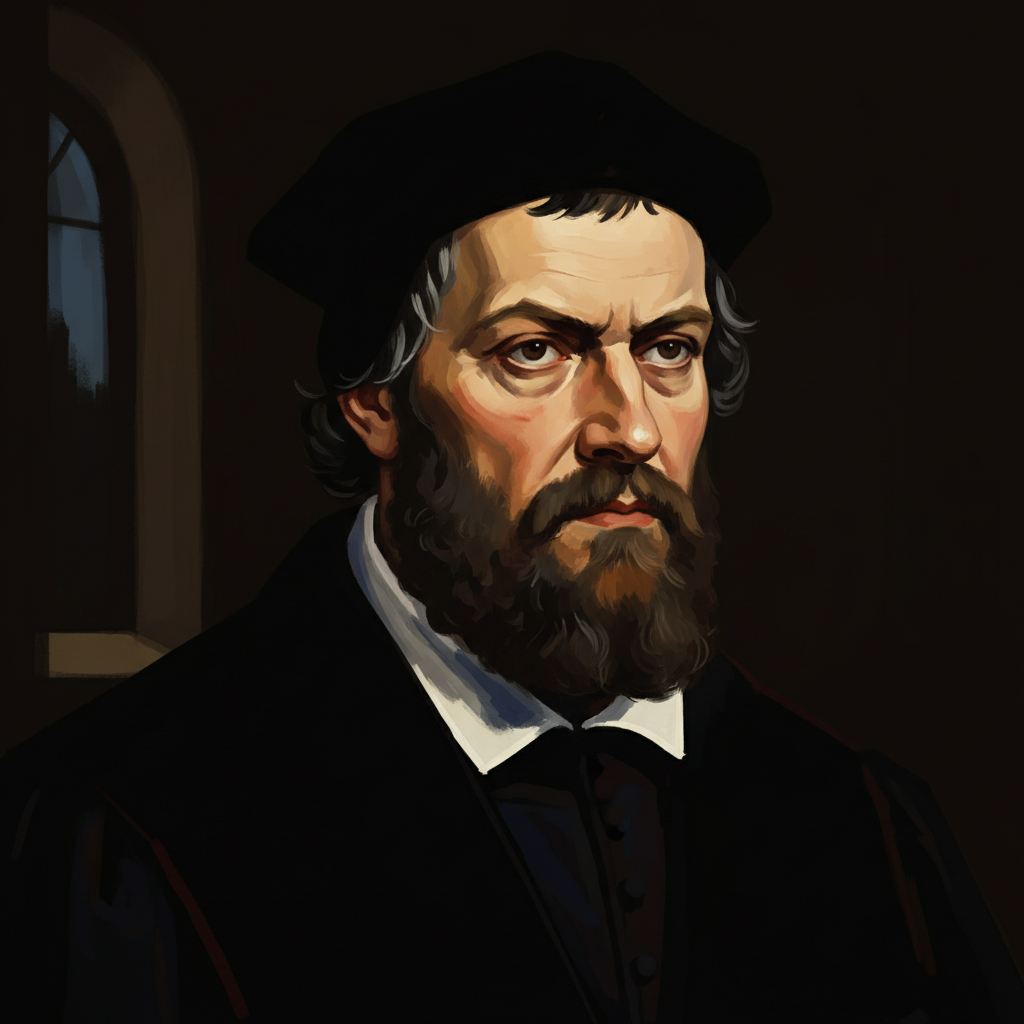
Martin Luther — "He who does not understand the devil, does not understand God."
He who does not understand the devil, does not understand God.
He who does not understand the devil, does not understand God.
Click any product to generate a realistic preview. Up to 3 at a time.
* Initial load can take up to 90 seconds — revising the preview in another color is nearly instant.
"Every man must do two things alone; he must do his own believing and his own dying."
"If I had to baptize a Jew, I would take him to the bridge of the Elbe, hang a stone around his neck and push him over with the words 'I baptize thee in the name of Abraham.'"
"Nor let ministers cease studying until they have discovered and are sure that they have taught the devil to death and have become more learned than God himself and all His saints."
"You are not yet a master of the Scriptures. You will find that out when you try to preach."
"Burn down their synagogues, forbid all that I enumerated earlier, force them to work, and deal with them with utmost severity, as Moses did in the wilderness, when he slew three thousand... for if we …"
German theologian whose 95 Theses (1517) launched the Protestant Reformation and broke the Catholic Church's monopoly on Western Christianity. Closely associated with Philipp Melanchthon (Lutheran systematizer) and John Calvin (later Reformer who built on Luther's break). For an intellectual contrast, see Pope Leo X, Renaissance pope (1513-1521) — Leo X's indulgence sales triggered Luther's break and Leo excommunicated him in 1521 — Luther's entire Reformation is structured as a direct answer to the indulgence-funded Vatican Leo represented.
Found in 2 providers: gemini,grok
2 sources checked
To truly know good, you must also recognize evil. Understanding God requires awareness of the forces that oppose Him, because faith is tested and defined through that opposition. Ignoring the reality of evil leaves a shallow, incomplete picture of the divine. Only by grasping temptation, deception, and spiritual struggle can a person appreciate grace, truth, and redemption for what they actually are.
Luther wrote extensively about spiritual warfare and claimed personal encounters with the devil during his theological struggles at Wartburg Castle. His doctrine of salvation by faith alone hinged on recognizing human sinfulness and demonic temptation. As a former Augustinian monk turned reformer, he saw the Christian life as constant combat between God's grace and satanic deception, making this tension central to his theology.
In early modern Europe, belief in an active, personal devil permeated daily life. The 1520s Reformation unfolded amid plague, peasant revolts, and fears of witchcraft, with Luther challenging the Catholic Church's authority over salvation. Theologians debated the devil's role in corrupting institutions, and Luther cast the papacy itself as satanic. This dualistic worldview shaped politics, art, and religious reform across a fracturing Christendom.
AI-generated insights based on extensive research and information for context. Factual errors? Email [email protected].
Your cart is empty