What it means
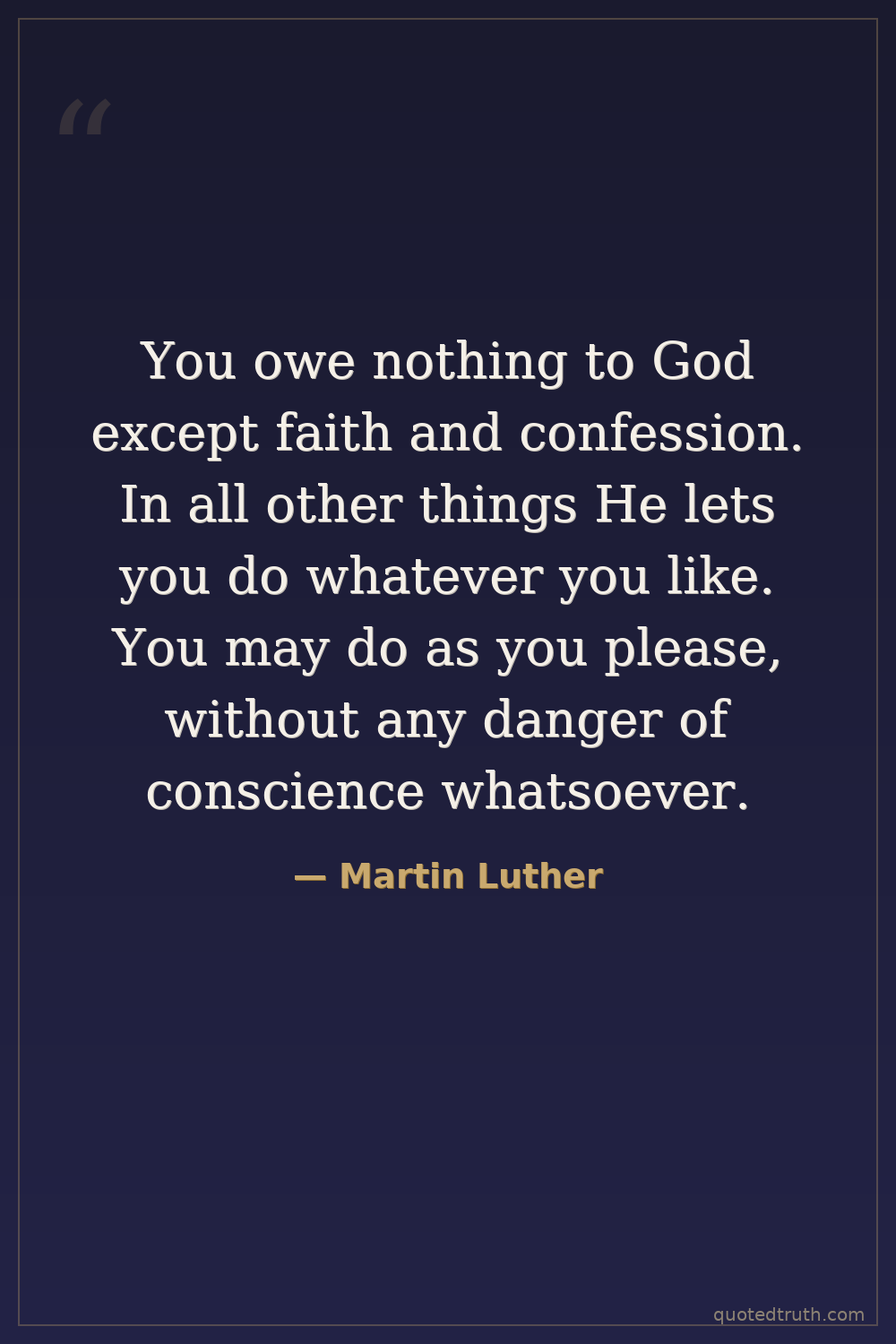
Your only real obligation to God is believing in Him and openly acknowledging that faith. Beyond those two things, you have complete freedom to live however you choose without worrying that ordinary decisions will condemn your soul. External rules, rituals, and religious duties aren't required to stay right with God. Faith alone secures your standing, leaving the rest of life as a realm of liberty where conscience need not be burdened by religious obligation.
Relevance to Martin Luther
This captures Luther's core doctrine of justification by faith alone, the theological hammer that shattered medieval Catholicism. As an Augustinian monk tormented by guilt over sins, Luther found liberation in Romans 1:17, concluding humans cannot earn salvation through works, penance, or indulgences. His 1517 Ninety-Five Theses attacked the church's sale of forgiveness. This quote distills his revolutionary claim that freed consciences from priestly control and relocated religious authority from Rome to personal faith.
The era
In early-sixteenth-century Europe, the Catholic Church monopolized salvation through sacraments, confession, pilgrimages, and indulgences sold to fund St. Peter's Basilica. Peasants lived under crushing spiritual anxiety and clerical authority. The printing press was spreading ideas rapidly, and humanist scholarship was questioning tradition. Luther's 1517 protest ignited the Protestant Reformation, fracturing Western Christendom, sparking peasant revolts, religious wars, and reshaping politics, literacy, and individual conscience across Germany and beyond for centuries.
AI-generated insights based on extensive research and information for context. Factual errors? Email [email protected].