Martin Luther — "The inner man cannot be forced to do out of his own free will, what he should do…"
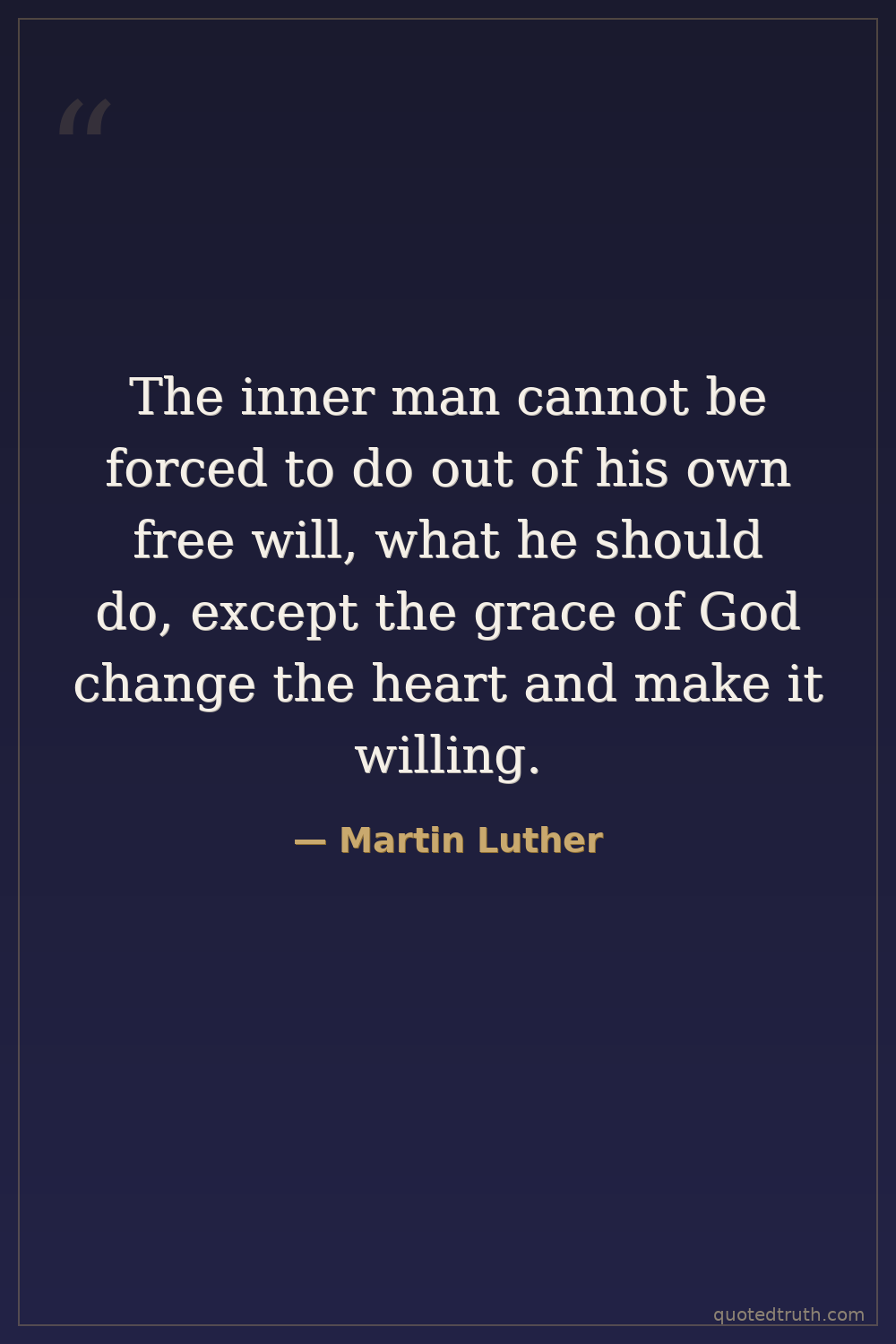
The inner man cannot be forced to do out of his own free will, what he should do, except the grace of God change the heart and make it willing.
The inner man cannot be forced to do out of his own free will, what he should do, except the grace of God change the heart and make it willing.
Click any product to generate a realistic preview. Up to 3 at a time.
* Initial load can take up to 90 seconds — revising the preview in another color is nearly instant.
"I would not give my faith for all the world's goods."
"They must be driven from our country."
"The church is not a pen-house but a mouth-house."
"The more you read the Bible, the more you will love it; the more you love it, the more you will read it."
"I am rough, boorish, stormy, and warlike. I am born to fight innately with innumerable monsters and devils."
German theologian whose 95 Theses (1517) launched the Protestant Reformation and broke the Catholic Church's monopoly on Western Christianity. Closely associated with Philipp Melanchthon (Lutheran systematizer) and John Calvin (later Reformer who built on Luther's break). For an intellectual contrast, see Pope Leo X, Renaissance pope (1513-1521) — Leo X's indulgence sales triggered Luther's break and Leo excommunicated him in 1521 — Luther's entire Reformation is structured as a direct answer to the indulgence-funded Vatican Leo represented.
Found in 1 providers: gemini
1 source checked
Real willingness cannot be coerced from the outside. You can force behavior, but you cannot force someone's inner desires, affections, or consent. Only a genuine change of heart produces authentic action, and Luther says that change is a gift from God, not something the person manufactures through willpower, discipline, or external pressure. The body obeys commands; the inner self responds only when something deeper shifts it.
This captures Luther's core theology of bondage of the will, which he defended against Erasmus in 1525. Luther insisted humans cannot will their way to righteousness; salvation comes by grace alone through faith, not merit or effort. As a former Augustinian monk who had exhausted himself chasing holiness through works, he knew firsthand that forced religious performance never produced real willingness. Only grace, he taught, rewrites the heart.
In early modern Europe, the Catholic Church taught salvation through sacraments, indulgences, and meritorious works, with coercive enforcement via inquisitions and excommunication. Luther's 1517 Ninety-Five Theses ignited the Reformation by challenging this machinery. Religious conformity was politically enforced across the Holy Roman Empire, yet reformers argued that forced conversion produced hypocrites, not Christians. This saying struck at both ecclesiastical coercion and the prevailing works-righteousness system Luther spent his life dismantling.
AI-generated insights based on extensive research and information for context. Factual errors? Email [email protected].
Your cart is empty