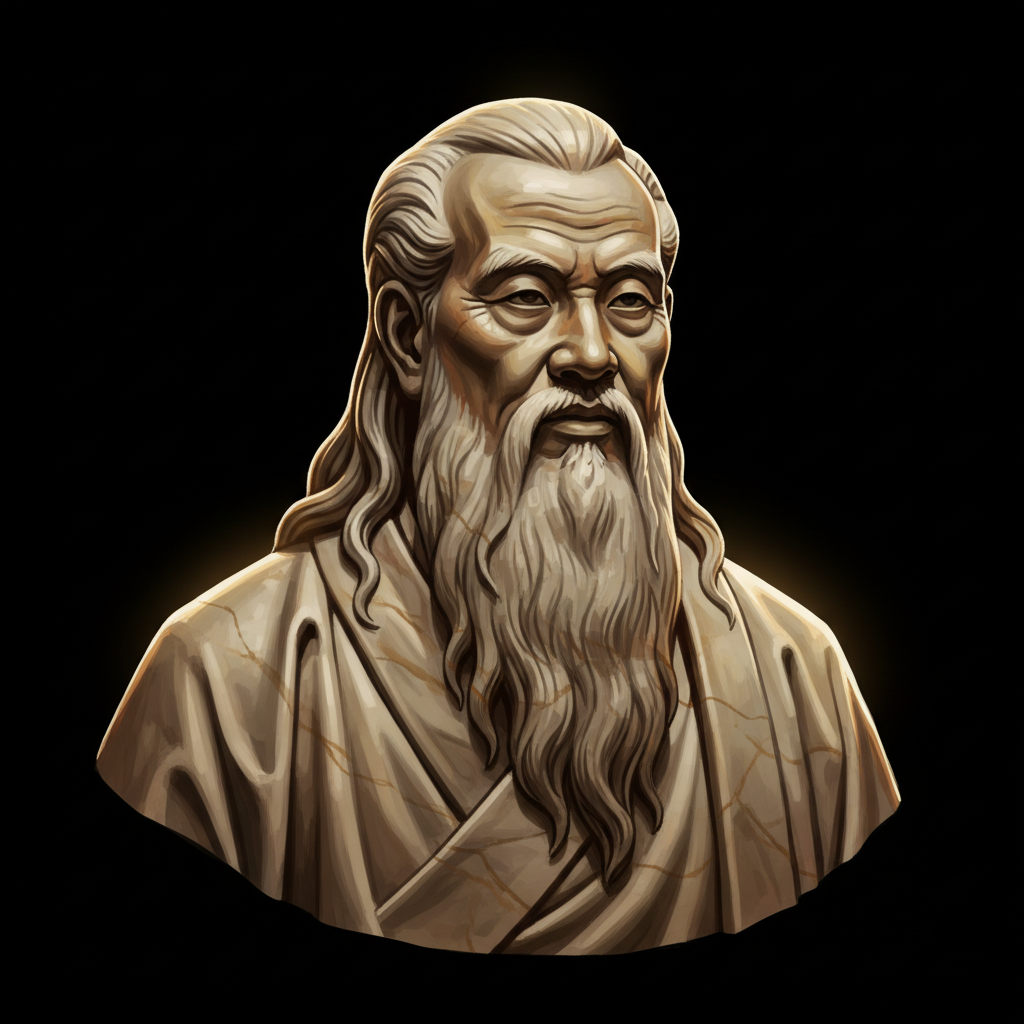
Laozi — "Do that which consists in taking no action; Pursue that which is not meddlesome;…"
Do that which consists in taking no action; Pursue that which is not meddlesome; Savor that which has no flavor.
Do that which consists in taking no action; Pursue that which is not meddlesome; Savor that which has no flavor.
Click any product to generate a realistic preview. Up to 3 at a time.
* Initial load can take up to 90 seconds — revising the preview in another color is nearly instant.
"Empty your mind of all thoughts. Let your heart be at peace. Watch the turmoil of the world, but let your serenity remain. Return to the root. This is tranquility. This is returning to your destiny."
"Great acts are made up of small deeds."
"The higher the sun rises, the less shadow it casts."
"The sage attends to the inner and not to the outer."
"The difficult is done easily; the easy is done with difficulty."
Reputed founder of Taoism and author of the Tao Te Ching, whose wu wei (effortless action) shaped East Asian philosophy. Closely associated with Zhuangzi (later Taoist who extended Laozi's framework). For an intellectual contrast, see Confucius, near-contemporary Chinese sage of social ritual and duty — Confucius systematized social order through ritual and hierarchy; Laozi argued that all such systems were the disease, not the cure — the two founding poles of Chinese moral philosophy.
Found in 1 providers: gemini
1 source checked
Act by not forcing things. Let events unfold according to their natural rhythm rather than pushing, scheming, or interfering. Take on tasks that don't require constant fiddling or control. Find depth in simple, unremarkable experiences instead of chasing intense stimulation. The point is that effort spent manipulating outcomes often backfires, while patient alignment with how things already move tends to produce better results with less strain.
Laozi built Taoism around wu wei, effortless action in harmony with the Dao. Tradition casts him as a keeper of royal archives who grew disillusioned with court ambition and withdrew westward, reportedly writing the Tao Te Ching at a border pass. This saying captures his signature move: rejecting striving, status, and sensory excess in favor of quiet alignment with nature's flow, the same ethic that supposedly drove his departure from public life.
Laozi lived during China's late Zhou period, an age of collapsing feudal order that fed into the Warring States chaos. Rival kingdoms fought constantly, and thinkers competed to advise rulers on control, law, and conquest. Confucians prescribed ritual and active governance. Against that noisy backdrop, counseling non-action, restraint, and contentment with plain things was a radical political and personal stance, offering rulers and citizens an exit from the era's exhausting cycle of ambition and war.
AI-generated insights based on extensive research and information for context. Factual errors? Email [email protected].
Your cart is empty