Laozi — "All things in the world come from being. And being comes from non-being."
All things in the world come from being. And being comes from non-being.
All things in the world come from being. And being comes from non-being.
Click any product to generate a realistic preview. Up to 3 at a time.
* Initial load can take up to 90 seconds — revising the preview in another color is nearly instant.
"No thought, no action, no movement, total stillness: only thus can one manifest the true nature and law of things... and at last become one with heaven and earth."
"The difficult is done easily; the easy is done with difficulty."
"When the world has the Tao, the swift horses are used for hauling manure. When the world is without the Tao, war horses are bred in the suburbs."
"The soft and the weak overcome the hard and the strong."
"The great square has no corners. The great vessel is never full. The great sound is inaudible. The great image has no form."
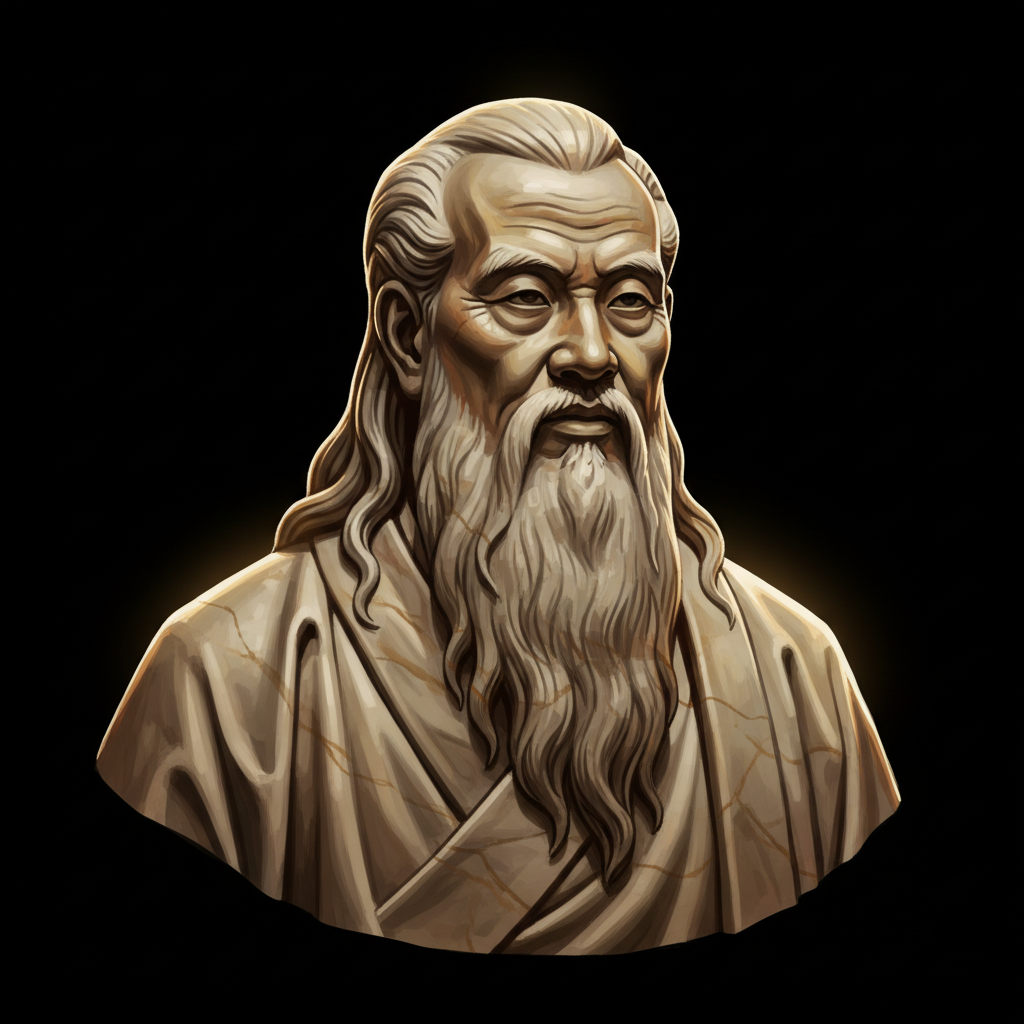
Reputed founder of Taoism and author of the Tao Te Ching, whose wu wei (effortless action) shaped East Asian philosophy. Closely associated with Zhuangzi (later Taoist who extended Laozi's framework). For an intellectual contrast, see Confucius, near-contemporary Chinese sage of social ritual and duty — Confucius systematized social order through ritual and hierarchy; Laozi argued that all such systems were the disease, not the cure — the two founding poles of Chinese moral philosophy.
Found in 1 providers: gemini
1 source checked
Everything you can see, touch, or name—every object, creature, and event—exists because it took some concrete form. But that form itself arose out of something formless, empty, and undefined. Before anything could be a specific thing, there had to be open, unshaped potential. Reality rests on a silent, invisible source that has no qualities of its own, yet gives rise to every particular thing we experience.
Laozi taught that the Tao, the ultimate source, is nameless and empty, yet fathers the ten thousand things. As the traditional author of the Tao Te Ching, he repeatedly praised the usefulness of emptiness—the hollow of a cup, the hub of a wheel. His reputed role as a reclusive archivist who withdrew from court life mirrors his preference for the unseen ground of things over the visible surface of ambition, status, and striving.
Laozi is placed in the late Zhou dynasty, a chaotic Warring States era of collapsing feudal order, constant warfare, and competing schools like Confucianism and Legalism all prescribing activist fixes. Against their emphasis on ritual, law, and named hierarchies, his teaching pointed back to a prior, unnamed source. Ancient Chinese cosmology was wrestling with origins—how order arose from primordial chaos—and his answer, that being springs from non-being, became foundational for Taoist thought.
AI-generated insights based on extensive research and information for context. Factual errors? Email [email protected].
Your cart is empty