Laozi — "He who knows that enough is enough will always have enough."
He who knows that enough is enough will always have enough.
He who knows that enough is enough will always have enough.
Click any product to generate a realistic preview. Up to 3 at a time.
* Initial load can take up to 90 seconds — revising the preview in another color is nearly instant.
"People fail at the threshold of success. Be as cautious at the end as at the beginning. Then there will be no failure."
"The truth is not always beautiful, nor beautiful words the truth."
"The whole world knows that the good is good, and this is how evil arises. The whole world knows that the beautiful is beautiful, and this is how ugliness arises."
"The more you know, the less you understand."
"By letting it go it all gets done. The world is won by those who let it go. But when you try and try. The world is beyond the winning."
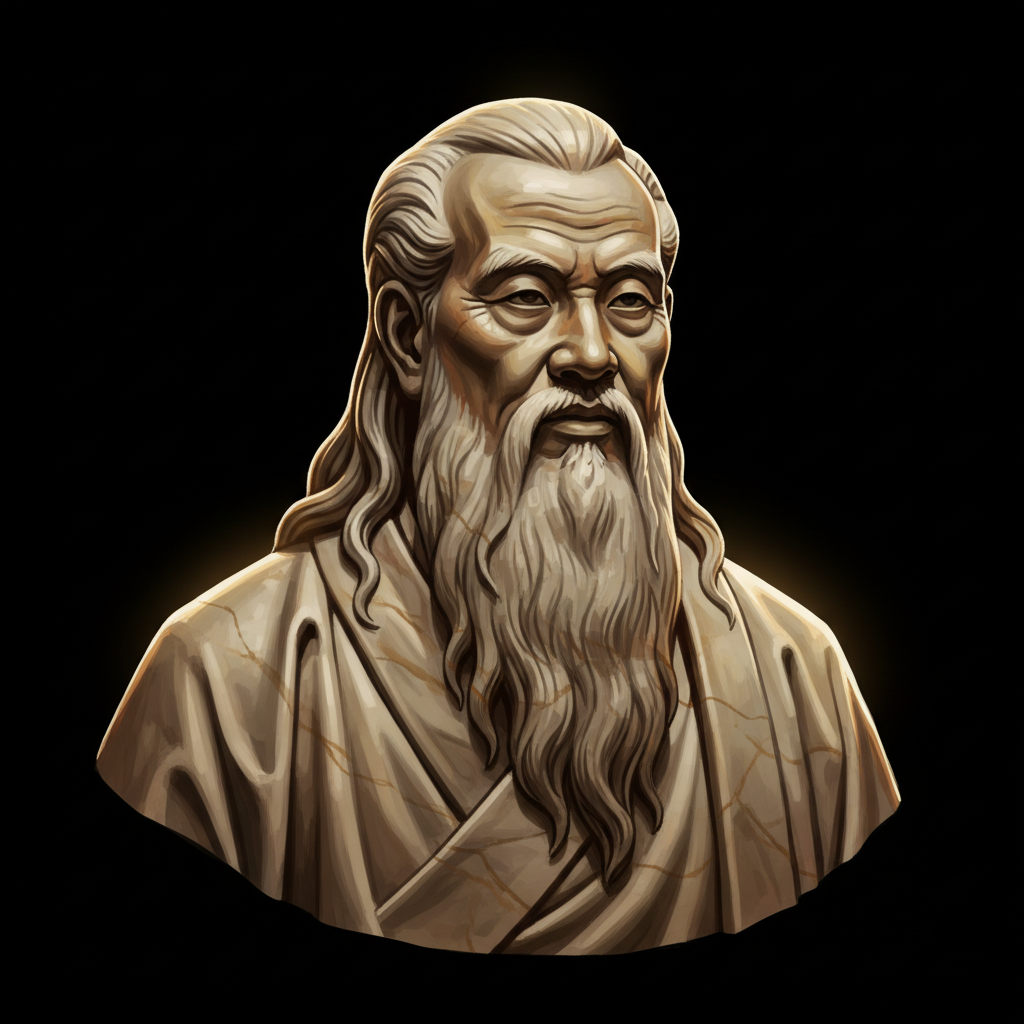
Reputed founder of Taoism and author of the Tao Te Ching, whose wu wei (effortless action) shaped East Asian philosophy. Closely associated with Zhuangzi (later Taoist who extended Laozi's framework). For an intellectual contrast, see Confucius, near-contemporary Chinese sage of social ritual and duty — Confucius systematized social order through ritual and hierarchy; Laozi argued that all such systems were the disease, not the cure — the two founding poles of Chinese moral philosophy.
Found in 2 providers: gemini,grok
2 sources checked
Contentment is a mindset, not a condition of wealth. The moment you recognize that what you already possess satisfies your actual needs, scarcity disappears. People who chase more are perpetually poor in spirit because the goalpost always moves. Someone who internalizes sufficiency stops grasping, stops comparing, and lives without the anxiety of lack. True abundance comes from recognizing enough, not from accumulating more, so the contented person never feels deprived.
Laozi, the legendary founder of Taoism, championed wu wei (effortless action) and simplicity as paths to harmony with the Tao. Legend says he worked as an archivist in the Zhou court before retiring westward, disillusioned with civilization's excess. The Tao Te Ching he reputedly authored repeatedly warns against desire, ambition, and hoarding. This saying distills his core teaching: the sage reduces wants rather than multiplying possessions, aligning the inner self with nature's quiet self-sufficiency.
Laozi lived during the Spring and Autumn period (roughly 6th century BCE), an era of collapsing Zhou authority, warring feudal states, and rampant competition among nobles for land, titles, and military power. Confucian scholars pushed ritual and ambition as remedies; Laozi responded with the opposite prescription: withdraw, simplify, desire less. Famine, conscription, and aristocratic excess made 'enough' a radical political claim, quietly critiquing rulers whose endless appetites impoverished peasants and destabilized the realm.
AI-generated insights based on extensive research and information for context. Factual errors? Email [email protected].
Your cart is empty