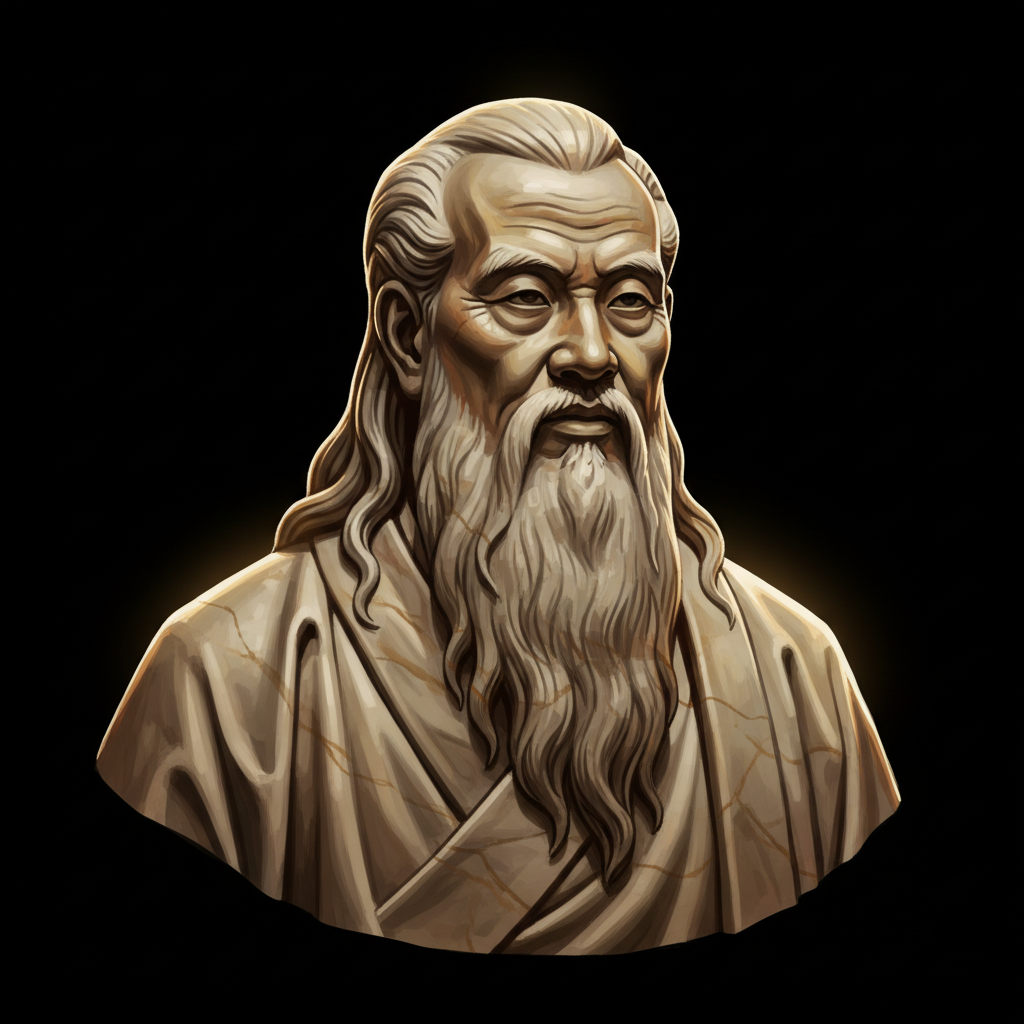
Laozi — "The sage attends to the inner and not to the outer."
The sage attends to the inner and not to the outer.
The sage attends to the inner and not to the outer.
Click any product to generate a realistic preview. Up to 3 at a time.
* Initial load can take up to 90 seconds — revising the preview in another color is nearly instant.
"Govern a state by justice, wage war by surprise, and take the world by doing nothing."
"A multitude of words is tiresome, unlike remaining centered."
"Difficult things in the world must needs have their beginnings in the easy; Big things must needs have their beginnings in the small."
"Therefore the sage holds to the one and becomes a model for the world. He does not display himself; therefore he shines. He does not assert himself; therefore he is known. He does not boast; therefore…"
"The Tao is always at ease. It is still, yet it moves the world."
Reputed founder of Taoism and author of the Tao Te Ching, whose wu wei (effortless action) shaped East Asian philosophy. Closely associated with Zhuangzi (later Taoist who extended Laozi's framework). For an intellectual contrast, see Confucius, near-contemporary Chinese sage of social ritual and duty — Confucius systematized social order through ritual and hierarchy; Laozi argued that all such systems were the disease, not the cure — the two founding poles of Chinese moral philosophy.
Found in 1 providers: gemini
1 source checked
Wisdom comes from cultivating your inner world—your thoughts, character, and awareness—rather than chasing external things like wealth, status, appearance, or the approval of others. A wise person looks inward to understand themselves and align with deeper truth, instead of being consumed by surface concerns. What you build inside shapes how you move through life, while outer pursuits without inner grounding leave you hollow and easily disturbed.
Laozi, traditionally a keeper of royal archives in the Zhou court, reportedly grew disillusioned with political posturing and ritual display, eventually leaving civilization to live quietly. This teaching reflects his core Taoist principle of wu wei—effortless action rooted in inner stillness rather than outward striving. His rejection of fame and ceremonial performance, and his emphasis on simplicity, humility, and alignment with the Tao, directly mirror this preference for inner cultivation over external achievement.
During the late Zhou dynasty and Warring States period, Chinese society was fractured by constant warfare, political scheming, and rigid Confucian emphasis on rituals, titles, and social hierarchy. Scholars competed for court positions, and outward displays of propriety defined status. Against this noisy backdrop of ambition and ceremony, Laozi's call to turn inward was radical—offering a counter-philosophy that valued quiet self-knowledge over the performative virtue and political maneuvering that dominated his era.
AI-generated insights based on extensive research and information for context. Factual errors? Email [email protected].
Your cart is empty