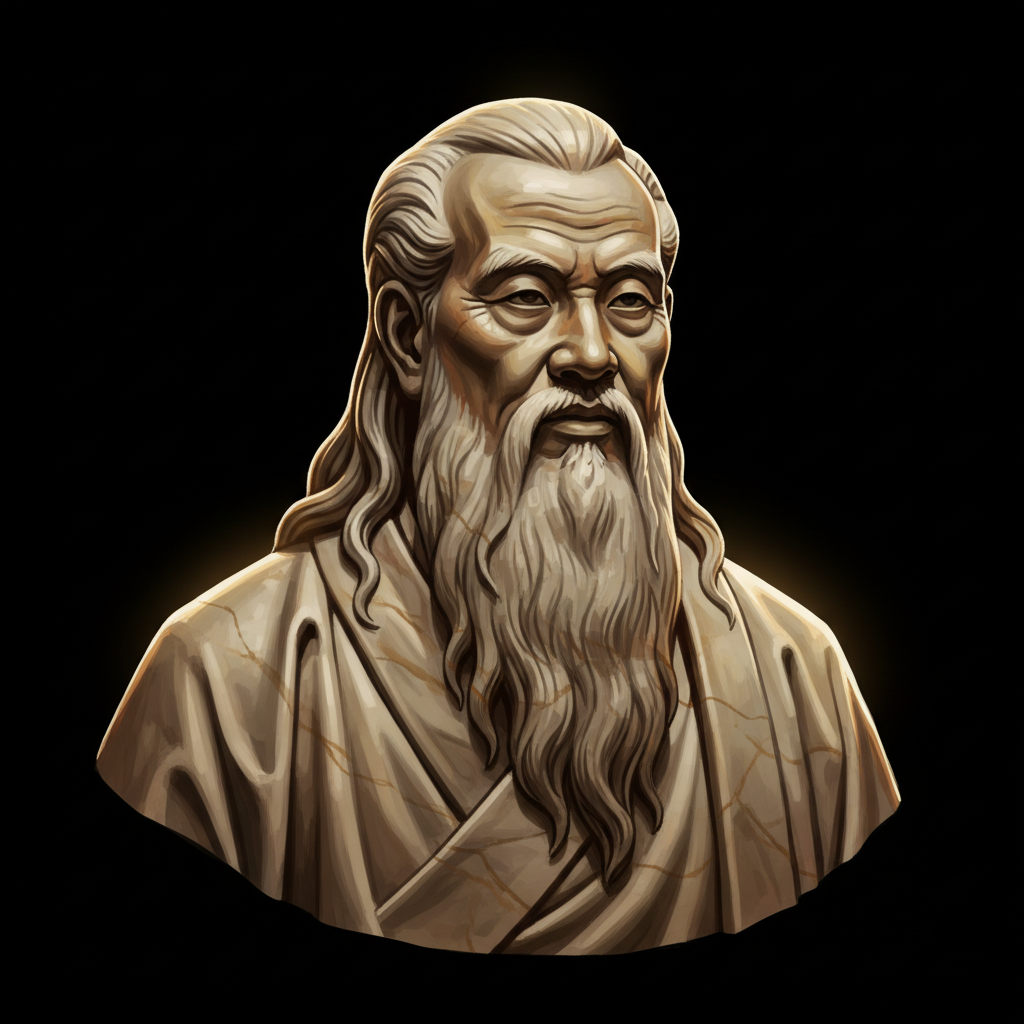
Laozi — "A multitude of words is tiresome, unlike remaining centered."
A multitude of words is tiresome, unlike remaining centered.
A multitude of words is tiresome, unlike remaining centered.
Click any product to generate a realistic preview. Up to 3 at a time.
* Initial load can take up to 90 seconds — revising the preview in another color is nearly instant.
"He who talks much is soon exhausted."
"The greatest evil is to have no satisfaction."
"The best of men is like water. Water benefits all things and does not compete with them. It dwells in lowly places that all disdain. This is why it is so near to the Tao."
"The journey of a thousand miles begins with a single step."
"No thought, no action, no movement, total stillness: only thus can one manifest the true nature and law of things... and at last become one with heaven and earth."
Reputed founder of Taoism and author of the Tao Te Ching, whose wu wei (effortless action) shaped East Asian philosophy. Closely associated with Zhuangzi (later Taoist who extended Laozi's framework). For an intellectual contrast, see Confucius, near-contemporary Chinese sage of social ritual and duty — Confucius systematized social order through ritual and hierarchy; Laozi argued that all such systems were the disease, not the cure — the two founding poles of Chinese moral philosophy.
Found in 1 providers: gemini
1 source checked
Talking too much exhausts both speaker and listener and rarely adds clarity. Endless explanations, arguments, and declarations scatter your focus and drain your energy, while often missing the point entirely. Staying grounded in your own calm awareness preserves strength and sharpens insight. Silence is not emptiness but steadiness. The saying urges restraint with speech and a return to inner balance, where fewer words carry more weight than a flood of noise.
Laozi was the legendary keeper of the Zhou royal archives, a role demanding quiet observation rather than public rhetoric. Tradition says he left the court in disillusionment and only reluctantly wrote the Tao Te Ching at a border guard's request. His teaching of wu wei, effortless action, and his praise of the uncarved block reflect a lifelong preference for stillness over debate. This line distills his conviction that chatter betrays the inner center sages must guard.
Laozi lived during the late Zhou dynasty, as feudal order crumbled into the Warring States period. Wandering scholars, Confucians, Mohists, and Legalists competed in courts, selling persuasive arguments to rival lords hungry for advantage. Rhetoric became a weapon, and philosophical debate filled marketplaces. Against this noisy climate of political salesmanship and moral posturing, Laozi's praise of silence and centeredness was a pointed rebuke, offering rulers and seekers an alternative rooted in quiet observation rather than clever speech.
AI-generated insights based on extensive research and information for context. Factual errors? Email [email protected].
Your cart is empty