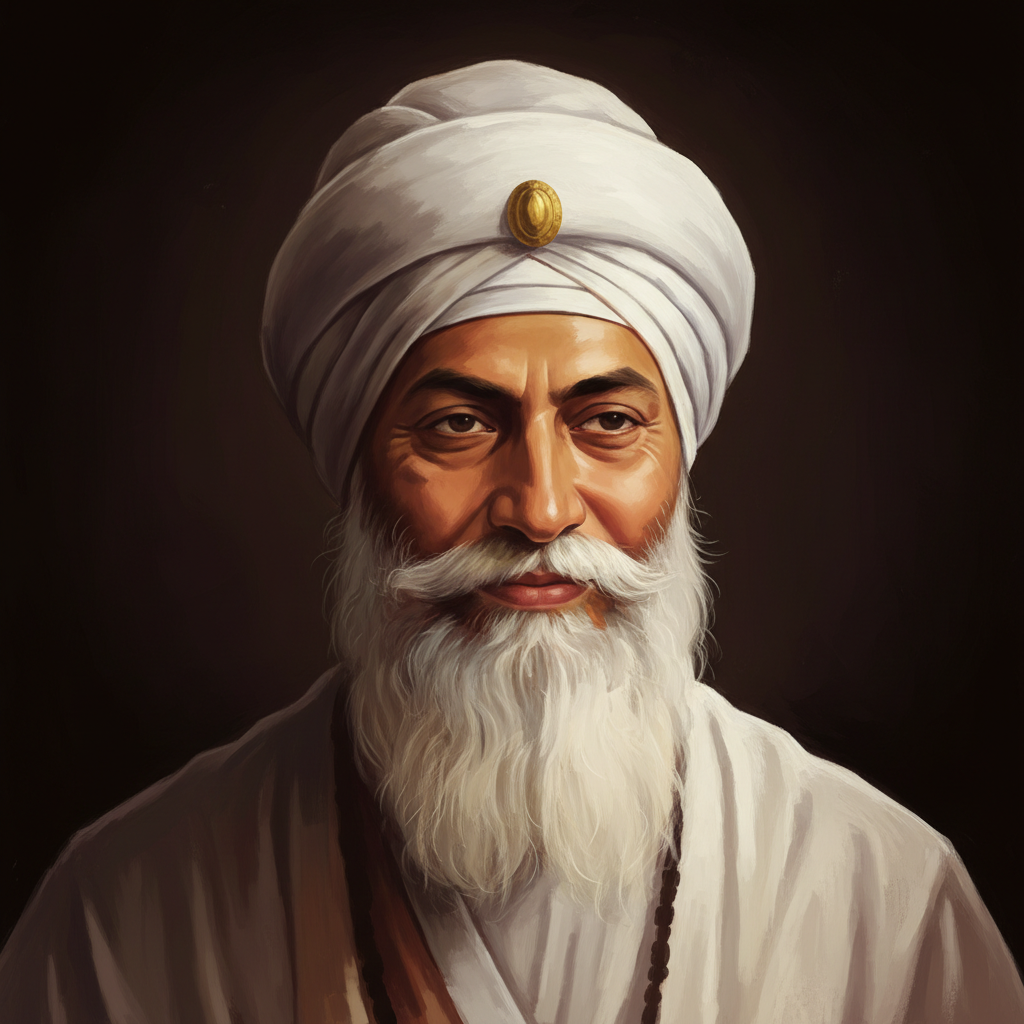
Guru Nanak — "Those who have loved are those that have found God."
Those who have loved are those that have found God.
Those who have loved are those that have found God.
Click any product to generate a realistic preview. Up to 3 at a time.
* Initial load can take up to 90 seconds — revising the preview in another color is nearly instant.
"The whole creation is His temple."
"If we worship stone idols of gods and goddesses (or any other kind of idol for that matter), they can't give anything, (so) I don't ask anything from them. Their Poojaa is like churning water and hopi…"
"Only by His Grace, can one be saved."
"Serve others with love and devotion. And remember where you put your keys afterwards."
"Whatever is in the universe is in the body of the devotee."
Founder of Sikhism and the first of the Ten Sikh Gurus, whose teachings of one universal God and rejection of caste shaped Punjab. Closely associated with Kabir (mystical poet whose verses appear in the Sikh Guru Granth Sahib). For an intellectual contrast, see Brahmanical orthodoxy, the Hindu caste-and-ritual establishment of his era — Sikhism was founded as a deliberate alternative to both Hindu ritual hierarchy and Islamic exclusivism — Nanak's universalism was a structural rejection of caste and priestly mediation.
Found in 1 providers: gemini
1 source checked
Love here is not romantic sentiment but the deepest form of connection — to other people, to creation, to existence itself. The quote asserts that spiritual realization is inseparable from genuine love. You don't find God through ritual, status, or doctrine; you find God by opening yourself completely to love. It democratizes the divine: anyone capable of authentic love has already arrived at the destination religion promises.
Guru Nanak (1469–1539) rejected caste hierarchy and ritualistic religion, teaching that the Divine dwells within every human being. He traveled thousands of miles — to Mecca, Tibet, Sri Lanka — preaching that God belongs to no single religion. His concept of Ik Onkar ('One God') was rooted in universal love. His life of service, communal kitchens (langar), and equal treatment of all people embodied this very teaching.
Nanak lived in 15th–16th century Punjab during intense Hindu-Muslim conflict, rigid caste oppression, and priestly gatekeeping of spiritual access. The Bhakti movement and Sufi Islam were both stressing personal devotion over ritual, yet sectarian violence remained widespread. Mughal expansion under Babur brought political upheaval. Into this fractured world, Nanak's declaration that love — not birth, creed, or ceremony — is the path to God was genuinely revolutionary.
AI-generated insights based on extensive research and information for context. Factual errors? Email [email protected].
Your cart is empty